Reimagining the future of cities in Singapore
Master of Future Cities students reflect on their time in The Garden City.
Estimated reading time: 2:21
The Master of Future Cities (MFC) program is empowering its students with competency in futures and system thinking and foresight methods to tackle the complex challenges of cities and urban areas. In May, MFC and other graduate students had the opportunity to come together for the inaugural offering of FCIT 610: International Field School. The course includes travel to an international city that exemplifies innovative, resilient strategies to prepare for a changing world. This year, the city was Singapore.
Singapore is an obvious choice for foresight and futures thinking professionals. “It’s an interesting example of the integration of foresight into governance,” says Emma Cochrane, a field course participant. “They have a Centre for Strategic Futures that sits within the Prime Minister’s Office and helps the entire public service anticipate and respond to emerging challenges and opportunities.”
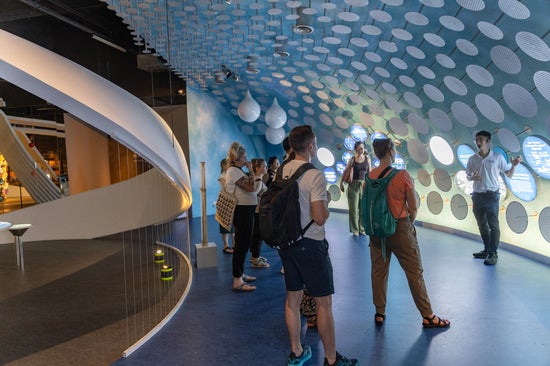
Learning about the water filtration of Marina Barrage.
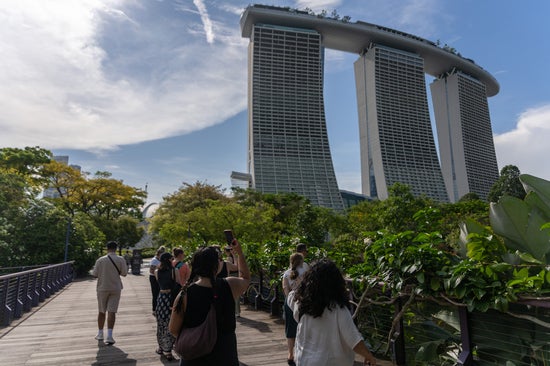
Exploring Gardens by the Bay.
The six-day course, co-led by Dr. Leia Minaker and Helen Kerr, included site visits, expert discussions, and immersive experiences centered around key urban challenges. Students embraced the Singaporean urban lifestyle and took public transit, ate at hawker markets, and visited key landmarks. “Before visiting, I knew that there were a lot of rules that governed daily life, and honestly, I felt a bit intimidated by what that would be like as a visitor”, reflects student Kelsey Kublik. “Being in Singapore, however, flipped that stereotype for me. There are lots of rules, [but] it seems to be widely accepted that the rules are in place for the common good, and that the common good is worthy of investment.”
Student Trisha Bernabe was impressed with the complex and well-developed public transit system. “MRT stations are hubs of public life. Everywhere in our travels, we were witness to organic activities that organized around permissive infrastructure as if confirming the adage: build it and they will come.”
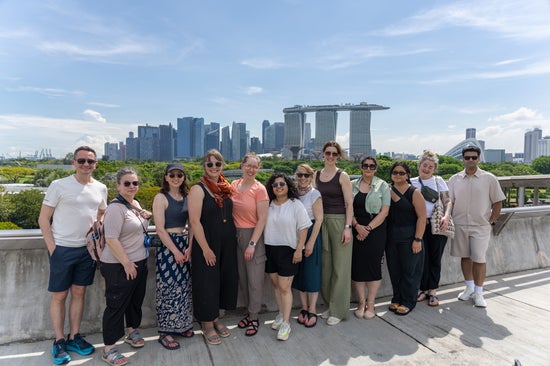
FCIT 610 instructors and students.
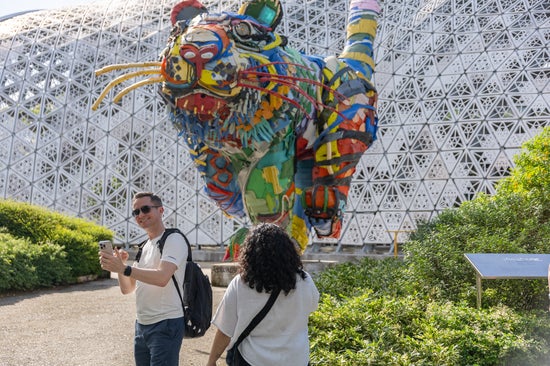
Trash-Sure, a sculpture made entirely from trash, in Gardens by the Bay.
Most importantly, the students had the privilege of learning from experts from industry and government, including the Centre for Strategic Futures, DPArchitects, Singapore Management Institute and the Urban Redevelopment Authority. “On our very first day when we spent the morning with a representative from the Urban Redevelopment Authority (URA),” says student Kari Hueber. “We got a first-hand look at a typical Singaporean urban housing development while learning about all the aspects that make these developments uniquely sustainable, livable, and affordable compared to housing developments in other parts of the world.”
Following the conclusion of the field course, the students submitted reflection projects about what they had learned. “We asked students to creatively express what Canada could learn from Singapore’s attention to innovative resilience-building for the future,” says Kerr. “Clearly, the experience was profoundly impactful! Students jumped in to produce insightful multimedia storytelling accounts that were thoughtful and deeply engaging. I was already impressed with their academic output, but this is another dimension of excellence that shows the value they will be bringing to the urban realm of tomorrow.”
Students in the 2025 International Field School to Singapore experienced a city that anticipates future trends, risks, and opportunities. This course enforces concepts learned in the classroom and sparks innovation for what is possible in the complex futures of cities. The student travelers gained valuable knowledge and an inspiring life experience.

