Transforming education through outdoor learning and sustainability
Douglas Jones has spent three decades putting a Waterloo co-op lesson into practice.
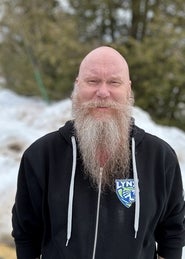
It was the last job Douglas Jones (BES ’93) wanted to end up in. As a first-year Geography student, he remembers telling a classmate, “I would lose my marbles if I had to teach geography to high school kids and that is not happening.” But that conviction changed during his third co-op term.
Jones found himself working at Boyne River Natural Science School, a residential outdoor education centre where he led students from urban schools through environmental and adventure-based activities. While he confesses he “didn’t love” working with the older kids, the week a group of Grade 5 students arrived changed the trajectory of his life.
“Their energy was different,” he says. “They seemed very interested in what was going on. They had just this endless enthusiasm that I didn't really see with the high school kids.”
He returned to Boyne River for a second co-op term and later based his honours thesis on the lasting impact of outdoor education. Published in the Ontario Journal of Outdoor Education, his research explored why experiences in nature stay with children in ways most classroom lessons do not.
More than 30 years later, he still uses one example to explain what he means.
“You probably cannot remember the moment you learned to add or subtract or to read. It just sort of evolved for you. But you probably can remember the moment that you stood outside and learned about where maple syrup comes from by tapping a maple tree.”
That lesson has stayed with Jones throughout his career as a teacher, vice-principal and principal. He believes students learn best when they can experience what they're learning for themselves.
Today, it shapes his leadership at Limehouse Public School, a small rural elementary school bordered by the Bruce Trail and Limehouse Conservation Area. When Jones arrived in 2021, students were emerging from months of pandemic disruption. He saw the school’s natural surroundings as an opportunity to support their well-being while rethinking where and how learning happened.
Jones gave his teachers permission to reconsider the boundaries of the classroom. Their guiding question became simple: “Where will kids learn this best?”
Sometimes the answer is inside. Often, it’s outside.
Mornings at Limehouse begin outdoors. Teachers use the surrounding land for lessons across the curriculum. Older students mentor younger ones and whole-school outings make learning a shared experience.

The shift hasn’t come at the expense of academics. In the first year, Limehouse’s academic results began outperforming both board and provincial averages. For Jones, it reinforced something he has seen throughout his career. Academic achievement, student well-being and meaningful learning don’t need to compete.
Sustainability has become equally embedded in the school’s culture. Under Jones’s leadership, Limehouse has earned EcoSchools Platinum certification for five consecutive years, placing it amongst the top schools in Canada. It became one of five schools in the region to adopt Learning for Sustainable Futures, bringing the UN Sustainable Development Goals to the classroom and inspiring students to think about real-world problems.
In 2025, researchers from Wilfrid Laurier University's Viessmann Centre for Engagement and Research in Sustainability assessed Limehouse at the threshold of what they called Stage 4: Collective Action and Widespread Practice. At that stage, sustainability is no longer a collection of individual initiatives but part of an organization’s culture.
His influence now extends beyond the school's walls. Jones mentors teachers, principals and administrators interested in outdoor and sustainability education, while educators visit the school to see its approach firsthand. The school has also been approved as the future Northern Centre for Environmental Leadership, creating new opportunities to share what it has learned.
Jones describes his influence as a “cascading effect.” Students carry what they learn into high school and beyond, while teachers and administrators go on to shape learning in their own schools. He may never know how far that influence reaches.
“You see light bulbs go off in people's minds…that's the spark. That's the reward for inspiring someone else.”
Douglas Jones is a recipient of the 2026 Distinguished Alumni Award, recognizing alumni whose professional achievements, community contributions and environmental impact exemplify the Faculty of Environment.