Turning environmental research into urban action
Jo Fitzgibbons brings research, community knowledge and municipal practice together.
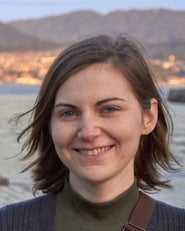
During a particularly difficult season of her life, Jo Fitzgibbons (MES ‘19) wandered into a Toronto ravine. Below the traffic and city noise she found marshland, red-winged blackbirds and something she hadn't realized she'd been missing.
Growing up, she'd been what she laughingly calls a "bog child," happiest catching frogs and exploring wetlands. Somewhere along the way she'd lost that connection. Walking through the ravine reminded her how supported she'd always felt by nature.
The ravine reconnected Fitzgibbons with a sense of purpose that had already begun shaping her career.
Her first formative career steps in Nova Scotia involved helping communities collect and use their own environmental and social data to advocate for the places they cared about.
“It showed me how community and local knowledge is just as important and impactful as scientific knowledge grown in universities," she says. “And when we work together, we can be more effective at driving change.”
Fitzgibbons brought her interest in community-engaged research with her to the University of Waterloo's School of Planning, where Associate Professor Carrie Mitchell taught her the skills to study issues she cared most about.
“Carrie really taught me how to be a situated researcher,” Fitzgibbons recalls. “I was never fully gratified by just being in school or just being in practice. Carrie coached me on how to weave the two worlds, so I could do both without burning out.”
Through an internship with the City of Toronto, representing Waterloo in international competitions, and research on equity in resilience planning, she tested those ideas in real-world settings. Her master's research earned the Governor General's Gold Medal.
As her research evolved, so did the questions she was asking.
"Who is deciding what is the public interest?" she says. "Are we, as planners, assuming we know what is in the public’s best interest? Or are we asking people—and who are we asking?"
Those questions remained foundational to her doctoral research at the University of British Columbia (UBC), where she moved beyond asking how communities participate in environmental decisions to exploring whose knowledge is recognized and valued in the first place.
Through UBC's Public Scholars Initiative, Fitzgibbons partnered with municipal staff and fellow researchers to co-design a workshop where planners, ecologists and local knowledge holders shared their knowledge and visions for the city. The workshop doubled as both a public engagement exercise and an experiment to study what helps and hinders diverse knowledge holders to express themselves in such settings.
It wasn’t research designed to sit on a library shelf. Some of Fitzgibbons’ dissertation chapters present findings through a hands-on toolkit and an artistic zine, departing from the traditional peer-reviewed paper format she argues is often inaccessible to the people whose knowledge contributes to research in the first place.

At the same time, Fitzgibbons was building her own career between those same two worlds. She became a Registered Professional Planner and completed her PhD while working for local government.
Today, Fitzgibbons brings her "pracademic" approach to the City of Vancouver, where she works across departments to embed ecology into land-use planning, development and public infrastructure.
“We work across disciplines, with engineers, planners, finance people, social policy people … it raises many of those same questions I grappled with in my PhD,” she says. “Whose knowledge gets a chance to shape our city?”
Working in government has given her an appreciation for what she calls the “deeply unsexy, tiny incremental kinds of change”: changing a process, navigating an institutional barrier or shifting someone’s thinking. She has come to see that work as part of transformative change, rather than separate from it.
“Incremental work can be transformative work,” she says. “We often think of them as separate, but small, careful changes build up over time.”
"I'm pretty much in my dream job," she says. She notes that some of the most rewarding moments are simple: restored wetlands, returning wildlife and creating more room for nature in the city.
“Nature has taken care of me, and my work is how I get to say thanks.”
Jo Fitzgibbons is a recipient of the 2026 Recent Alumni Inspiration Award, recognizing emerging leaders whose professional achievements, community contributions and environmental impact inspire others.