Thursday, September 28, 2017 3:00 pm
-
4:00 pm
EDT (GMT -04:00)
Events
Filter by:
Thursday, March 29, 2018 12:00 pm
-
12:00 pm
EDT (GMT -04:00)
Cryosphere Research Group Seminar
In preparation for her upcoming MSc thesis defence, Marie Hoekstra will practice her presentation this Thursday at noon in EV3-4222. Her presentation is entitled:
“Toward Automated Ice-Water Classification on Large Northern Lakes Using RADARSAT-2 Synthetic Aperture Radar Imagery”
Please join us with your tough questions to help Marie prepare. Her abstract follows:

Wednesday, October 29, 2025 3:00 pm
-
3:50 pm
EDT (GMT -04:00)
GEM Seminar Series
Topic: The wetland with the trees: my long-term relationship with swamp gases.
Speaker: Meg Schmidt (PhD candidate supervised by Maria Strack)
Location: AL 105

Wednesday, November 26, 2025 3:00 pm
-
3:50 pm
EST (GMT -05:00)
GEM Seminar Series
Topic: Assessing Climate Resilience in Dominica’s Tourism Infrastructure: Supporting the Vision of the World’s First Climate-Resilient Nation
Speaker: Shania Scotland (MA candidate supervised by Michelle Rutty)
Location: AL 105

Wednesday, January 28, 2026 3:00 pm
-
3:50 pm
EST (GMT -05:00)
GEM Seminar Series
Topic: Making a home in Waterloo: international student families and housing insecurity
Speaker: Dr. Nancy Worth, with Dr. Alkim Karaagac
Location: EV3 1408
Our two-year case study in Waterloo, Ontario—a city known for its purpose-built student housing—reveals that international student families face distinct challenges in the local housing market. While all students contend with high housing costs, families struggle to find suitable accommodations in a market dominated by single-student units. International student families must also navigate unfamiliar rental processes with limited institutional support, as higher education institutions typically consider off-campus housing beyond their remit. Although international students are often blamed for housing affordability issues, our findings indicate they are among the housing crisis’ most vulnerable groups.

Wednesday, February 25, 2026 3:00 pm
-
3:50 pm
EST (GMT -05:00)
GEM Seminar Series
Topic: Exploring Amplification Pathways of Nature-Based Climate Solutions in Canadian cities
Speaker: Kayne Boyall (MSc student supervised by Dr. Sarah Burch)
Location: EV3 1408
Cities are increasingly central sites of climate action, amid compounding biodiversity and economic crises. Yet efforts to transform urban systems remain constrained by path dependency, indeterminacy, and shifting priorities. Nature-based climate solutions (NBCS) have gained prominence for their capacity to “multi-solve” by mitigating emissions, addressing climate risks, enhancing biodiversity, and delivering social–ecological co-benefits. Despite this promise, urban NBCS in Canada often remain confined to small-scale pilots and disconnected demonstration projects, limiting their transformative potential.
This research examines how NBCS can move beyond pilots to be amplified within broader systems of urban governance and transformation. Drawing on 20 semi-structured interviews with NBCS practitioners and governance experts alongside planning and policy documents in comparative case study of Vancouver, BC and Halifax, NS, this study maps distinct but interrelated pathways of amplification along with the actors, enabling conditions, and catalysts shaping the growth of NBCS initiatives. Particular attention is given to how institutional and organizational contexts influence the stability, diversity, and prioritization of co-benefits. The findings inform efforts to design, govern, grow and sustain NBCS in support of just, low-carbon and resilient urban futures.
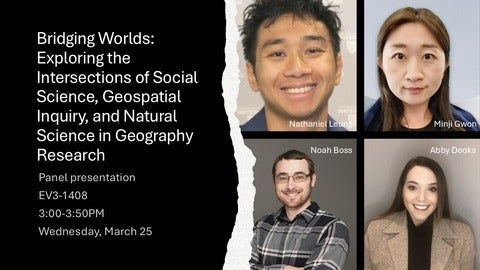
Wednesday, March 25, 2026 3:00 pm
-
3:50 pm
EDT (GMT -04:00)
GEM Seminar Series
Topic: Bridging Worlds: Exploring the Intersections of Social Science, Geospatial Inquiry, and Natural Science in Geography Research
Location: EV3-1408
Abstracts:
Nathaniel Leung: From Map to Mandate: How Geospatial Data Gaps Shape Federal Policy
Abby Dooks: The Role of Tourism Development in Informal Settlement Disaster and Climate Resilience
Noah Boss: Methane, Carbon Dioxide, and Warming: Predicting Peatland Responses to Climate Change
Minji Gwon: Gendered Digital Geographies of Diaspora: Tal-Joseon of Young South Korean Women and Non-binary People

Wednesday, April 29, 2026 3:00 pm
-
3:50 pm
EDT (GMT -04:00)
GEM Seminar Series
Location: EV1-132
Speaker: Tamara Marchant
Title: Evaluating Evolving Dynamics of Belcher Glacier, Nunavut, Canada
Speaker: Tyler Herrington
Title: Investigating Reanalysis and LDAS Soil Temperature Performance over the Extratropical Northern Hemisphere