Alumni

Thursday, June 26, 2014 3:00 pm - 4:00 pm EDT (GMT -04:00)

Ganainy: Quantum-inspired photonic structures

Ramy El Ganainy, Michigan Technological University

Quantum physics is playing an ever increasing role in several interdisciplinary research fields. In this presentation, I will show how some of the elementary mathematics of quantum mechanics can be used to synthesize classical photonic structures having novel functionalities.
Wednesday, June 18, 2014 2:00 pm - 3:00 pm EDT (GMT -04:00)

Kuntz: Quantum non-Gaussian and Gaussian States at Multiple Side-band Frequencies

Katanya Kuntz,  University of New South Wales, Canberra, Australia

We simultaneously generate photon-subtracted squeezed vacuum and squeezed vacuum at three frequencies from an optical parametric oscillator by utilizing its frequency non-degenerate sidebands. Quantum non-Gaussianity is demonstrated by applying a novel character witness.

Laura Mancinska, Centre for Quantum Technologies, Singapore

Quantum entanglement is known to provide a strong advantage in many two-party distributed tasks. We investigate the question of how much entanglement is needed to reach optimal performance. For the first time we show that there exists a purely classical scenario for which no finite amount of entanglement suffices. To this end we introduce a simple two-party nonlocal game $H$, inspired by Hardy's paradox. In our game each player has only two possible questions and can provide bit strings of any finite length as answer.

Ivette Fuentes, The University of Nottingham

Quantum technologies are widely expected to bring about many key technological advances this century. Quantum metrology and quantum information have been so far successfully applied in the design of devices that outperform their classical counterparts by exploiting quantum properties. Impressively, the quantum era is now reaching relativistic regimes. Table-top experiments demonstrate relativistic effects in quantum fields and long range quantum experiments will soon reach regimes where relativity kicks in.

Monday, June 2, 2014 2:30 pm - 3:30 pm EDT (GMT -04:00)

Gharibian: Ground state connectivity of local Hamiltonians

Sevag Gharibian, University of California, Berkeley

The study of ground spaces of local Hamiltonians is a fundamental task
in condensed matter physics. In terms of computational complexity
theory, a common focus in this area has been to estimate a given
Hamiltonian’s ground state energy. However, from a physics
perspective, it is often more relevant to understand the structure of
the ground space itself. In this paper, we pursue the latter direction
by introducing the notion of “ground state connectivity” of local

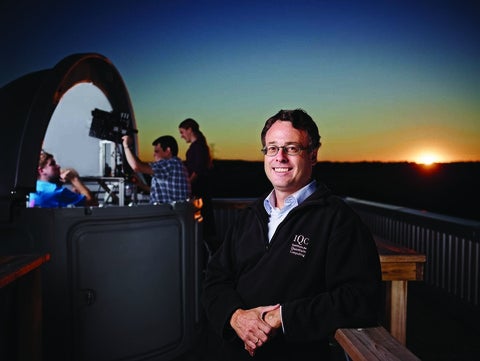
IQC researchers, led by Thomas Jennewein, have been awarded $250,000 by the Canadian Space Agency to train and develop Canadian grad students through a space science and technology project.

The Canadian Space Agency (CSA) funding will support Thomas Jennewein (Physics and Astronomy) and his QEYSSat team in conducting a demonstration of Quantum Key Distribution (QKD) between a receiver payload on an airborne platform and a transmitter on the ground.

Wednesday, May 21, 2014 1:00 pm - 2:00 pm EDT (GMT -04:00)

Elkouss: Analysis of a rate-adaptive reconciliation protocol

David Elkouss, Universidad Complutense de Madrid

"Quantum key distribution performs the trick of growing a secret key in two distant places connected by a quantum channel. In practical systems, whether because of finite resources or external conditions, the quantum channel is subject to fluctuations. A rate adaptive information reconciliation protocol, that adapts to the changes in the communication channel, is then required to minimize the leakage of information in the classical postprocessing.

Monday, May 12, 2014 2:30 pm - 3:30 pm EDT (GMT -04:00)

Fawzi: Achieving the limits of the bounded/noisy quantum-storage model

Omar Fawzi, McGill University

The goal of two-party cryptography is to enable Alice and Bob to solve tasks in cooperation even if they do not trust each other. Examples of such tasks include bit commitment, coin flipping and oblivious transfer. Unfortunately, it has been shown that even using quantum communication, none of these tasks can be implemented when the adversary is completely general.

Monday, April 28, 2014 11:00 am - 12:00 pm EDT (GMT -04:00)

Stobinska: Quantum state engineering of multiphoton quantum superpositions

Magdalena Stobinska, University of Gdańsk/Polish Academy of Sciences, Warsaw

We discuss a device capable of filtering out two-mode states of light with mode populations differing by more than a certain threshold, while not revealing which mode is more populated. It would allow engineering of macroscopic quantum states of light in a way which is preserving specific superpositions. As a result, it would enhance optical phase estimation with these states. We propose an optical scheme, which is a relatively simple, albeit non-ideal, operational implementation of such a filter.