Current graduate students
Co-organized by the National Research Council of Canada
The meeting brings together the Canadian community of scientists and engineers who perform research and development on spin-based quantum technologies. This will be the third annual workshop, with the main goal to foster spin qubit research and attract and train highly qualified personnel for the emerging quantum technologies sector in Canada.
Nicole Yunger Halpern, Harvard-Smithsonian Institute for Theoretical Atomic, Molecular, and Optical Physics
Join us in QNC 1201 for a Meet and Greet with Nicole Yunger Halpern, Postdoctoral Fellow at the Harvard-Smithsonian Institute for Theoretical Atomic, Molecular, and Optical Physics (ITAMP). All are welcome. Snacks and refreshments will be provided.
What makes someone a good ally? How can you use your privilege to stand up and support others?
Martin Savage, Institute for Nuclear Theory
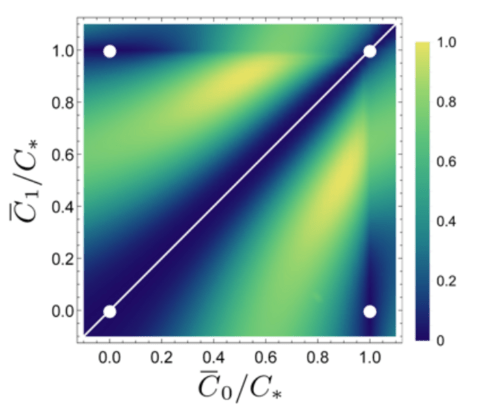
Recently, Silas Beane, David Kaplan, Natalie Klco and I considered the entanglement power of the S-‐matrix describing low-‐energy hadronic interactions, and the implications of particular limits. We found that vanishing entanglement power occurs at points of emergent global symmetries, which are seen to be consistent with nature and also recent lattice quantum chromodynamics (QCD) calculations. I will discuss aspects of these results.
Candidate: Guofei Long
Supervisors: David Cory and Guo-Xing Miao
A polar decomposition for quantum channels: insightful tools to navigate through noisy quantum circuits
Arnaud Carignan-Dugas, Institute for Quantum Computing
Inevitably, assessing the overall performance of a quantum computer must rely on characterizing some of its elementary constituents and, from this information, formulate a broader statement concerning more complex constructions thereof.
Journal club presentation:
"Experimental superposition of orders of quantum gates" by Procopio et. al.
(Nature Comms 6, 7913 (2015)
Arash Ahmadi, Institute for Quantum Computing
Quantum computers achieve a speed-up by placing quantum bits (qubits) in superpositions of different states. However, it has recently been appreciated that quantum mechanics also allows one to ‘superimpose different operations’.
Chinmay Nirkhe, University of California, Berkeley
We study approximate quantum low-density parity-check (QLDPC) codes, which are approximate quantum error-correcting codes specified as the ground space of a frustration-free local Hamiltonian, whose terms do not necessarily commute. Such codes generalize stabilizer QLDPC codes, which are exact quantum error-correcting codes with sparse, low-weight stabilizer generators (i.e. each stabilizergenerator acts on a few qubits, and each qubit participates in a few stabilizer generators).
Three Results in Quantum Physics
Master's Candidate: Jaron Huq
Nicole Yunger Halpern, Harvard University Department of Physics
Thermodynamics has shed light on engines, efficiency, and time’s arrow since the Industrial Revolution. But the steam engines that powered the Industrial Revolution were large and classical. Much of today’s technology and experiments are small-scale, quantum, and out-of-equilibrium. Nineteenth-century thermodynamics requires updating for the 21st century. Guidance has come from the mathematical toolkit of quantum information theory.