Current students

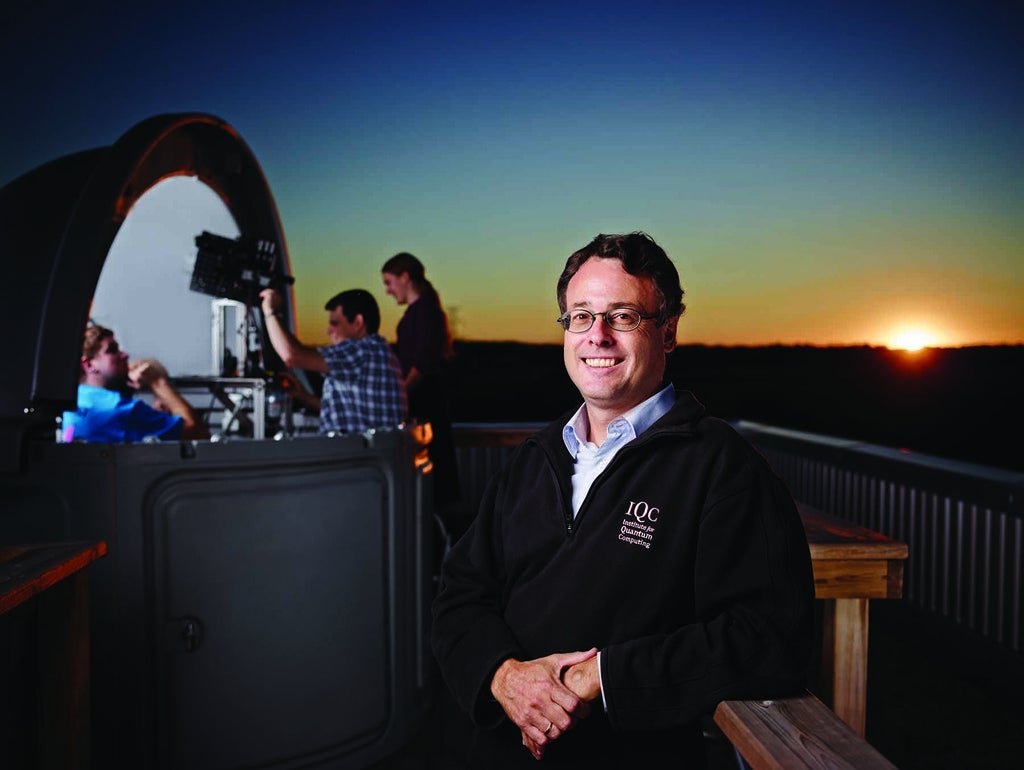
IQC researchers, led by Thomas Jennewein, have been awarded $250,000 by the Canadian Space Agency to train and develop Canadian grad students through a space science and technology project.

The Canadian Space Agency (CSA) funding will support Thomas Jennewein (Physics and Astronomy) and his QEYSSat team in conducting a demonstration of Quantum Key Distribution (QKD) between a receiver payload on an airborne platform and a transmitter on the ground.

Wednesday, May 21, 2014 1:00 pm - 2:00 pm EDT (GMT -04:00)

Elkouss: Analysis of a rate-adaptive reconciliation protocol

David Elkouss, Universidad Complutense de Madrid

"Quantum key distribution performs the trick of growing a secret key in two distant places connected by a quantum channel. In practical systems, whether because of finite resources or external conditions, the quantum channel is subject to fluctuations. A rate adaptive information reconciliation protocol, that adapts to the changes in the communication channel, is then required to minimize the leakage of information in the classical postprocessing.

Monday, May 12, 2014 2:30 pm - 3:30 pm EDT (GMT -04:00)

Fawzi: Achieving the limits of the bounded/noisy quantum-storage model

Omar Fawzi, McGill University

The goal of two-party cryptography is to enable Alice and Bob to solve tasks in cooperation even if they do not trust each other. Examples of such tasks include bit commitment, coin flipping and oblivious transfer. Unfortunately, it has been shown that even using quantum communication, none of these tasks can be implemented when the adversary is completely general.

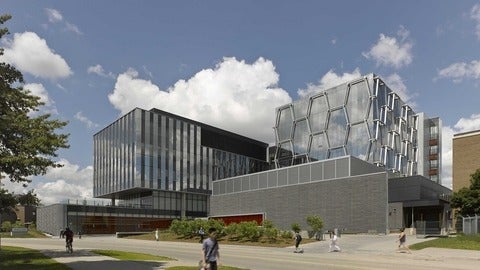
WATERLOO, Ont. (Thursday, May 1, 2014) – The Province of Ontario renewed its investment in world leading quantum technology research today allotting $25 million to the Institute for Quantum Computing at the University of Waterloo over five years.

“We are extremely grateful that the Province of Ontario continues to create the conditions for Ontario, and Canada, to lead the world in quantum information research," said Feridun Hamdullahpur, president and vice-chancellor of Waterloo.

Monday, April 28, 2014 11:00 am - 12:00 pm EDT (GMT -04:00)

Stobinska: Quantum state engineering of multiphoton quantum superpositions

Magdalena Stobinska, University of Gdańsk/Polish Academy of Sciences, Warsaw

We discuss a device capable of filtering out two-mode states of light with mode populations differing by more than a certain threshold, while not revealing which mode is more populated. It would allow engineering of macroscopic quantum states of light in a way which is preserving specific superpositions. As a result, it would enhance optical phase estimation with these states. We propose an optical scheme, which is a relatively simple, albeit non-ideal, operational implementation of such a filter.

Tuesday, May 6, 2014 4:00 pm - 5:30 pm EDT (GMT -04:00)

Quantum Industry Lecture Series: Jonathan Hodges

IQC presents the first in a series of lectures from members of industry in quantum computing and quantum information. Jonathan Hodges, VP of engineering for Diamond Nanotechnologies, will be speaking about his research as well as the day-to-day realities of working in industry. You can learn more about the company here: http://www.diamondnanotechnologies.com/

Monday, May 5, 2014 2:30 pm - 3:30 pm EDT (GMT -04:00)

Pappas: Quantum Information, Surfaces, and Interfaces

David P. Pappas, NIST

Progress in the field of experimental quantum information processing has been steady over the past decade with important developments continuing to be made in the understanding, design, and measurement of systems at the quantum level. As the boundaries of these measurements are pushed, we are finding that surface and interfacial properties play an increasingly important role. In general, this field has benefitted immensely from advances in VLSI.

Amir Jafari-Salim, IQC

In this talk, I will give a summary of my recent research on superconducting nanostructures for quantum detection of electromagnetic radiation. In this regard, electrodynamics of topological excitations in 1D superconducting nanowires and 2D superconducting nanostrips is investigated. Topological excitations in superconducting nanowires and nanostrips lead to crucial deviation from the bulk properties.

Tuesday, April 22, 2014 11:00 am - 12:00 pm EDT (GMT -04:00)

Hilke: Graphene growth and characterization for device applications

Michael Hilke, McGill University

We will review several proof of principle applications for graphene based devices performed in our group, including in field sensors, electronics, THz spectroscopy, spintronics, nanofluidics, and even musical instruments. We will then discuss the synthesis mechanism of graphene as well as the synthesis of very large single layered graphene monocrystals with various shapes, ranging from hexagons to fractals, dubbed graphlocons.