Crossing the chasm — still a relevant challenge

Angela Mondou, author, entrepreneur and founder of ICE Leadership Inc., shared her insight into technology commercialization at the CryptoWorks21 Distinguished Lecture March 12.

Angela Mondou, author, entrepreneur and founder of ICE Leadership Inc., shared her insight into technology commercialization at the CryptoWorks21 Distinguished Lecture March 12.
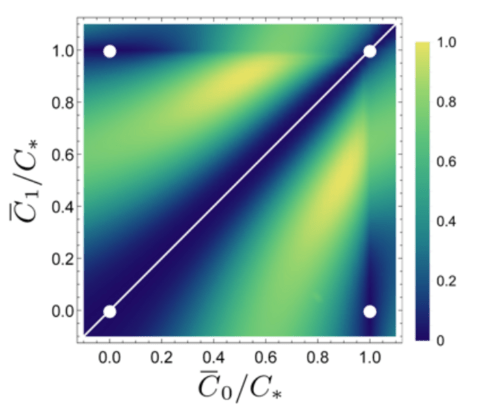
Recently, Silas Beane, David Kaplan, Natalie Klco and I considered the entanglement power of the S-‐matrix describing low-‐energy hadronic interactions, and the implications of particular limits. We found that vanishing entanglement power occurs at points of emergent global symmetries, which are seen to be consistent with nature and also recent lattice quantum chromodynamics (QCD) calculations. I will discuss aspects of these results.
Candidate: Guofei Long
Supervisors: David Cory and Guo-Xing Miao
Inevitably, assessing the overall performance of a quantum computer must rely on characterizing some of its elementary constituents and, from this information, formulate a broader statement concerning more complex constructions thereof.
Quantum computers achieve a speed-up by placing quantum bits (qubits) in superpositions of different states. However, it has recently been appreciated that quantum mechanics also allows one to ‘superimpose different operations’.
We study approximate quantum low-density parity-check (QLDPC) codes, which are approximate quantum error-correcting codes specified as the ground space of a frustration-free local Hamiltonian, whose terms do not necessarily commute. Such codes generalize stabilizer QLDPC codes, which are exact quantum error-correcting codes with sparse, low-weight stabilizer generators (i.e. each stabilizergenerator acts on a few qubits, and each qubit participates in a few stabilizer generators).
Master's Candidate: Jaron Huq
Lindsay Babcock, Katanya Kuntz, Sebastian Slaman, et Ramy Tannous du Laboratoire de photonique quantique, sous la direction de Thomas Jennewein, chercheur à l’Institut d’informatique quantique (IQC), ont conçu et réalisé une démonstration portable de distribution quantique de clés (DQC). L’appareil de démonstration faisait appel à des composantes conçues par Excelitas Technologies, partenaire industriel qui fournit des systèmes personnalisés d’optoélectronique et d’électronique avancée.
Lindsay Babcock, Katanya Kuntz, Sebastian Slaman, and Ramy Tannous of the Quantum Photonics Lab, led by Institute for Quantum Computing (IQC) researcher Thomas Jennewein, designed and constructed a working portable demonstration of Quantum Key Distribution (QKD). The QKD demo used hardware components designed by Excelitas Technologies, an industry partner who provides customized optoelectronics and advanced electronic systems.
Thermodynamics has shed light on engines, efficiency, and time’s arrow since the Industrial Revolution. But the steam engines that powered the Industrial Revolution were large and classical. Much of today’s technology and experiments are small-scale, quantum, and out-of-equilibrium. Nineteenth-century thermodynamics requires updating for the 21st century. Guidance has come from the mathematical toolkit of quantum information theory.