Current undergraduate students
Estimating outcome probabilities of quantum circuits using quasiprobabilities
Hakop Pashayan, The University of Sydney
We present a method for estimating the probabilities of outcomes of a quantum circuit using Monte Carlo sampling techniques applied to a quasiprobability representation.
Progress toward a spin squeezed optical atomic clock beyond the standard quantum limit
Boris Braverman, Massachusetts Institute of Technology
State of the art optical lattice atomic clocks have reached a relative
inaccuracy level of order $10^{-18}$, making them the most stable time
references in existence.
Security of differential quadrature phase shift quantum key distribution
Shun Kawakami, University of Tokyo
One of the simplest methods for implementing quantum key distribution over fiber-optic communication is the Bennett-Brassard 1984 protocol with phase encoding (PE-BB84 protocol), in which the sender uses phase modulation over double pulses from a laser and the receiver uses a passive delayed interferometer.
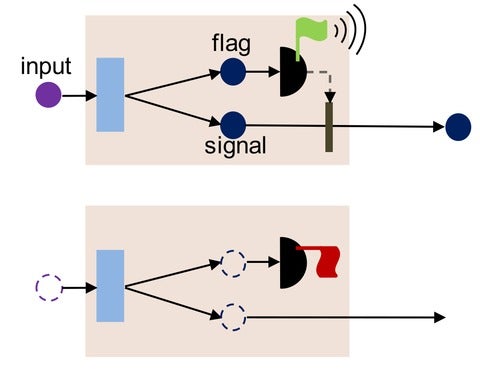
A team lead by researchers from the Institute for Quantum Computing and the Department of Physics and Astronomy at the University of Waterloo has successfully detected the presence of single photons while preserving their quantum states.
Toward single atom qubits on a surface: Pump-probe spectroscopy and electrically-driven spin resonance
William Paul, IBM Research
Single Fe atoms placed on a thin MgO film have exceptional magnetic properties: Their spin relaxation lifetime can extend to many milliseconds, and their quantum state can be coherently manipulated by RF electric fields. In this talk, we will discuss a scanning tunneling microscopy (STM) investigation of the dynamics of spin-relaxation and the electric-field-driven spin resonance of individual Fe atoms on a MgO/Ag(001) surface.
 Evan Meyer-Scott of the Department of Physics and Astronomy will be defending his thesis:
Heralding photonic qubits for quantum communication
Evan is supervised by Professor Thomas Jennewein.
Separations in query complexity using cheat sheets
Shalev Ben-David, Massachusetts Institute of Technology (MIT)
We show a power 2.5 separation between bounded-error randomized and quantum query complexity for a total Boolean function, refuting the widely believed conjecture that the best such separation could only be quadratic (from Grover's algorithm). We also present a total function with a power 4 separation between quantum query complexity and approximate polynomial degree, showing severe limitations on the power of the polynomial method.
Nitrogen-vacancy (NV) centers in diamond nanophotonic structures for quantum networking
Edward Chen, Massachusetts Institute of Technology
The exceptional optical and spin properties of the negatively charged nitrogen-vacancy (NV) center in diamond have led to a wide range of hallmark demonstrations ranging from super-resolution imaging to quantum entanglement, teleportation, and sensing. The solid-state environment of the NV allows us to engineer nano-structures that can enhance the properties of the NV and improve the readout and initialization fidelities of the spin.
Quantum Max-flow/Min-cut
Xingshan Cui, University of California, Santa Barbara
The classical max-flow min-cut theorem describes transport through certain idealized classical networks. We consider the quantum analog for tensor networks. By associating a tensor to each node in an integral flow network, we can also interpret it as a tensor network, and more specifically, as a linear map.
Sample-optimal tomography of quantum states
Nengkun Yu, IQC
It is a fundamental problem to decide how many copies of an unknown mixed quantum state are necessary and sufficient to determine the state. Previously, it was known only that estimating states to error ϵ in trace distance required O(dr2/ϵ2) copies for a d-dimensional density matrix of rank r. Here, we give a theoretical measurement scheme (POVM) that requires O((dr/δ)ln(d/δ)) copies of ρ to error δ in infidelity, and a matching lower bound up to logarithmic factors.