Faculty

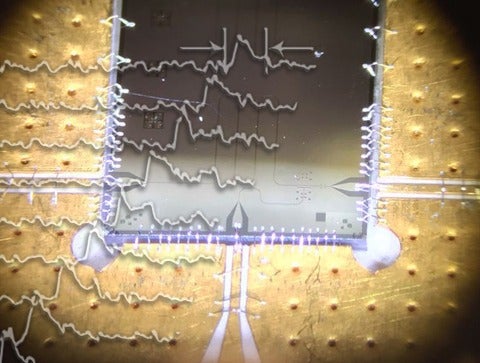
Robert F. McDermott, University of Wisconsin, Madison

One of the remarkable recent discoveries in information science is that quantum mechanics can lead to efficient solutions for problems that are intractable on conventional classical computers.

Friday, December 1, 2017 3:00 pm - 3:00 pm EST (GMT -05:00)

Applications of the trilinear Hamiltonian with three trapped ions

Roland Esteban Hablützel Marrero, Centre for Quantum Technologies, National University of Singapore

Three coupled harmonic oscillators with an interaction given by the trilinear Hamiltonian $a^{\dagger} b c + a b^{\dagger} c^{\dagger}$ can describe a wide range of physical processes. In this talk I will show how we implement the trilinear Hamiltonian utilizing a chain of three $^{171}$Yb$^+$ ions in a linear Paul trap.

Colloquium: Zhengcheng Gu, The Chinese University of Hong Kong

Searching for p+ip topological superconducting (SC) state has become a fascinating subject in condensed matter physics, as a dream application awaits in topological quantum computation. In this talk, I will report the theoretical discovery of a p+ip SC ground state (coexisting with ferromagnetic order) in honeycomb lattice Hubbard model with infinite repulsive interaction at low doping(< 0.2), by using both the state-of-art Grassmann tensor product state(GTPS) approach and a quantum field theory approach.

Wednesday, November 8, 2017

Shaping photons on-demand

Experiment finds way to increase photon efficiency for quantum communications

A team of researchers at the Institute for Quantum Computing (IQC) demonstrated a new type of on-demand single photon generator that can shape photons to increase their efficiency when used in a quantum network.

Next-generation communication networks will rely on the transmission of quantum information. Single photons, as carriers of quantum information, will play an integral role in building these future networks.

Monday, November 13, 2017 2:30 pm - 2:30 pm EST (GMT -05:00)

Shining Light on Perovskite Chalcogenides

Colloquium: Jayakanth Ravichandran - University of Southern California

Perovskite Chalcogenides are a new class of semiconductors, which have tunable band gap in the visible to infrared part of the electromagnetic spectrum. Besides this band gap tunability, they offer a unique opportunity to realize large density of states semiconductors with high carrier mobility. In this talk, I will discuss some of the advances made both in my research group and in the research community in theory, synthesis of these materials and understanding their optoelectronic properties.

Monday, October 30, 2017 2:30 pm - 2:30 pm EDT (GMT -04:00)

The NV center in diamond: a versatile quantum technology

Colloquium: Ania Jayich, University of California, Santa Barbara

The nitrogen vacancy (NV) center in diamond is an atomic-­scale defect that exhibits remarkably coherent quantum properties in a uniquely accessible way: at room temperature, in ambient conditions, and even immersed in biological environments. NV centers are being explored for a variety of quantum technologies, including quantum sensing and quantum information processing.