Faculty

Monday, September 25, 2017 11:00 am - 11:00 am EDT (GMT -04:00)

Seminar: Aging and Domain Growth in the Spin Glass Copper Manganese

Daniel Tennant - University of Texas, Austin

I will report on dynamical magnetic susceptibility measurements of
both bulk and thin film samples of the spin glass Copper Manganese.
By studying the Thermoremanent Magnetization (TRM) of multi-layer thin
films of various thicknesses, we are able to show the maximum energy
barrier encountered during correlated spin flip transitions is cut off
by the thickness of the film and is independent of temperature. The
distribution of energy barriers is shown to follow from a hierarchical

Quantum machine learning and artificial intelligence, quantum-safe cryptography, and simulation of quantum systems all rely on the power of quantum computing.

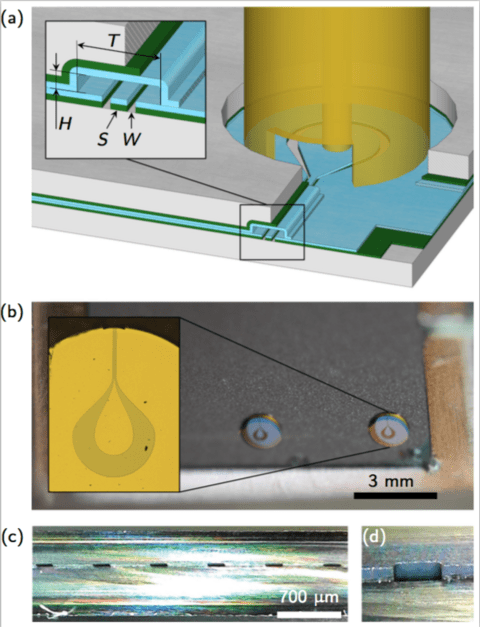
A team of researchers at the Institute for Quantum Computing (IQC) have taken a step closer to realizing the powerful possibilities of a universal quantum computer. The Laboratory for Digital Quantum Matter, led by faculty member Matteo Mariantoni, is developing technologies for extensible quantum computing architectures based on superconducting quantum devices.

New research chair in quantum error correction demonstrates continued leadership by IQC and Waterloo in the pursuit of a quantum computer and in the development of other quantum technologies.  

WATERLOO, Ont. (Thursday, September 14) The University of Waterloo, in collaboration with Mike and Ophelia Lazaridis, has launched a new $8-million research chair to further solidify Waterloo’s leadership in quantum information research.

Tuesday, September 12, 2017 1:00 pm - 1:00 pm EDT (GMT -04:00)

Seminar: Successes and limits in engineering photon pair sources

Evan Meyer-Scott, Universität Paderborn 

I will present a realization of a great photon pair source based on parametric down-conversion, and discuss a not-so-great limit to the performance of photon pair sources in general. The former is a fully fiber-coupled waveguide pair source with 46% raw heralding efficiency, and no optical alignment required. The latter restricts the achievable heralding efficiency, when spectrally filtering the photons to increase the purity.

Behrooz Semnani, PhD candidate, Department of  Electrical and Computer Engineering, University of Waterloo  

Recent rapid advancements in nanofabrication technologies have widened the realm of possibilities in nanophotonics, nonlinear and sub-wavelength optics. Realizing nonlinear optics in subwavelength scale paves the way for low cost integrated photonics. Ultra-high-Q photonic crystal nanocavities and nanostructured materials are examples of such structures. Those structures offer very small mode volume guaranteeing highly enhanced field intensity.

Tuesday, September 12, 2017 11:00 am - 11:00 am EDT (GMT -04:00)

Self-testing QRNG: A lot of randomness for little trust!

Hugo Zbinden, Université de Genève

An approach to quantum random number generation based on unambiguous quantum state discrimination (USD) is developed. We consider a prepare-and-measure protocol, where two non-orthogonal quantum states can be prepared, and a measurement device aims at unambiguously discriminating between them.