Faculty

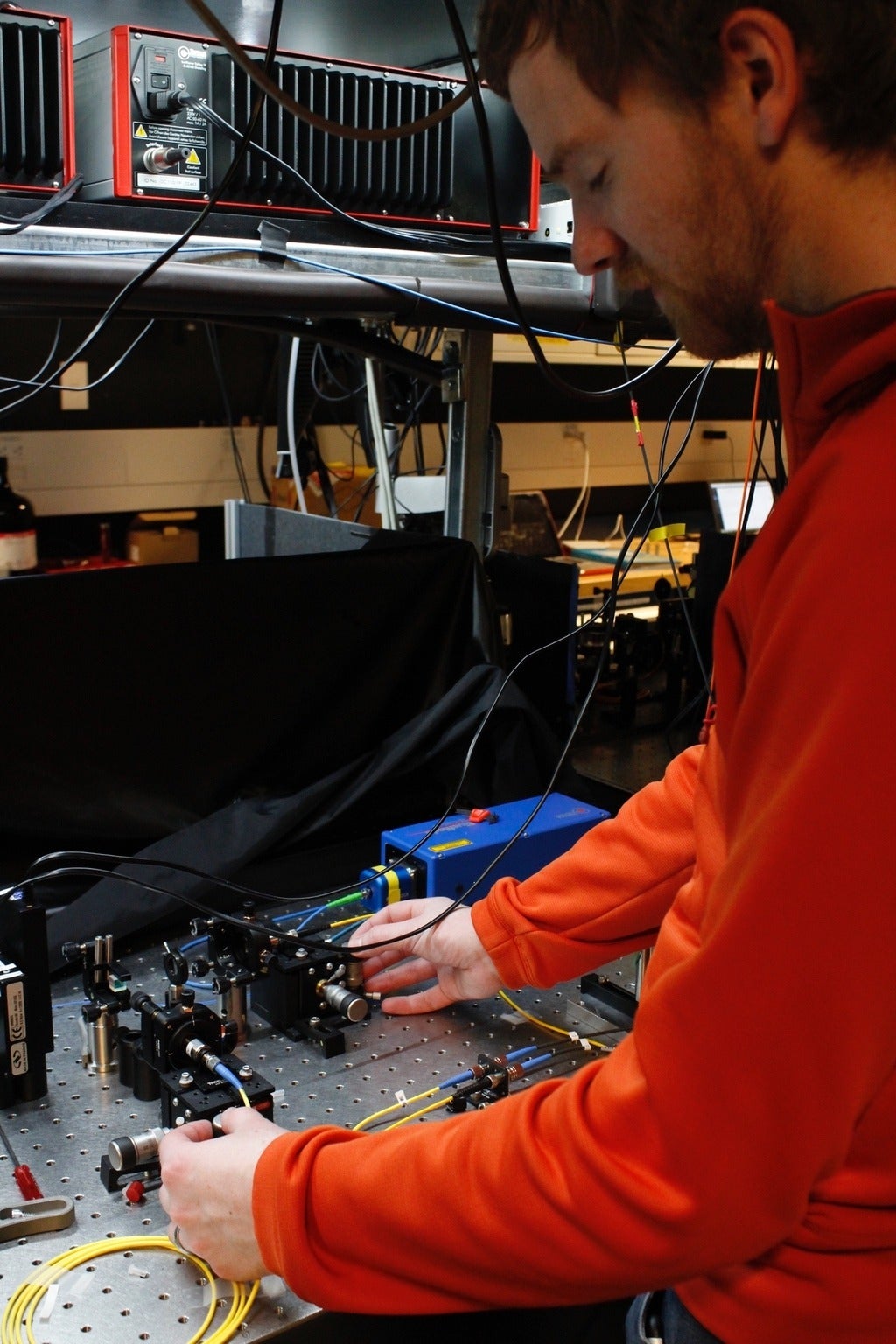
Researchers in Canada, the United States and Europe led by the National Institute of Standards and Technology in Boulder, Colorado and Institute for Quantum Computing alumnus Krister Shalm have ruled out classical theories of correlation with remarkably high precision. A group including Institute for Quantum Computing members Evan Meyer-Scott, Yanbao Zhang, Thomas Jennewein, and alumnus Deny Hamel built and performed an experiment that shows the world is not governed by local realism.
Monday, November 30, 2015 2:30 pm - 2:30 pm EST (GMT -05:00)

Colloquium: Karsten Flensberg

Towards demonstration of Majorana-based topological qubits

Karsten Flensberg, Niels Bohr Institute

The first part of the talk presents recent progress in the search for condensed matter systems hosting Majorana bound state in semiconductor-superconductor nanowire-based heterostructures. In the second part a proposal for the next steps towards manipulation of quantum information stored in topological qubits is presented.

Friday, November 6, 2015 2:30 pm - 2:30 pm EST (GMT -05:00)

Analysis seminar: Fred Shultz

Applications of order isomorphisms of C*-algebras

Fred Shultz, Wellesley College

We will review known results about order isomorphisms of C*-algebras,
and will describe some applications to complete positivity of maps and
a generalization of the Choi matrix. (This is joint work with Vern Paulsen.)
Then we will describe some applications to quantum information theory.

Tuesday, November 10, 2015 1:00 pm - 1:00 pm EST (GMT -05:00)

Seminar: Nai-Hui Chia

How hard is deciding trivial versus non-trivial in the dihedral coset problem

Nai-Hui Chia, Pennsylvania State University

The dihedral coset problem (DCP) is an important open problem in quantum algorithms and has been studied since the early days of quantum computing. This problem attracts attention even from experts in cryptography due to its application to the lattice-based cryptosystems. It has been shown by Oded Regev in 2005 that the DCP has deep connections to the unique shortest vector problem and the random subset sum problem.

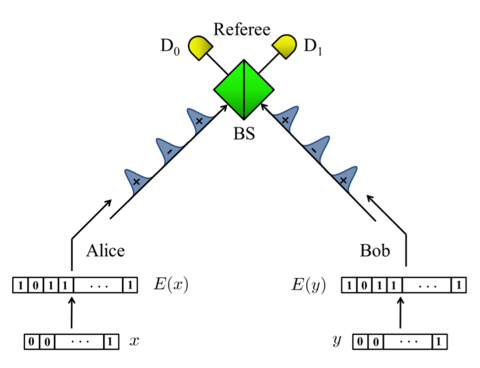
Computer scientists, including Institute for Quantum Computing (IQC) members John Watrous and Richard Cleve have long been looking at protocols where quantum communication offers an advantage compared to the classical case. However technology hasn’t progressed as quickly, so researchers had previously been unable to implement the protocols.

Monday, November 2, 2015 2:30 pm - 2:30 pm EST (GMT -05:00)

Colloquium: Mukund Vengalattore

Measurement-induced localization of an ultracold lattice gas

Mukund Vengalattore, Cornell University

The act of observation has profound consequences on a quantum system. I will describe our experimental demonstration of a Heisenberg microscope based on nondestructive imaging of a lattice gas. We show that the act of imaging these atoms induces their localization - a manifestation of the quantum Zeno effect.

Thursday, October 15, 2015 10:00 am - Friday, March 11, 2016 4:00 pm EDT (GMT -04:00)

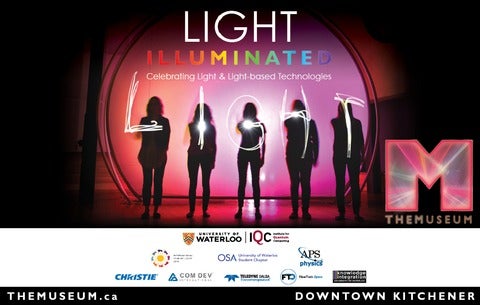
LIGHT Illuminated at THEMUSEUM

Celebrating light and light-based technologies

LIGHT Illuminated celebrates the United Nation's International Year of Light. In this interactive exhibition at THEMUSEUM you can learn about the value and importance of light-based technologies by exploring a black-light room, playing with colour mixing stations, and trying to get through a laser maze.