Future students

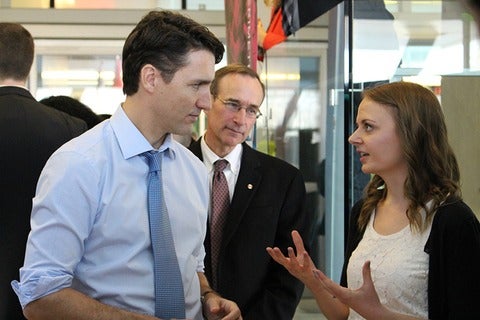
Institute for Quantum Computing (IQC) Executive Director Raymond Laflamme talked quantum computing with Prime Minister Justin Trudeau during a tour of Perimeter Institute for Theoretical Physics (PI) on Friday, April 15, 2016. Their conversation went on to seed a social media sensation that garnered headlines around the world.
Thursday, April 21, 2016 12:00 pm - 12:00 pm EDT (GMT -04:00)

Seminar: Cheng Guo

Tensor Rank and Entanglement Transformation between Multipartite Pure States

Cheng Guo, Tsinghua University & University of Technology, Sydney

The tensor rank of a symmetric tensor is equal to the polynomial rank of some homogeneous polynomial. I will introduce the isomorphism between symmetric states and homogeneous polynomials.

Monday, April 18, 2016 2:30 pm - 2:30 pm EDT (GMT -04:00)

Colloquium: Lidia del Rio

Finding non-signalling agents and subsystems in global theories

Lidia del Rio, University of Bristol

How can we find operational notions of local agents within a global theory? In this talk, I will present an operational way to model the effective state spaces of individual agents, as well as the range of their actions. I will then address the aspects of locality relevant to derive independence and non-signalling conditions between agents. This approach establishes an operational connection between local action and local observations, and gives a global interpretation to concepts like discarding a subsystem or composing local functions.

Imagine a movie showing particles in a gas moving and colliding with each other. Then when you play the movie backwards the velocity of the particles will be opposite, but their motion is still governed by the same laws of physics – we could just as well call the backwards film “forward” – there is no fundamental way to distinguish the arrow of time. This is called time-reversal symmetry.

Monday, March 28, 2016 11:00 am - 11:00 am EDT (GMT -04:00)

Seminar: Crystal Senko

Bottom-up approaches for quantum many-body physics with cold trapped atoms

Crystal Senko, Harvard University

A major outstanding challenge in quantum science is the development and refinement of techniques to control interactions among quantum particles, which will be a key ingredient in quantum information processing and laboratory studies of quantum many-body physics. This talk will describe two atom-based platforms for studying artificial spin-spin interactions.

Wednesday, March 9, 2016 10:30 am - 10:30 am EST (GMT -05:00)

Seminar: Carl Miller

Quantum Randomness Expansion - New Results

Carl Miller, University of Michigan

Is it possible to create a source of provable random numbers? An affirmative answer to this question would be highly useful in information security, where random numbers are needed to provide the keys for encryption algorithms. Bell inequality violation experiments offer hope for this problem, since the outputs of a Bell violation must be non-classical and therefore not fully predictable to an adversary. The challenge is to prove something stronger: that the outputs can be processed (extracted) to obtain uniformly random data. This leads to some complex and beautiful mathematics.

Thursday, March 10, 2016 2:00 pm - 2:00 pm EST (GMT -05:00)

Seminar: Igor Mekhov

Quantum optics of strongly correlated many-body systems

Igor Mekhov, University of Oxford

We show that quantum backaction of weak measurement constitutes a novel source of competitions in many-body systems, thus leading to new phenomena. We consider a system of ultracold atoms in optical lattices trapped inside a high-Q cavity, which requires a fully quantum description of both light and matter waves. The QND measurements lead to the generation of genuinely multipartite entangled modes of the matter fields, which have analogies in quantum optics (e.g. two-mode squeezing), but are non-Gaussian.

Tuesday, June 21, 2016 12:00 am - Friday, June 24, 2016 12:00 am EDT (GMT -04:00)

Relativistic Quantum Information North

The Relativistic Quantum Information North (RQI-N) Conference, hosted by the Institute for Quantum Computing (IQC), will bring together an interdisciplinary community of researchers at the interface of quantum information science and relativity.

Monday, March 21, 2016 2:30 pm - 2:30 pm EDT (GMT -04:00)

Seminar: Yasunobu Nakamura

Hybrid quantum systems using collective degrees of freedom in solids

Yasunobu Nakamura, The University of Tokyo

In the course of the development of superconducting qubits, we learned that we can fully control quantum states of selected collective degrees of freedom in superconducting circuits. Such collective modes, rigidly extending in a macroscopic scale, strongly couple to electromagnetic fields via their large dipole moments. Moreover, Josephson junctions bring large nonlinearity into the system without adding dissipation.