Future students

Friday, May 1, 2015 12:00 pm - 1:00 pm EDT (GMT -04:00)

Tim J. Bartley: Mesoscopic quantum optics

Tim J. Bartley, National Institute of Standards and Technology, Boulder

Fundamental to quantum optics is the study of the distribution of photons in modes of an electromagnetic field. Until now, direct photon number measurements on nonclassical states occupying a single mode have been limited to the few-photon regime (typically no more than 5). I will present results from direct measurements of nonclassical states containing up to 50 (fifty) photons, at telecom wavelengths and with total raw efficiencies well above 60%.

Ben Baragiola, University of New Mexico

Traveling wave packets of light prepared with a definite number of photons, known as multimode Fock states, are well-suited for the role of "flying qubits" to relay information in a quantum computing device. In both the optical and microwave domain, propagating single-photon fields are routinely produced and manipulated, with ongoing progress toward higher photon numbers.

Michele Piscitelli, Royal Holloway University

The focus of this talk will be a general introduction to Nuclear Magnetic Resonance (NMR) detection schemes that are based on the use of Superconducting Quantum Interference Devices (SQUIDs) as highly sensitive magnetometers. I will begin by providing an overview of the relevant concepts and principles behind SQUID-detected NMR. In the main part of my talk I will be presenting our experimental results and achievements in the field of ultralow field SQUID NMR spectroscopy and Magnetic Resonance Imaging (MRI).

Monday, April 20, 2015 2:30 pm - 3:30 pm EDT (GMT -04:00)

Jerry Chow: Taking Superconducting Qubits to the Next Generation

Jerry Chow, IBM T.J. Watson Research Center, USA

Fault tolerant quantum computing is possible by employing quantum error correction techniques. In this talk I will describe an implementation of a true quantum code using 4 lithographically defined superconducting qubits in a square lattice capable of measuring both types of possible quantum errors occurring on a single qubit. The experiment requires highly coherent qubits, high quality quantum operations implementing the detecting circuit, and a high quality independent qubit measurement set-up.

Tuesday, June 9, 2015 7:00 pm - 7:00 pm EDT (GMT -04:00)

Quantum Computing: Transforming the Digital Age

Public lecture by Dr. Krysta Svore, Microsoft Research

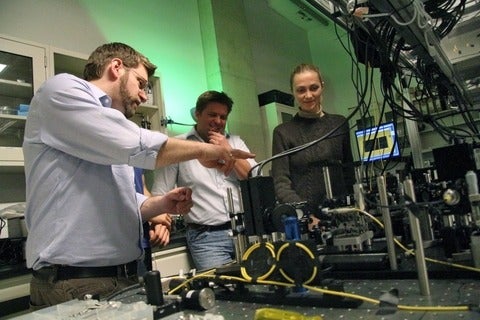
Krysta SvoreIn 1981, Richard Feynman proposed a device called a “quantum computer” to take advantage of the laws of quantum physics to achieve computational speed-ups over classical methods. Quantum computing promises to revolutionize how we compute.
Thursday, April 30, 2015 4:00 pm - 5:00 pm EDT (GMT -04:00)

Quantum Frontiers Distinguished Lecture: Sajeev John

Sajeev John, University of Toronto

Photonic band gap materials: semiconductors of light

Join us for the next Quantum Frontiers Distinguished Lecture Series when Dr. Sajeev John will talk about light-trapping crystals.

Monday, March 16, 2015 11:00 am - 12:00 pm EDT (GMT -04:00)

Na Young Kim: Carbon Nanotube Transport and Exciton-Polariton Condensation

Na Young Kim, Stanford University

We in modern society are beneficiaries of advanced electronics, photonics and the combination of two. As an effort to develop new platforms of electronics, photonics and optoelectronics harnessing quantum nature, I have studied transport properties of carbon nanotubes, where long-range interaction plays a significant role. In photonics domain, I have been studying exciton-polaritons in a quantum-well-microcavity structure, where dynamical macroscopic condensation emerge via stimulated scattering process arising from exchange interactions.

Konstantinos Lagoudakis,  Stanford University

Light matter interactions lie in the heart of several phenomena of fundamental and applied interest. Both condensation of exciton polaritons in semiconductor microcavities as well as quantum information processing with charged quantum dots in micro-resonators rely on strong light matter interactions.