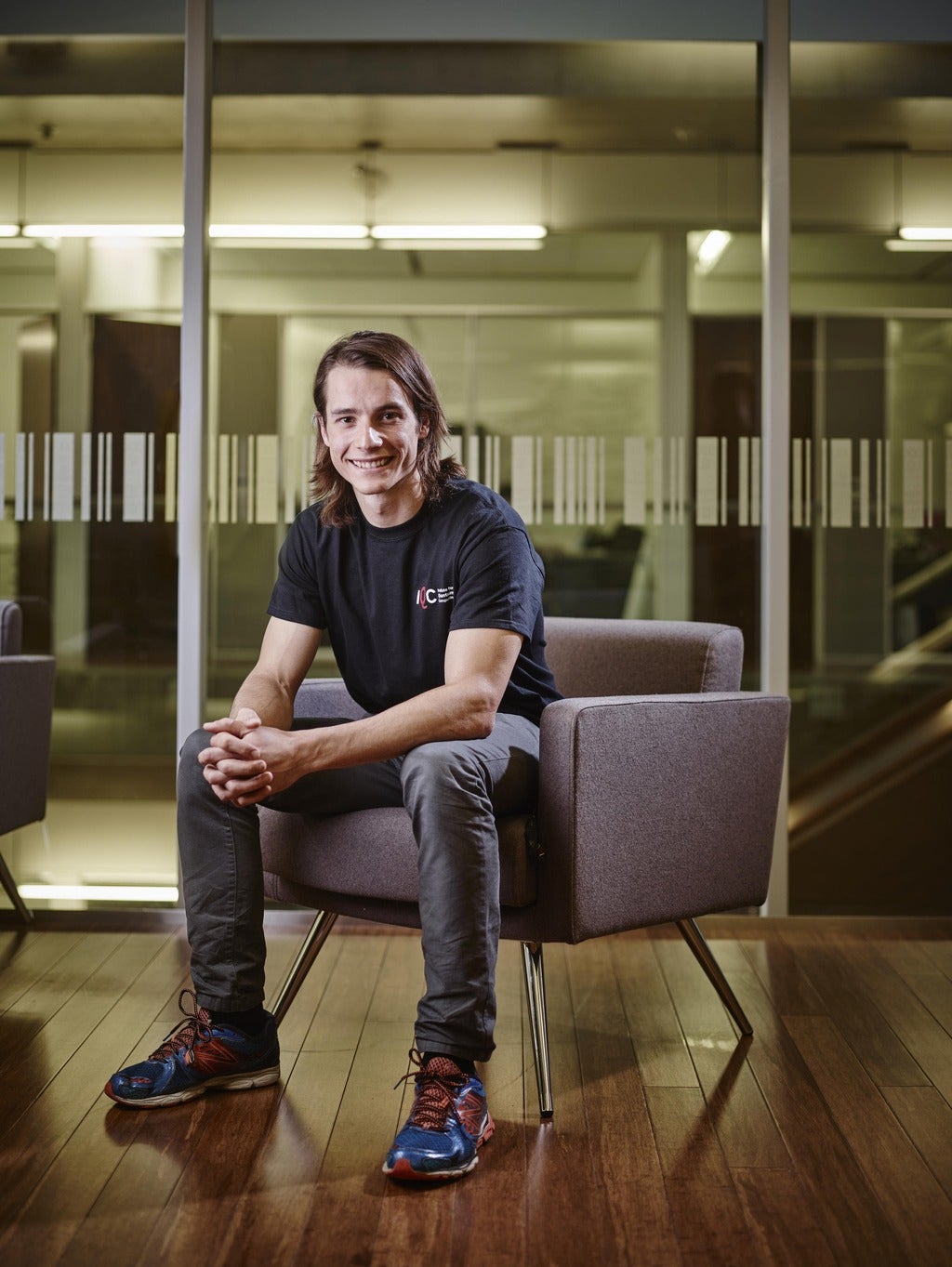
PhD Thesis Defence
Ultrafast metrology in the quantum domain
PhD Candidate: Jean-Philippe MacLean
Supervisor: Kevin Resch
PhD thesis presentation in QNC 0101.
PhD Candidate: Jean-Philippe MacLean
Supervisor: Kevin Resch
PhD thesis presentation in QNC 0101.
PhD Candidate: Matthew Amy
Supervisor: Michele Mosca
Oral defence in QNC B204.
The design and compilation of correct, efficient quantum circuits is integral to the future operation of quantum computers. This thesis makes contributions to the problems of optimizing and verifying quantum circuits, with an emphasis on the development of formal models for such purposes. We also present software implementations of these methods, which together form a full stack of tools for the design of optimized, formally verified quantum oracles.
In his own words, Marc Morin is “addicted to the game.”
Morin is the CEO and co-founder at Auvik Networks, pronounced awe-vik, as in awesome. “It’s like having a child who does way better than you and it’s awesome,” Morin explained at the CryptoWorks21 Distinguished Lecture last fall. Elaborating on his evolving role as a CEO in a tech company, he shared lessons learned—the mistakes he made and the things he got right—during his personal journey as a serial technology entrepreneur.
Speaker: Jacqueline Armstrong Gates
Speaker: Doug Beynon
Abstract:
Speaker: Thomas K. Hunter
Cold atoms confined inside hollow-core waveguides enable strong-matter interactions, thus offer a unique platform for studies of quantum and non-linear optics. We developed an experimental system that traps cesium atoms in a magneto optical trap (MOT) and loads these atoms into a hollow core photonic crystal fiber using a dipole trap at cesium magic wavelength (935 nm), which removes the AC-Stark shift of the optical transition and suppresses the inhomogeneous broadening.
A random walk on a graph, P, with marked vertex set M, finds a marked vertex using a O(HT(P,M)) steps of the walk, where HT(P,M) is the hitting time. Previous quantum algorithms could detect the presence of a marked vertex in O(sqrt{HT(P,M)}) steps, or find a marked vertex in O(sqrt{HT(P,M)}) steps if M contained at most one vertex, but the case of finding in the presence of multiple marked vertices was left as an open problem.
Rangefinding has many applications in navigation, civil engineer, construction, military, surveillance and security. Most commonly rangefinders estimate the distance to an object by measuring the time of flight of light for the journey to and returning from the target. Conventional techniques use lasers for illumination in state of the art rangefinding systems. However, the particular state of light lasers produce makes them easy to detect.
Quantum random-access memories (qRAM) are required by numerous quantum algorithms. In many cases, qRAM queries are the limiting factor in the implementation of these algorithms. In the limit of a large number of queries, there will be a massive resource overhead, as in this regime it is not possible to bypass the need for active error correction. In this talk, I will present our work towards quantifying this overhead. We will explore a variety of different qRAM circuits designed to query classical bits in superposition.