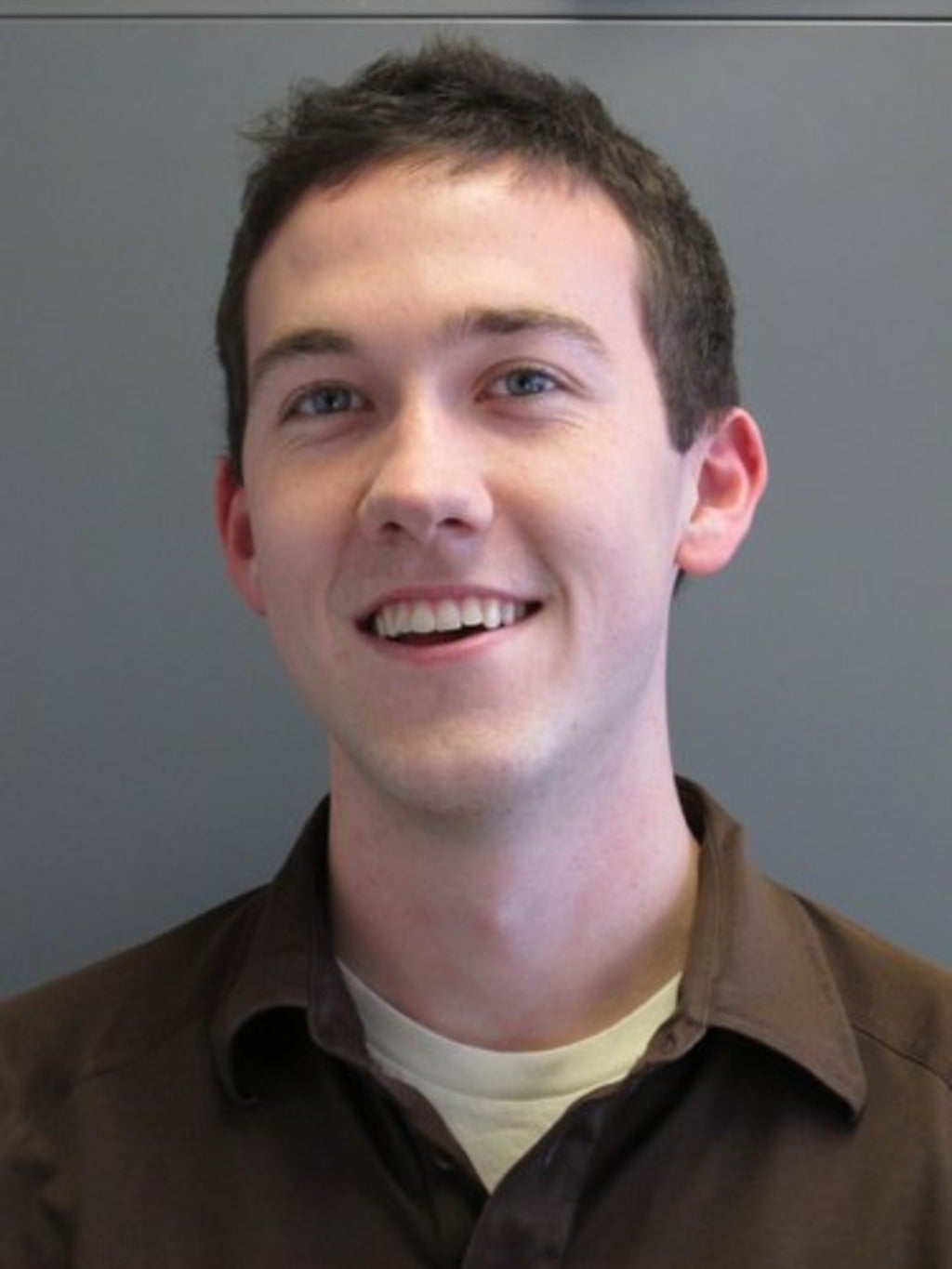
PhD Thesis - Kent Fisher
Kent Fisher of the Department of Physics and Astronomy is defending his thesis:
Photons & Phonons: A room-temperature diamond quantum memory
Kent is supervised by Professor Kevin Resch.

Kent Fisher of the Department of Physics and Astronomy is defending his thesis:
Photons & Phonons: A room-temperature diamond quantum memory
Kent is supervised by Professor Kevin Resch.
Projective measurement is used as a fundamental axiom in quantum
We show a power 2.5 separation between bounded-error randomized and quantum query complexity for a total Boolean function, refuting the widely believed conjecture that the best such separation could only be quadratic (from Grover's algorithm). We also present a total function with a power 4 separation between quantum query complexity and approximate polynomial degree, showing severe limitations on the power of the polynomial method.
We will review known results about order isomorphisms of C*-algebras,
and will describe some applications to complete positivity of maps and
a generalization of the Choi matrix. (This is joint work with Vern Paulsen.)
Then we will describe some applications to quantum information theory.
The act of observation has profound consequences on a quantum system. I will describe our experimental demonstration of a Heisenberg microscope based on nondestructive imaging of a lattice gas. We show that the act of imaging these atoms induces their localization - a manifestation of the quantum Zeno effect.
A classical current in a conductor radiates a classical electromagnetic field. We explore some properties of the field radiated by a conductor when electron transport must be described by quantum mechanics, i.e. when the electron current becomes quantum itself.
The behavior of conventional transistors derives from large numbers of acceptor and donor impurities that promote carriers into the valence and conduction bands. More recently, nano-electronic devices based on the bound states of individual dopant impurities in silicon have received considerable attention for quantum computation, due to the long spin coherence times of dopants in silicon. This invariably requires control over dopant wavefunctions and the interactions between individual dopants [1].
In this talk, I will discuss correlations that can be generated by performing local measurements on bipartite quantum systems. I'll present an algebraic characterization of the set of quantum correlations which allows us to identify an easy-to-compute lower bound on the smallest Hilbert space dimension needed to generate a quantum correlation. I will then discuss some examples showing the tightness of our lower bound.
Join us for two days at the Institute for Quantum Computing (IQC) for the Teaching Quantum Technology workshop (TQT) December 5-6. You will have the opportunity to attend lectures and engage in hands-on activities focused on the integration of quantum technology into the current teaching curriculum. We will discuss quantum information science and technology to give you a deeper understanding of quantum mechanics.
Anirudh of the Department of Physics and Astronomy will be defending his thesis:
Experimentally Testable Noncontextuality Inequalities via Fourier-Motzkin Elimination.
Jihyun is supervised by Professors Joseph Emerson and Robert Spekkens.