Over $2.1 million in NSERC awards for IQC members
Faculty, associates and affiliates of the Institute for Quantum Computing (IQC) collected 10 awards from the Natural Sciences and Engineering Council of Canada (NSERC) on Thursday, June 23.
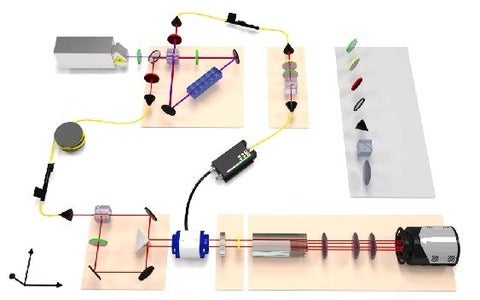
Theorists from Perimeter and experimentalists from the Institute for Quantum Computing have found a new way to test whether the universe is quantum, a test that will have widespread applicability: they’ve proven the failure of noncontextuality in the lab.
What does it mean to say the world is quantum? It’s a surprisingly difficult question to answer, and most casual discussions on the point are heavy on the hand-waving, with references to cats in boxes.
WATERLOO, Ont. (Friday, May 20, 2016) – What once took months by some of the world’s leading scientists can now be done in seconds by undergraduate students thanks to software developed at the University of Waterloo’s Institute for Quantum Computing (IQC), paving the way for fast, secure quantum communication.
Researchers at the Institute for Quantum Computing (IQC) at the University of Waterloo developed the first available software to evaluate the security of any protocol for Quantum Key Distribution (QKD).
AMSTERDAM: Europe’s top researchers, government and industry leaders gathered today at the Quantum Europe 2016 conference in Amsterdam to discuss a comprehensive strategy for quantum technology development and commercialization.
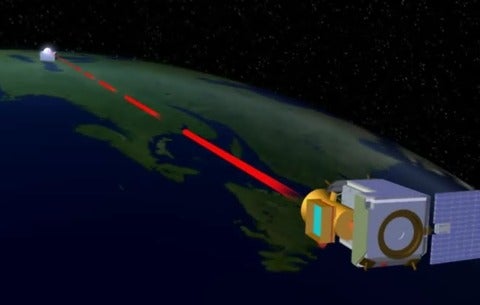
The Canadian Space Agency (CSA) has awarded Thomas Jennewein an $182,000 grant to train and develop Institute for Quantum Computing (IQC) graduate students through participation in an international space satellite project.
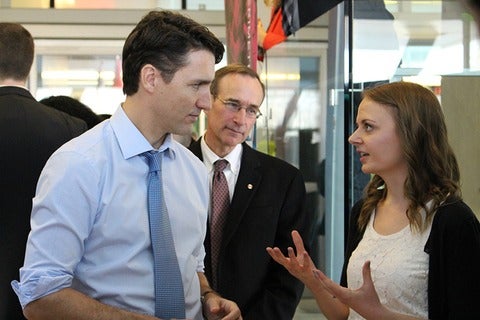
Institute for Quantum Computing (IQC) Executive Director Raymond Laflamme talked quantum computing with Prime Minister Justin Trudeau during a tour of Perimeter Institute for Theoretical Physics (PI) on Friday, April 15, 2016. Their conversation went on to seed a social media sensation that garnered headlines around the world.
Imagine a movie showing particles in a gas moving and colliding with each other. Then when you play the movie backwards the velocity of the particles will be opposite, but their motion is still governed by the same laws of physics – we could just as well call the backwards film “forward” – there is no fundamental way to distinguish the arrow of time. This is called time-reversal symmetry.
/*-->*/
Five of Canada’s leading science outreach organizations launch Innovation150, a national program that celebrates our country’s innovative past and sparks ideas and discoveries to propel our future.
by Aephraim M. Steinberg, University of Toronto
An international team of researchers from the University of Toronto, Griffith University (Brisbane), and the Institute for Quantum Computing (Waterloo) demonstrate "surrealistic" quantum trajectories in the lab.
A team lead by researchers from the Institute for Quantum Computing and the Department of Physics and Astronomy at the University of Waterloo has successfully detected the presence of single photons while preserving their quantum states.