
Tuesday, December 6, 2016
Visualizing randomness
Local artist creates visual project from random BIG Bell Test data
Do atoms behave differently when we are not looking at them?
The Bell test seeks to catch quantum particles “talking” to each other by matching their answers (output), to the questions asked (measurement). Unpredictable and independent input is one condition needed to perform Bell test experiments. Last week, the BIG Bell Test (BBT) brought true human unpredictability and randomness to the first ever human-driven Bell test.
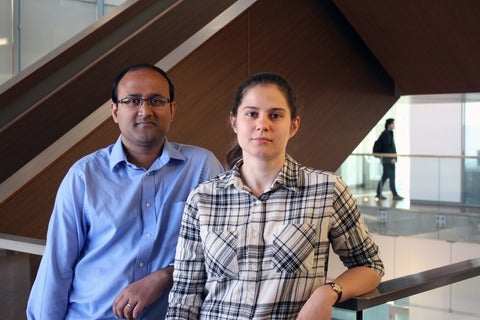
 Jon Yard joins the Institute for Quantum Computing (IQC) as Associate Professor from Microsoft’s Research Station Q team. He is jointly appointed with the Department of Combinatorics and Optimization in the Faculty of Mathematics and as an Associate Faculty member with the Perimeter Institute for Theoretical Physics (PI).