Nutrition and aging: Why aren't older adults eating well?
Poor nutrition is rampant is Canada’s long term care homes—and inadequate food and liquid intake is often to blame.
Professor Heather Keller, of the Department of Kinesiology, and a Schlegel research chair in nutrition and aging, will receive $979,000 over two years to investigate why many Canadians living in long-term care homes are poorly nourished.
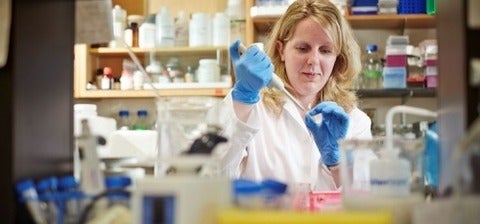
Kristin Marks, a researcher who looks into ways that estrogen affects different fats, has become an advocate for the misunderstood molecule that has been vilified for North America’s growing obesity crisis.
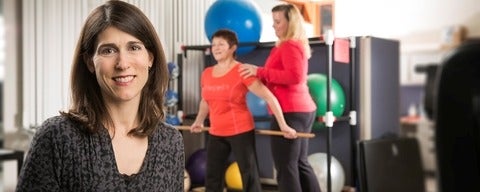
Osteoporosis Canada recently launched Too Fit to Fracture, a set of exercise recommendations aimed at managing the progression and symptoms of osteoporosis.
Waterloo researchers have used cell phones equipped with a GPS to prove there is a link between the geographical area a person covers in daily life and dementia in older adults.
People with osteoporosis, and those at risk of developing it, can prevent bone loss, fractures and falls by combining specific types of exercises, says new recommendations that Osteoporosis Canada released today.
Initial results from a study of Chris Hadfield and other astronauts who spent months aboard the International Space Station have turned up changes like those seen in someone developing Type 2 diabetes on Earth.
In spring 2014, professor Marina Mourtzakis of the Department of Kinesiology received the province of Ontario's Early Researcher Award.
Robinson’s skill in chiropractic medicine, primed by his kinesiology degree from the University of Waterloo (BSc 1993), has earned him a spot on the support team for Canada’s athletes in the Russian city.
Kinesiology student Matt Vonk, supervised by Laura Middleton, was selected as this year's winner in the 2014 Applied Health Sciences (AHS) 3MT competition.