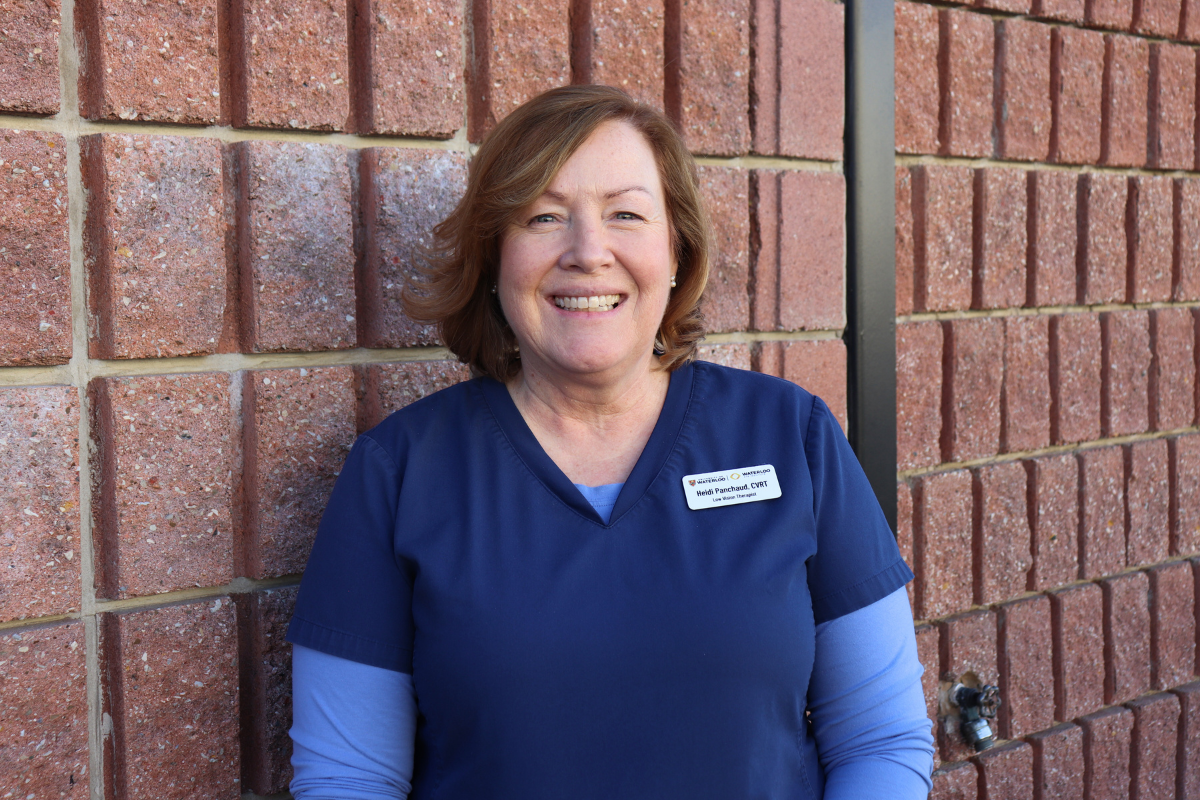
Heidi Panchaud, once a teacher and now a low vision therapist, is retiring after almost 18 years of service at the Waterloo Eye Institute.
By Kavya Piraba
When Heidi Panchaud trained as an educational assistant after a period as a stay-at-home mom, working in low vision wasn’t on her radar at all. However, her first classroom assignment, which was with a blind student, changed the course of her career. Now, more than 20 years later, she’s retiring as a low vision therapist at the Waterloo Eye Institute’s George and Judy Woo Centre for Sight Enhancement (CSE)’s Low Vision Service.
Born and raised in Waterloo, Panchaud pursued a post-secondary education in business at Conestoga College. After working briefly in the business world, she married and welcomed two daughters. Choosing to prioritize family, she stayed home to raise them until they were ready to go to school. During that time, she attended night school for two years to become an educational assistant, preparing for a career that would ultimately define her professional career.
When her daughters began school, Panchaud stepped into the classroom. Though she had no prior experience working with students with visual impairments, she embraced the challenge and quickly discovered her passion for supporting them. Fascinated with the world of vision, she dedicated a full year of Saturdays to learning braille. This commitment led her to work as an educational assistant and braillist for the Waterloo Region District School Board’s Vision Team, serving children of all ages. She made herself indispensable to the school board and her skills working with students who were blind or visually impaired helped change lives forever.
To further strengthen her expertise, from 2005 to 2006 she took a hiatus from work to go back to school full–time to become an Instructor for Blind & Visually Impaired – Rehabilitation Teacher. She then returned to teaching – until the next year, when she applied to work at the School of Optometry and Vision Science clinic. She was keen to apply her skill set to something new.
In March 2008, Panchaud joined the clinic in the role of low vision therapist. Though she possessed rehabilitation teaching skills, at the clinic she needed to become more versed in the world of optics. Thankfully, the low vision optometrists working in the clinic were more than happy to teach her the ropes and help her settle into her new role. Now, almost two decades later, Panchaud is an expert low vision therapist and certified vision rehabilitation therapist.
“My favourite part of the job is working with the patients,” said Panchaud. “Being here since 2008, I’ve seen the same people several times, and some of them I’ve seen grow up. Some who were teenagers in my first year of working here now are married with children. I have patients who were in their 60s when they first came in and are now thriving in their 80s. I do what I do because I love being able to make a difference for people and give them the opportunity to do things they never thought they would be able to do again.”
Panchaud’s work not only requires technical skills but also deep empathy. Many patients arrive with hopes of fully restoring their vision and are sometimes initially disappointed when they find out that the clinic does not have the ‘cure’ for their visual impairment.
“We have to understand the grieving process and acknowledge their loss before they can accept low vision rehabilitation,” says Panchaud.

Heidi Panchaud training a patient to use a low vision device to help watch TV.
The Low Vision Service has always worked as a team, though. Dr. Melinda Szilva, the low vision rehabilitation counsellor, often helps patients adjust to vision loss. When they’re ready, Panchaud and her colleagues work with patients through low vision rehabilitation.
Panchaud fondly recalls working with Szilva to organize annual bus trips to the Stratford Festival for five consecutive years that ended with the COVID-19 pandemic. These excursions allowed patients with low vision to enjoy musicals and plays with audio descriptions, creating lasting memories for patients and staff alike.
Throughout her career, Panchaud has enjoyed working with individuals across generations. She frequently noticed the unique challenges faced by adults who lost their vision later in life, as opposed to children who never knew life with full vision. Adults required more patience and understanding as they adjusted to new realities, but she also noted that they frequently expressed their gratitude for the assistance received from the clinic.
Colleagues came and went, but to Panchaud, they all became like family.
“I had the kind of support here that I’ve never felt anywhere else,” she says, crediting her colleagues with making her look forward to work every morning. They shared a common goal: to place patients at the center of everything they did.
Empathy and patience are two virtues Panchaud honed through her work at the clinic. She’ll be taking those same qualities with her as she heads into retirement. December 18 marks her last day at the clinic and the end of an extraordinary chapter. With more time on her hands, she has plans to spend time with her family and travel domestically. Her plans will include playing with her three grandchildren that live locally as well as going on a trip with her husband to visit their daughter in Halifax. While she will miss her patients and colleagues deeply, she has assured them she will return to visit from time to time.
Panchaud’s influence will continue to resonate within the clinic and all the lives she has touched through her work. She leaves behind a legacy defined by empathy, patience and unwavering determination to improve the lives of her patients.
“We are eternally grateful for Heidi’s kindness, her vast knowledge and the countless ways she has enriched our clinic over the years. Her departure leaves a tremendous void that will be deeply felt by all of us. We wish her joy, fulfillment, and every happiness as she embarks on the next stage of her journey,” says Dr. Tammy Labreche, director of the CSE.