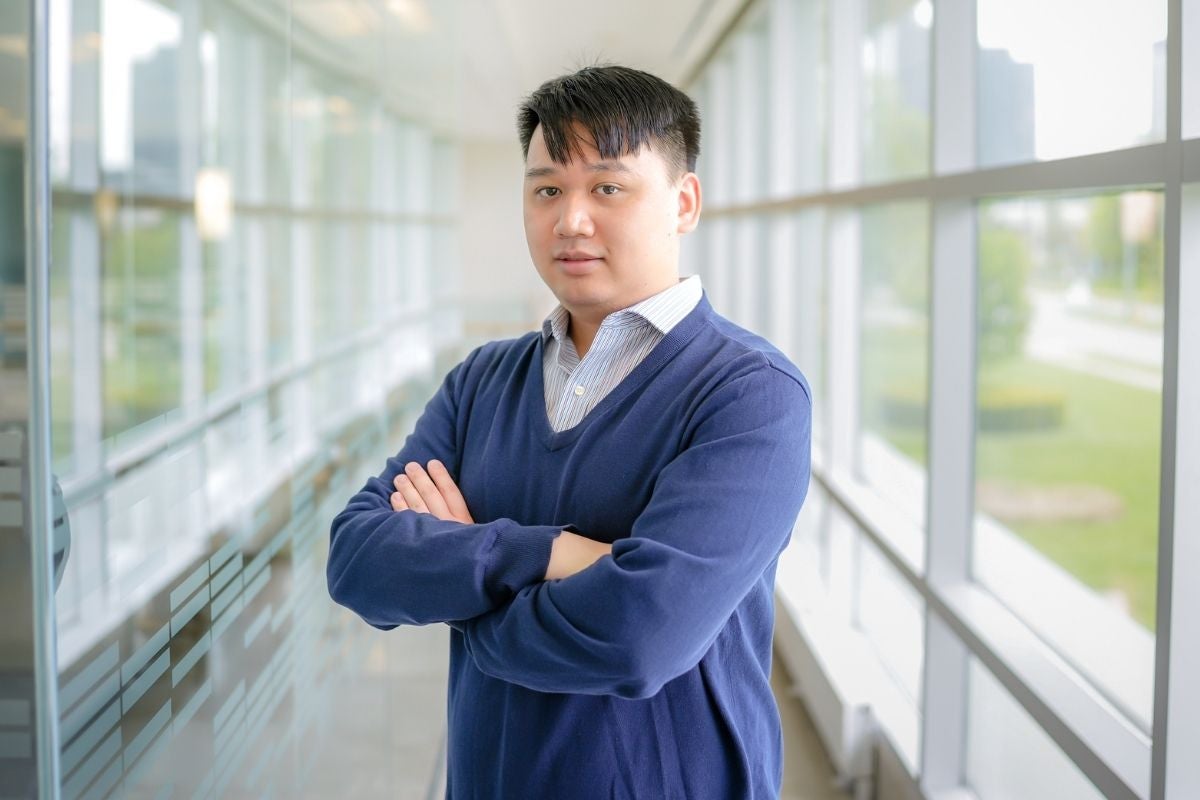
Dr. Yongjiang (John) Chen, the School’s first assistant clinical professor, community practice, is set to work on increasing access to vision care for all.
By Karen Kawawada
When he was growing up in Toronto, Yongjiang (John) Chen never thought too much about access to health care. If he had a concern, his parents took him to the doctor – that was it. So it was eye-opening for him when, as an optometry student, he met patients who’d had to drive six or seven hours and stay overnight to access specialized vision care at the University of Waterloo School of Optometry and Vision Science clinic.
Now, five years after his 2020 graduation, Chen has taken on a newly created tenure-track role at his alma mater: assistant clinical professor, community practice.
In addition to continuing to work in the Waterloo Eye Institute optometry clinic as an optometrist and clinical instructor, Chen will be leading projects and research focused on increasing access to eye and vision care for underserved populations, including Indigenous people, people in remote communities, people with special needs, newcomers, people in long-term care and unhoused or precariously housed people.
“For various reasons, there are many people in our communities who don’t have good access to care,” says Chen. “There are logistical barriers, financial barriers and social barriers. And yet, in many cases, it doesn’t really take much to help these people. It just takes a bit of collaboration and coordination to find ways to break the cycle.”
From bookish boy to caring clinician
Though books had always been his refuge, an interest in health care led the teenaged Chen to venture outside his comfort zone by getting a part-time job helping people in wheelchairs get around a hospital. It was what opened the door to a summer research assistantship in a retinoblastoma lab at Mount Sinai Hospital.
The high school summer job was what got Chen interested in eyes. In his third year at Western University, he applied to the University of Waterloo School of Optometry and Vision Science primarily to test the waters for a more serious application the following year. To his surprise, he got in on his first try, so he accelerated his degree so he could finish his Bachelor of Medical Science within three years.
Starting at the School in 2016, he was comfortable with everything in the first few years – lectures, studying, some clinical experience. Then came his fourth year. Chen’s first clinical placement was in Florida – not only a different country and climate, but a very busy clinic with a primarily geriatric, often medically complex population.
“I wasn’t just flipping through books anymore; I was seeing 20 to 30, on some days as many as 60 patients in one day and interacting with a lot of different people,” says Chen. “I needed to develop my people skills in a way I hadn’t needed to do until then.”
In his third year, Chen realized, he’d tended to speak to patients stiffly and clinically. Now he needed to explain things to patients both efficiently and in sufficient detail, in a way they could understand. It was something of a trial by fire, but he developed his skills.
After he graduated, Chen completed a residency at the School focused on low vision rehabilitation.
“Most of the patients have conditions that can’t be cured, but they’re still people who live lives and have goals and accomplishments. Being able to help them is very rewarding,” says Chen. “One thing that really struck me is that visual impairment itself is a barrier to care. If you can’t drive and you live where there aren’t many providers, it’s hard to get the care you need.”
He also gained experience working with people who have intellectual and developmental disabilities.
“Patients with special needs especially struggle to get care,” says Chen. “There were patients who were literally feeling their way around but nobody had assessed their vision in years because they’re non-verbal.”
Focusing on community practice
Chen continued to work at the School as a clinical instructor after he finished his residency. He was drawn to the new community practice role for the chance to make more of a difference on a structural level while continuing to work with patients.
One major focus will be on working with various partners across the country to develop a national strategy for Indigenous access to eye care. Many barriers exist for First Nations, Inuit and Métis people, including the remoteness of some communities, lack of infrastructure, and a history of racism and mistreatment by some health-care practitioners.
Change will take time, but Chen is working on progress on a number of fronts. Personally, he’s continuing the journey of educating himself – formally through courses and informally through relationships – even as he works with colleagues on developing cultural competency course materials for students and practicing optometrists.
One aspect of the strategy will be teleoptometry as a complement to in-person care. With multiple partners, the School has been involved in teleoptometry pilot projects and research about clinician and patient experiences with the aim of developing best practices. A teleoptometry centre of excellence is planned for the Waterloo Eye Institute reconstruction, expected to open in late 2026.
“I don’t see teleoptometry as being ‘the’ answer – there’s always going to be a need for on-the-ground care – but technology can help us extend the radius and frequency of care,” says Chen.
Bringing in-person optometric care to Indigenous communities will continue to be important too. Part of that involves creating systems and infrastructure to facilitate visits, but ultimately, even better would be to recruit more people from Indigenous communities to become optometrists themselves, he says. The School is developing an Indigenous recruitment strategy in consultation with the Southern Chiefs' Organization in Manitoba.
Overall, Chen is excited to help bring optometric care to more people. Though he recognizes there’s always going to be more for a young, able-bodied man from the big city to learn about the realities of other people’s lives, he’s already come a long way.
“When I started, I was thinking about optometry in a very clinical way, focusing on diseases and states of eyes,” says Chen. “As you work in clinic, though, you realize eyes are connected to people. Recognizing how much inequity there can be in terms of access to eye care, the idea of helping to dismantle some of the systemic barriers really stokes a passion in me.”