The outgoing 2024-25 optometry residents are looking forward to applying lessons learned from 13 months of expert mentorship in specialized areas to their future careers.
By Karen Kawawada
Thirteen months ago, four new residents arrived at the Waterloo Eye Institute fresh out of optometry school. When they were fourth-year optometry students, they’d been through clerkships – full-time internships where they practiced under supervision at clinics across North America – but this was something different. This was an opportunity to immerse themselves in a specialized area of optometry.
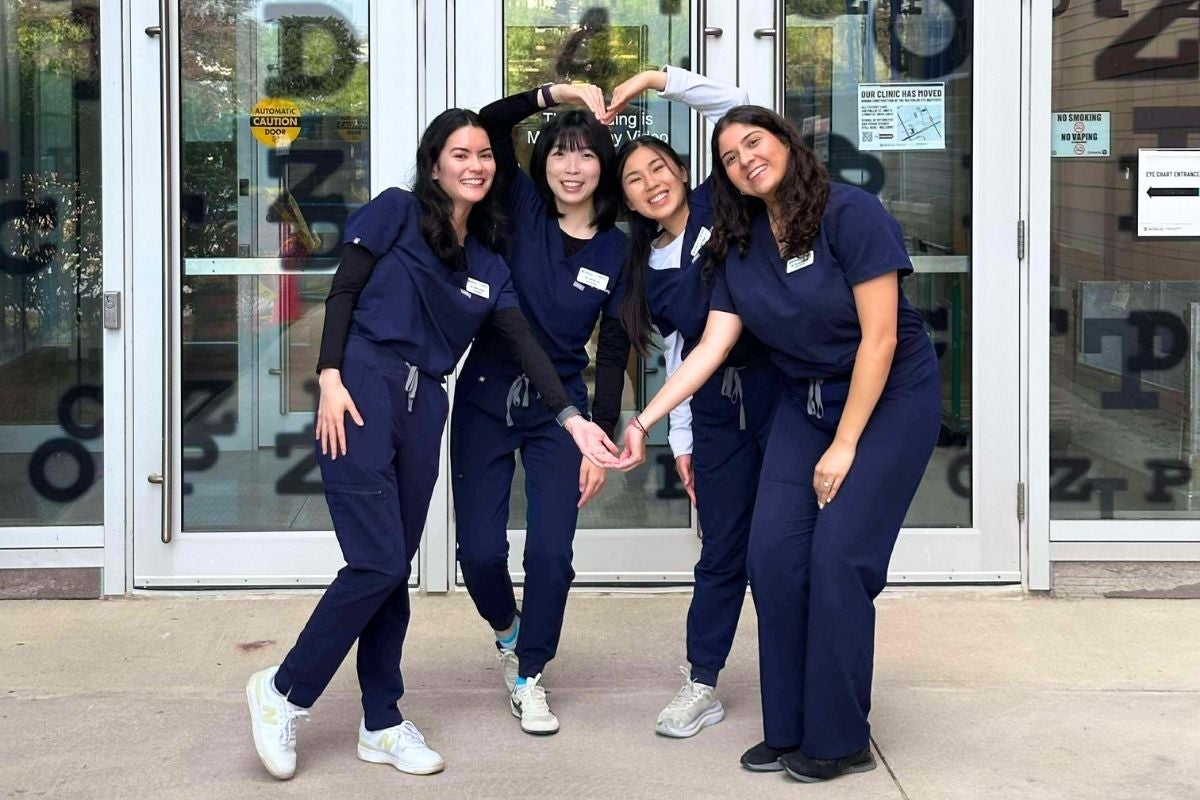
At the time, Drs. Natasha Bhanot, Joanne Jin, Ivana Latalisa and Bella Phan were a little nervous about practising more independently as newly registered doctors of optometry. Now, as they wrap up their residencies, they’re confident, knowledgeable and ready to take the next steps in their careers.
Residencies are optional post-graduate programs for early-career optometrists who want to develop their expertise in areas such as ocular disease, advanced contact lenses, pediatric eye care or low vision rehabilitation.
Because they’re based at the Waterloo Eye Institute, which attracts patients who need specialized care from across the province and sometimes beyond, they get to see more patients who need that care than they would at the average private practice. (Some residencies also have residents practice part time at another large, specialized clinic.) The result is that residents gain the equivalent of what would normally be years of experience in their area of interest in just one intensive year.
Residents also participate in scholarly activities including research, presentations and teaching, which further establishes them as emerging experts.
The residency supervisors and other clinic staff recently celebrated the many accomplishments of the 2024-25 residents, which gave them a chance to reflect on the past year. In their own words, here’s some of what they had to say.

Residents and supervisors from left: Dr. Ivana Latalisa, Dr. Sarah MacIver, Dr. Chelsea Bray, Dr. Natasha Bhanot, Dr. Lisa Christian, Dr. Virginia Donati (Bolton Optometry Clinic), Dr. Julie Shalhoub, Dr. Joanne Jin, Dr. Bella Phan, residency program coordinator Nadeera Careless
Dr. Natasha Bhanot
Natasha Bhanot was the Dr. Gina Sorbara cornea and contact lens resident. After her residency, she is staying on part time as a clinical instructor at the Waterloo Eye Institute. She will also be looking for more work in private practice after she gets married in September.
Residency has taught me, challenged me and strengthened my specialty contact lens skill set – a skill set I might not have tapped into if I’d gone straight into practice. I’ve learned how to identify patients who can benefit from these services and how to work to optimize their vision.
Through residency, I see the importance of being a lifelong learner. The program has inspired me to continue to seek out what’s new out there to continually improve the level of care we can provide to our patients.
It’s been great to work collaboratively with the other residents and specialties in our clinic to meet the different visual needs of our patients. I’d like to say thank you so, so much to the whole team for being my support system all the way through, giving me space to grow, encouraging me, challenging me and providing me with the tools and guidance to become the optometrist I am now.
Dr. Joanne Jin
Joanne Jin was the pediatric optometry resident, concentrating on binocular vision issues. Her time was split between the Waterloo Eye Institute and the Bolton Optometry Clinic. After her residency, she will be looking for work at private practices in and around the Markham area, ideally ones where she can focus significantly on binocular vision.
Residency was everything I expected and better. I learned a lot from an academic perspective, with all the literature research and presentations. The patient exposure was also great in terms of both regular pediatric eye exams as well as binocular vision assessments for children and adults.
I learned a lot about mini red flags to look out for that might indicate a patient is suffering from some degree of binocular vision disorder that requires more testing and perhaps therapy or another game plan to help the patient function to the best of their ability.
Through the residency, I learned different approaches to binocular vision and different vision therapy activities. I observed how different cases present, what different things I can consider in terms of testing and what steps I should include in therapy.
The people I got to work with, from my co-residents and supervisors to the super-cute kids to the adults, made my whole residency really enjoyable. I’d like to say thank you to everyone and I’d like to wish the new residents the best in their journeys.

Dr. Ivana Latalisa
Ivana Latalisa was the ocular disease resident. After her residency, she will be working part time at Downtown Vision in Toronto and seeking other work.
I’m very happy with my residency experience. I learned how to more properly manage complex ocular diseases and how to thoroughly assess ocular emergencies. I learned different treatment methods I might not have encountered outside of residency.
One thing I found surprising was that a lot of supervisors have different philosophies and do things a little bit differently, so there’s not necessarily a single right way to do something. It taught me to think more outside the box and try to reach out to academia as well to be a better clinician overall.
The people made the residency special. I got really close with a lot of the clinic staff and supervisors from every clinic. I’m really grateful for all the support they provided. Whenever I had a question, everyone was always eager to help and provide their wisdom. I now feel much more confident in managing complex eye conditions.
Dr. Bella Phan
Bella Plan is the vision rehabilitation resident. She will be finishing her residency in January. After that, she will focus on bringing more low vision rehabilitation to Toronto Eye Care, where she already works part time.
I’ve learned a lot from the patients over my residency, the low vision patients in particular. No two people come in with the same vision and impairments, even if they have the same vision condition, so digging deep into what they want out of their vision gives me a great opportunity to problem solve.
I’m going to take away that some patients need more time than others. If I know a patient is low vision, I’m just going to have to take more time with them and that’s okay, because nowhere else will they be able to really talk about their vision impairments and what they need.
I was surprised at how much I love the supervision side of residency. It’s teaching students how exciting low vision can be. I think some people are scared of vision problems that they can’t solve entirely, so teaching them new tools and assessments they can do has been really rewarding. The support I’ve gotten has been great too, so thank you to all the people at the Waterloo Eye Institute.