This Vision Science student is using ocular imaging technology to advance clinical optometry in Waterloo, aspiring for future impact in Africa

Dr. Kristine Dalton presents an award to Daniel Kessie during the 2025 Graduate Student Awards Ceremony.
By Ameera Khan
Meet Daniel Kessie, a graduate student at the University of Waterloo School of Optometry and Vision Science. In 2021, he completed a Doctor of Optometry degree at the University of Cape Coast in Ghana, where he then worked as a clinician for two years. Today, Daniel is in his second year of an MSc in vision science, developing ultra high-resolution optical coherence tomography (UHR-OCT). His passion for imaging and early disease detection has earned him the School’s Clinician Scientist Graduate Award (2025) and the International Master’s Award of Excellence (2024).
What made you choose the University of Waterloo School of Optometry and Vision Science for your master’s?
While working in Ghana as a clinician, we used an imaging tool called optical coherence tomography, or OCT. I regularly used this technology on patients and became keen on wanting to help develop and improve it. That’s when I heard about Dr. Kostadinka Bizheva’s lab, which specializes in OCT systems. I shared with her that I was interested in developing technology to diagnose eye diseases at earlier stages, and she gave me an opportunity to come to the University of Waterloo.
Tell us about your research
Like how ultrasounds use sound waves to generate an image, the OCT uses light. Our lab is developing ultra high-resolution OCT systems, which have a better diagnostic capability than conventional OCTs currently used in clinical practice. The OCTs in our lab have high imaging speeds, capable of forming volumetric images. It also boasts of high resolution that can image the individual cells in the eye. We then use this technology to study different eye diseases.
Currently, I am studying limbal stem cell deficiency (LSCD), which is a disease in the front part of the eye. Although it is rare, it is a potentially blinding disease that affects many people around the world. The main issue is that in clinic, LSCD is underdiagnosed, sometimes even misdiagnosed, so we only see it in its last stages.
I am working to improve early detection so that medical intervention starts at earlier stages and patients can avoid surgical treatment. Primarily, I use our OCT technology to image healthy patients and also those with LSCD. What’s great about OCT is that it is accurate, non-contact and non-invasive. Because we can see the individual cells, we can see any small changes and detect disease at the cellular level, and then we can intervene.
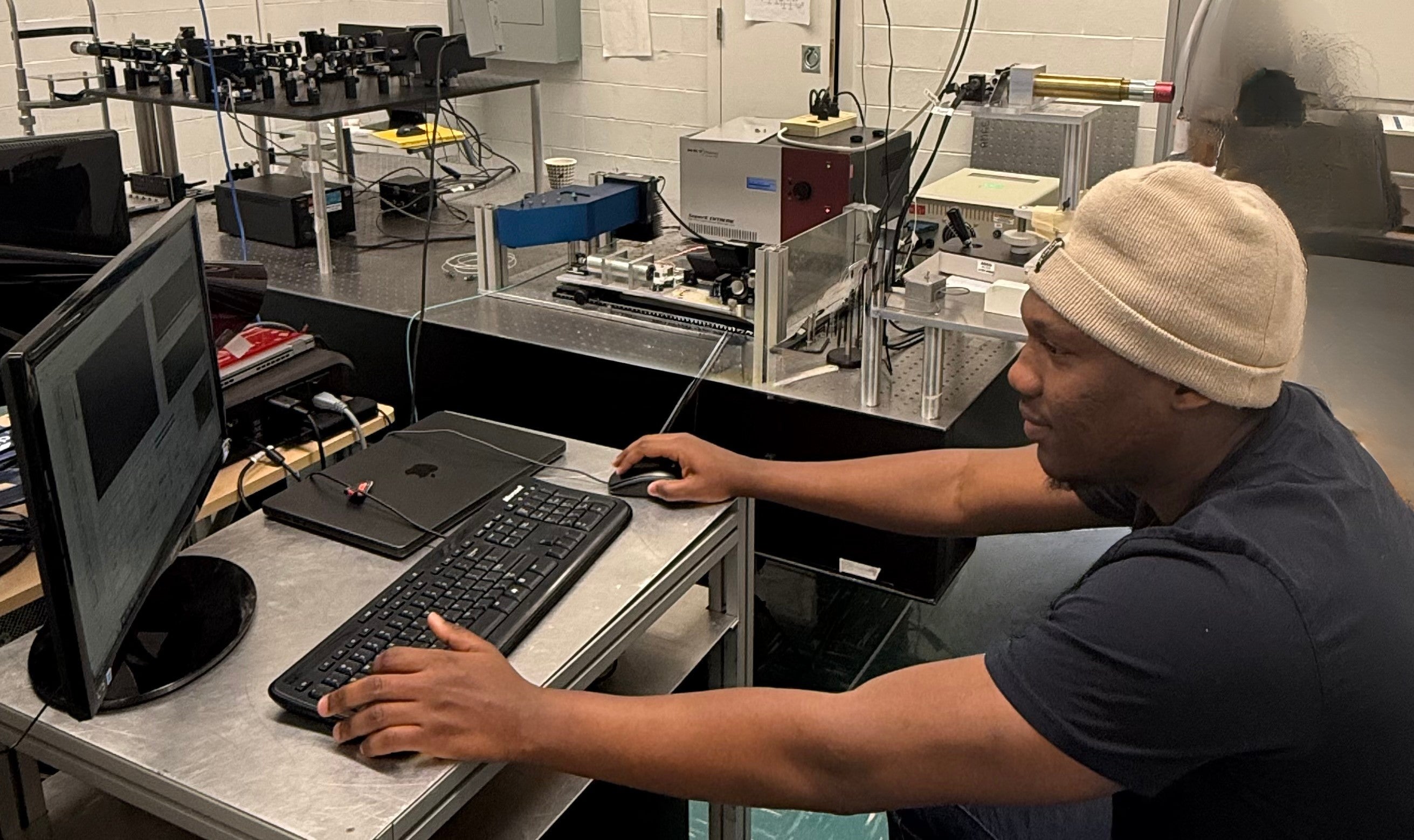
Daniel Kessie working in lab.
What impact do you see your research having in the long run?
Although OCT is already a big part of eye care, in the long run, I want our custom-built OCT systems to be used in clinics around the world to help diagnose eye diseases at very early stages. Then doctors can treat them right away, so patients won’t have to wait until later stages that are harder to treat.
OCT imaging as a whole is very objective, not subjective, so everyone can see what is happening clearly. As clinicians, we want objectivity when diagnosing patients for accurate diagnosis and the best treatment.
Do you have any insights for students interested in doing research at the School?
Initially, grad school was pretty tough because although I am a clinician and I enjoy everything about optometry, a challenge for me was understanding the physics behind the technology. I had to take a course and really take the time to learn and understand. On top of that, getting started in Canada was a big change.
I think the most important thing for research is having good supervisors. I have Dr. Kostadinka Bizheva from the Physics and Astronomy department and Dr. Alex Hui from the Centre for Ocular Research and Education (CORE). They have been amazing and very supportive, and while grad school is not that easy, your supervisors can make it a little cool for you. I really like my program, and I see the future of optometry through developing OCT.
What do you see as your next step?
Back in West Africa, research is growing, but we need even more scientists and people doing research. For example, the OCTs they use in practice are based on data from studies from North America. The metrics of the machines are based on people from America, and those same machines are used in Africa. We need more researchers to use and test these devices on African populations. People from different regions have different characteristics and genes, and so they also have different eyes as well. My interest is to become one of the researchers that bridges that gap.
I see myself becoming a professor and continuing doing research as well as working in clinic. I also want to mentor upcoming optometrists in research because we need more of them.