Dr. Denise Hileeto, who is taking early retirement, has helped create building blocks of knowledge about eye tissue, imaging and disease.
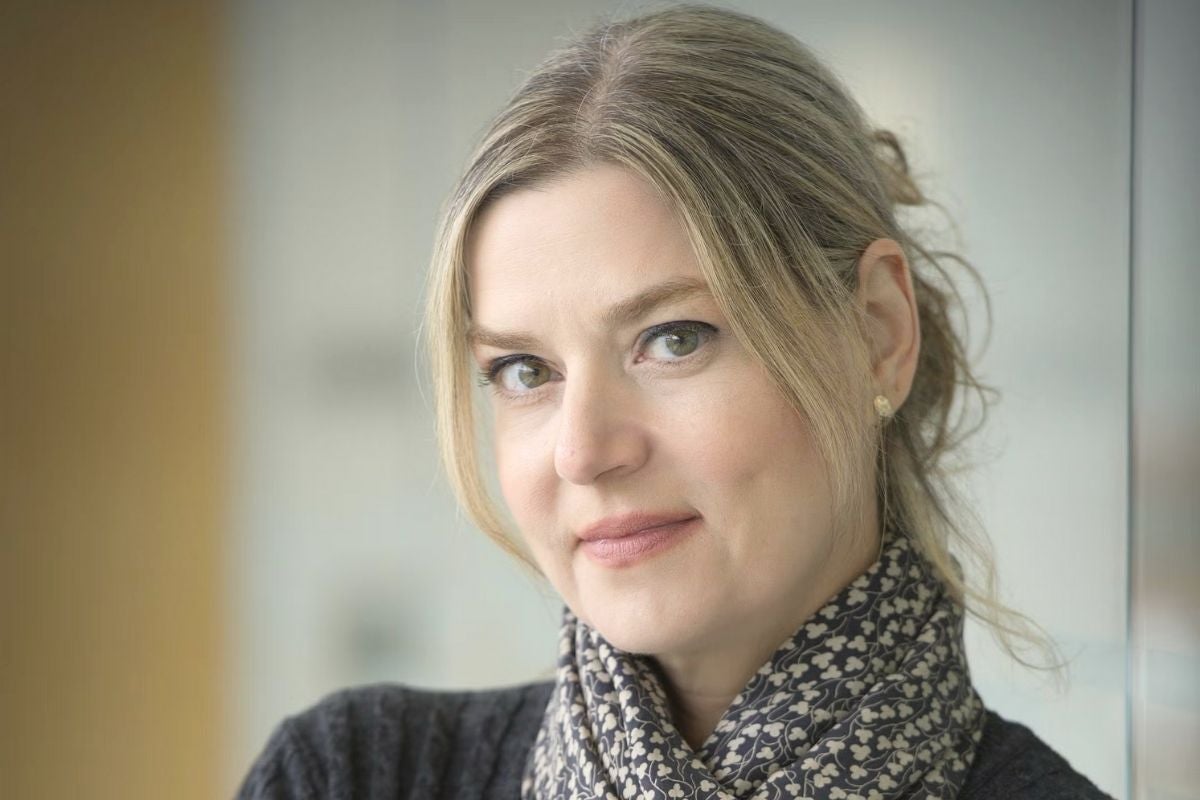
By Karen Kawawada
For Dr. Denise Hileeto, being a general pathologist was a demanding job, but fundamentally, it involved getting a tissue sample, sectioning it, staining it and examining it under a microscope to come up with a diagnosis. Most of the time, there was a single right answer. She liked that.
Becoming an ophthalmic pathologist, then a clinical associate professor at the University of Waterloo School of Optometry and Vision Science, involved more uncertainty and fewer tissue samples. Because the eye is such a small, delicate and complex organ, it generally cannot be biopsied, sectioned and examined the way larger organs can.
Hileeto, however, valued learning and flexibility over certainty. Even now, as she moves into retirement, she’ll keep learning through the research projects she’s continuing – and she’ll have to keep being flexible as she balances the needs of her elderly mother and teenage daughter and the pull of her native Europe with her longtime Canadian home.
“It was a difficult decision to retire early,” says Hileeto. “I love what I do, but I felt something had to give. I want to be there for my mom, my daughter, my students and my institution, and I only have 24 hours to do everything. I’ll miss the students terribly. We have amazing students at Waterloo. It’s been such an honour to teach them.”
A worldwide journey to becoming an eye tissue expert
When Hileeto was growing up in Bulgaria, she was fascinated by her grandfather’s medical textbooks – even though she couldn’t read them. He had studied orthopedic surgery in France, so the books were in French. This ignited a lifelong fascination with languages and medicine.
In medical school, Hileeto realized surgery wasn’t for her. What she loved was pathology – specifically, histopathology, the microscopic study of tissues. It’s often the histopathologist who makes definitive diagnoses, seeing beyond the apparent and precisely determining a diagnosis based on objective morphological evidence.
Hileeto also loved research and was eager to travel, so after medical school and an internship, she went to Western University in London, Ontario, for a master’s degree, which taught her to design studies, plan experiments, work with statistics and more. She followed that with a residency at Yale University in Connecticut, then a research fellowship at McMaster University in Hamilton.
Her next move was something of a whim. Having no personal or family commitments at the time, she was intrigued by a job posting she saw for an ophthalmic pathologist in Spain. However, there were two major obstacles: she was no expert on the eye, having received only general training on it in med school, and she didn’t speak a word of Spanish.
The University of Valladolid, however, recognized how few ophthalmic pathologists there were. The idea was to train a general pathologist to become an eye expert. Raised by an engineering professor mother, Hileeto had always valued learning, so she contacted the university to express her interest in the job despite her lack of Spanish.
To Hileeto’s surprise, the university was interested in her and was willing to hire a secretary-translator too. After a time in Washington, training with some of the world’s top ophthalmic pathologists, she began to establish herself as an expert in her own right, writing up pathology reports in English. The lab technician, however, didn’t speak English. This was a challenge at first – but it helped Hileeto learn Spanish.
A career blossoms in Waterloo
After four years in Valladolid, Hileeto spoke Spanish quite well and loved the city, university and associated hospital, but she had something new in her life to consider – a young daughter. Asking herself which country she loved most and wanted her daughter to grow up in, she decided the answer was Canada.
A job she saw posted, looking for an ophthalmic histologist to teach and do research at the University of Waterloo School of Optometry and Vision Science, sounded perfect. She did worry that a university without a medical school might not have enough access to tissue for her research, but assured this wouldn’t be the case, she moved to Waterloo in 2012.
“It turned out there are a lot of labs working with tissues and a lot of avenues where I could pursue interdisciplinary projects with people from physics, engineering and other disciplines,” says Hileeto. “I got the chance to design the tissue aspect of many collaborative experiments.”
A major focus of Hileeto’s research has been refining imaging procedures to achieve the resolution of a biopsied tissue sample without harming the living eye. With physicists, engineers and optometrists, she has researched diseases such as keratoconus and limbal stem cell deficiency, particularly focusing on improving high-resolution imaging techniques.
“What I’m most grateful for is that I was given the opportunity to be an integral part of projects that went further because of my histopathology evaluations and input,” says Hileeto. “I was able to collaborate with colleagues from other indispensable fields to advance ideas. At Waterloo, people are amazing at collaborating. I’m proud to have been part of it.”
A special community of people
At Waterloo, Hileeto taught optometry students histology, immunology and systemic disease. She had limited time to teach everything an optometrist might need to know about areas such as dermatology, neurology and cardiology, but the students consistently impressed her.
“They’re a joy to teach,” says Hileeto. “They work so hard, they put so much effort into everything, I know every word I say makes a difference. It’s amazing to see them develop from first year, where they come in with a low level of knowledge, to becoming competent clinicians. It’s a dramatic transformation in a short period of time.”
Though she won’t be teaching anymore, Hileeto isn’t stepping away entirely – she’s maintaining adjunct status and will keep working on at least three research projects with colleagues. She’s staying in Waterloo, but she’s glad she’ll have more flexibility to go back and forth to Europe, since she has family in Bulgaria and Switzerland.
She plans to stay in close touch with her Waterloo colleagues, who are her friends and support system. From the moment she arrived as a single mother of a toddler, they helped in ways such as scheduling classes after daycare drop-off. When her mother was sick and had to have a couple of operations, colleagues stepped up to cover her classes.
“It’s such a supportive community,” she says of the School. “I’ll always have it in my heart.”