
The School of Optometry and Vision Science is excited to welcome two new faculty members. Nicole Noel and Xiaoye Michael Wang bring expertise in photoreceptor biology and visual perception, adding to the breadth of research in the school and helping set the stage for the opening of the Waterloo Eye Institute in 2027.
Please join us in welcoming Noel and Wang to Waterloo!
Nicole Noel

Noel uses fish models to learn more about photoreceptor cells, the light detecting cells of the eye, and how they are formed, maintained, and ultimately break down over time. She hopes to take what she learns from these fish models to develop methods that can stop or reverse vision loss in human patients.
She is currently using a new model system called turquoise killifish. These fish develop hallmark features of aging that are also observed in humans, such as age-related vision loss and deterioration of photoreceptor cells. They also age rapidly. With a six-month life span, Noel can explore questions about aging tissues in the eye on a much shorter timeline than in longer-lived animal models.
“We don’t know much about how photoreceptor cells form or why they eventually break down in aging and disease,” says Noel. “It’s difficult to study aging in a lot of animals because they live so long. This model allows us to interrogate questions about photoreceptor cells on a much shorter timeline, which has huge potential.”
Born and raised in Fort McMurray, Alberta, Noel completed her PhD in medical genetics at the University of Alberta before travelling to University College London where she was a postdoctoral fellow and first started working with turquoise killifish. As a fish researcher, she’s excited to have access to the WATER facility here at Waterloo and the diverse fish species it houses.
Noel also looks forward to teaching an undergraduate pathophysiology course in the winter term. “I absolutely love teaching,” she says. “Watching students get excited about a concept and the process of learning and discussing new things is just so much fun and very rewarding!”
When she can get away from the lab, Noel is likely to head to the gym. She discovered a love of powerlifting during her PhD. “There’s just something about feeling your own body’s power, especially as a woman,” she says. “It’s not something that’s celebrated very often, and I find it really amazing.”
Xiaoye Michael Wang
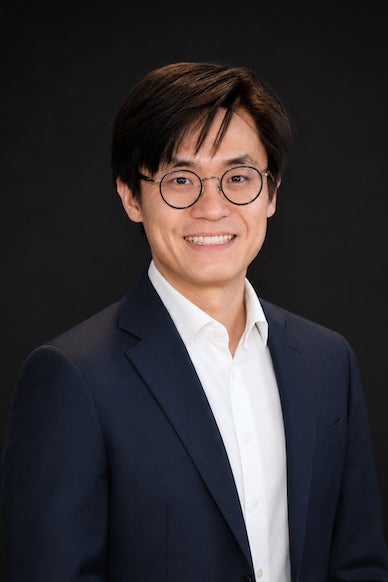
Wang is interested in how we perceive and interact with the world, and his research focuses on 3D visual perception and motor control. Using virtual reality as a tool, he examines fundamental problems in perception and action and explores how these insights can help people learn new skills and improve performance.
His path into this research wound through many different disciplines. After completing a degree in psychology and philosophy, Wang went on to study questions related to vision from an empirical perspective through a PhD in experimental psychology and cognitive science at Indiana University. He has also held postdoctoral fellowships at York University in the Centre for Vision Research and at the University of Toronto in the Faculty of Kinesiology and Physical Education.
Wang’s research examines how people perceive and act in immersive virtual environments and explores how virtual interactions can be designed around the capabilities and constraints of different immersive systems. For instance, he has developed a VR application that simulates chemical engineering unit operations laboratory training, providing students with an immersive environment in which to learn and practise laboratory procedures. He has also worked with motion capture and machine learning to track sports performance for the Toronto Raptors.
Most recently, he has developed a computational solution to address the convergence and accommodation issues inherent in current virtual reality head-mounted displays. He’s eager to continue this research at Waterloo.
“I’m excited to be working with Austin Roorda and Lisa Christian to further develop this project,” says Wang. “Working alongside an optical engineer and an optometrist will allow me to take these ideas further. This kind of interdisciplinary collaboration is very rewarding!”
Wang is helping students follow in his footsteps. “Things are changing rapidly, especially now with tools like AI,” says Wang. “For students to be successful, they can’t be confined to a single discipline. I help them develop transferable skills that they can apply to different contexts in the job market.”
Outside of academia, Wang and his wife, Emily Gong, are co-founders of the Asian Arts and Culture Trust (AACT), which promotes Asian arts and culture in Canada. ACCT has worked with many artists and community partners, including the Toronto International Film Festival (TIFF), helping to bring Asian Canadian stories and experiences to broader audiences.
When he can find some spare time, Wang loves to cook and host dinner parties for family and friends. He even used to have his own YouTube cooking channel!