How Sophia Detillieux leads an initiative of acceptance and awareness at the School of Optometry and Vision Science
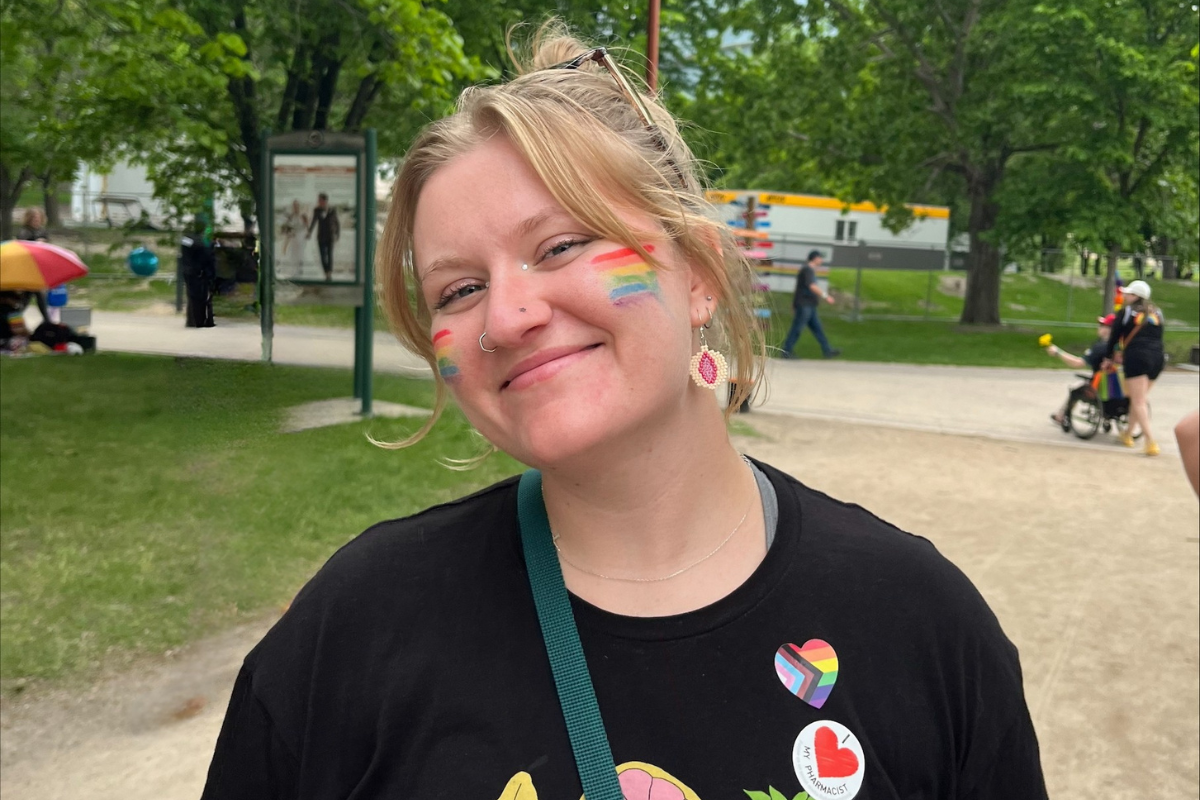
By Ameera Khan
Founder and president of UWaterloo Queer Eye, Sophia Detillieux just finished her first year at the University of Waterloo School of Optometry and Vision Science. Not only did Sophia work through rigorous first year courses, but she also decided that it was time for the school to have a society in support of LGBTQ+ optometry students, optometrists, and patients alike. Here is the story of how UWaterloo Queer Eye was created.
What led you to found UWaterloo Queer Eye?
I did my undergraduate degree at the University of Manitoba, where I was also a part of a community outreach program called WISE Kid-Netic Energy. As a student instructor, I taught over 20 eyeball dissections and this experience really drove me towards starting to shadow my optometrist and eventually apply to optometry school. Similarly, I was also a classroom leader at a kids’ camp run by the University of Manitoba that allowed me to work with young kids and exposed me to many experiences that really taught me how important queer advocacy is.
An instance of this includes when we had a camper who was around seven years old and went by all pronouns. Due to the fact they were more feminine presenting, the rest of the campers and staff never really took the time to consider their gender fluidity. It was very important to me that this camper felt seen and listened to, so not only did I respect their pronouns, but I took the pins staff wore for pronouns, like she/her, he/him, they/them, and offered all three to the camper.
Similarly, I had an experience with a set of twins who went by they/them. I always made the effort to use their preferred pronouns and escort them to the only gender-neutral washroom, which was on the other side of the building. This experience also taught me why advocacy is so important to me. I was younger, more timid, and didn’t want to ruffle any feathers, so when my coworkers kept forgetting to use their correct pronouns, I did not get the opportunity to have a discussion with them about why that can be hurtful. This really taught me that I value advocacy for students, and now I hope to always be the voice of acceptance.
I carry these lessons with me, so when I saw that two of the other optometry schools I applied to in the USA had queer societies and the Waterloo School of Optometry and Vision Science didn’t, I decided to create one. I joined the University of Waterloo Optometry Student Society, UWOSS, and connected with Dr. Shamrozé (Zay) Khan to start the club. After creating a club constitution, we had a movie night in January 2025, then a bake sale in February where we were able to donate $150 to Waterloo Spectrum, Waterloo Region's first-ever rainbow community space.

UWaterloo Queer Eye's first Valentine's Day bake sale
How do you envision the future of UWaterloo Queer Eye?
As of right now, we are a community that aims to provide a safe space for queer students. Beyond that, we have two long-term goals I hope to see in effect. Our first goal is to promote inclusive healthcare for patients. This can be through small changes like a sticker in the window or electronic medical systems (EMRs) that allow patients to indicate their preferred name and pronouns, to larger-scale initiatives that promote more queer and trans-accepting optometry clinics. This would also include hosting workshops and talks that would educate optometrists and optometry students who may lack the knowledge of how to approach trans and queer patients so that they don’t go into practice unprepared.
Another primary goal for us is to promote the identity of queer optometrists. Instagram accounts like @pride_ods have already engaged with our social media and have shown their support. We would like to play our part in these societies. This could also go into having optical staff like receptionists and opticians promoting optometry offices as queer-accepting spaces.
Already, we’ve seen support from optometrists who share how they would have liked to have been a part of UWaterloo QueerEye when they were at the School. There was even a study here at the University of Waterloo that explored Access to Primary Eye Care among Transmasculine Individuals in Canada and the researchers, Dr. Molly Brawdy and Dr. Ethan Wohlgemuth, expressed interest in UWaterloo Queer Eye.
What does LGBTQ+ / Queer visibility in optometry look like for you?
We need more inclusiveness in healthcare as a whole, but also in optometry. The biggest difference can be made by how our EMRs are formatted, ensuring preferred names are used more than legal names, etc. I’ve been working at the same clinic in Winnipeg since 2021, where we have had patients express their interest in sharing their preferred names and pronouns, and yet our system does not yet have these features. Similarly, health cards don’t represent expressed gender, so you have to go through a lengthy process to get your gender marker legally changed and even UWaterloo QueerEye members have expressed that, as patients, they are often misgendered.
Ultimately, we want patients to feel more comfortable, and in a field like optometry, where biological sex is not as relevant outside of the exam room as it may be in other medical fields, we can make the effort to make sure all our patients feel seen and respected.
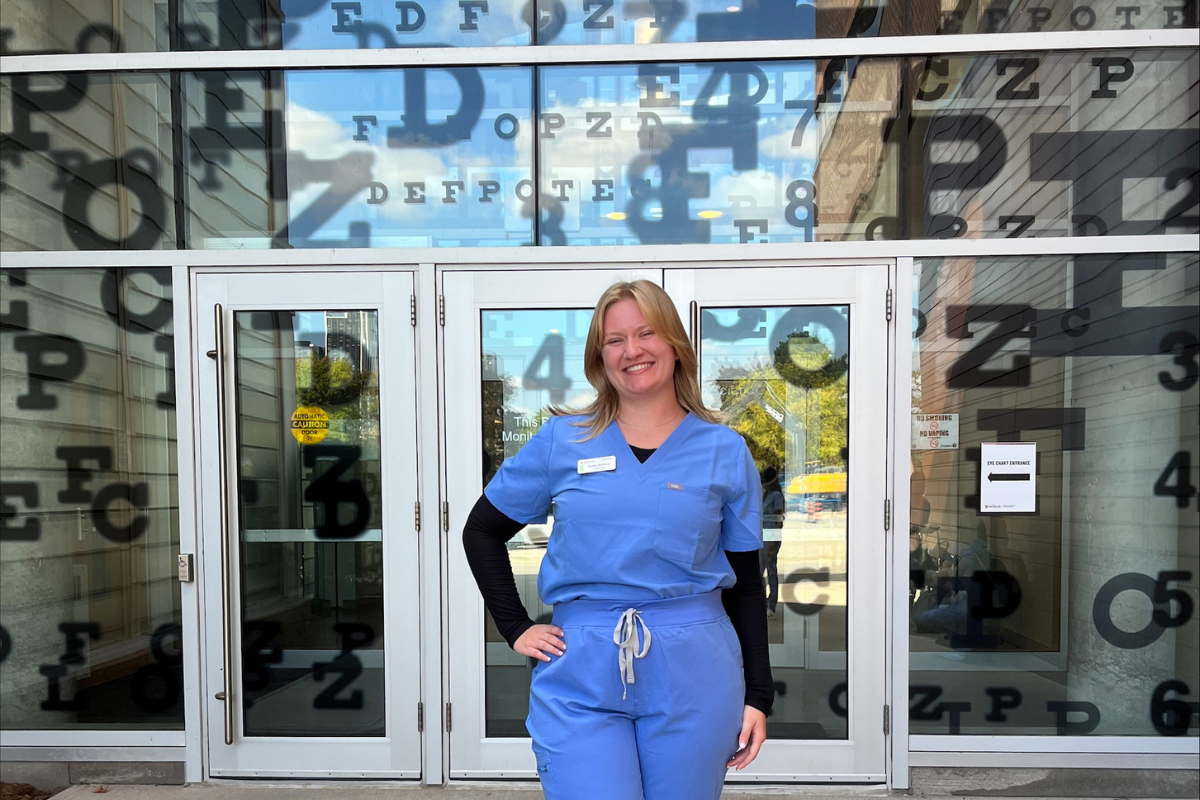
Sophia Detillieux at the eye chart doors outside of UWaterloo Optometry
What advice would you give to students hoping to follow your path?
It may sound cliché, but you really do have to believe in yourself. I myself did not get into the School when I first applied. While some in our class did extremely well in undergrad, others like me had to retake classes or rewrite the OAT (Optometry Admission Test). In those times, it's easy to feel like it’s impossible but it’s not. Believe in yourself.
Just having completed first year, I have seen how it can be very busy with multiple intense classes and labs, but it’s nice that everyone’s in the same classes. We really are all in it together.
As a future queer optometrist, I feel very lucky to be a queer woman in a professional field. Something I hope to do as president of UWaeterloo Queer Eye and as an optometrist is to be an advocate for queer voices that can't be heard. Not only do I want to create an inclusive space, which is so important, but I especially want to be able to advocate for queer inclusion in healthcare!