News

Filter by:

Limit to news where the title matches:
Limit to items where the date of the news item:
Date range
Limit to news items where the audience is one or more of:

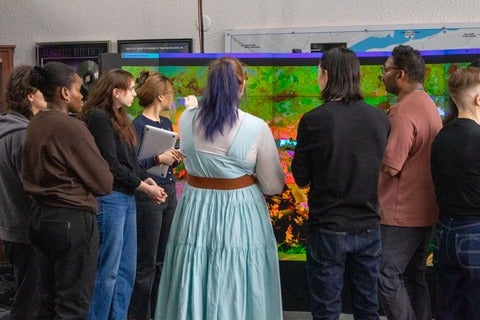
Three student-designed installations will be featured within Destination Stratford’s Welcome Centre.

46 students from the course “GBDA 412 – Special Topics in Digital Culture” were challenged to create large-scale interactive media art pieces for the Lights On festival, inspired by the Thirteen Grandmother Moons stories, an Indigenous knowledge tradition. Students drew inspiration from this tradition to create installations that explore light as a symbol of knowledge, community, and continuity.

Monday, November 24, 2025

Extending the boundaries of education

Dr. Ville Mäkelä and colleagues at Waterloo’s Stratford School of Interaction Design and Business are redefining education through Canada’s first large-scale VR-based 3D design course. Using tools like Gravity Sketch and immersive headsets, their innovative approach blends creativity and technology, preparing students for the future of digital design. This initiative sets new standards for interactive learning and showcases Waterloo’s leadership in VR education.

100 years after The Great Gatsby, GBDA alum Kristen Fajardo releases a speculative, queer cyberpunk reimagining of the American classic. Her background in UX and the tech industry shaped both the novel’s content and the entrepreneurial strategies behind its launch.

Congratulations to Dr. Noorin Manji for receiving the Arts Award for Excellence in Teaching! Dean Alexie Tcheuyap and the Arts Honours and Awards committee are pleased to announce the results of the 2025 Arts Awards for Excellence in Service, Teaching, and Research. The awards recognize outstanding contributions from faculty and staff, with Dr. Manji being honored for her exemplary teaching over the past five years. The awards will be presented this Fall at the annual Celebration of Arts event.

Researchers at the Stratford School of Interaction Design and Business challenge the belief that Virtual Reality (VR) inherently fosters perspective-taking in their article, “Seeing Is Not Thinking: Testing capabilities of VR to Promote Perspective-Taking.” They argue that VR's potential as an "empathy machine" relies on intentional design that promotes active cognitive engagement. Through experiments, they found that perspective-taking is enhanced when users are prompted with specific tasks, encouraging them to consider the character's viewpoint. This study, which received the Best Paper Award at IEEE VR, underscores the importance of purposeful VR design to effectively harness its empathetic capabilities.

Professors Karen Cochrane and Daniel Harley from Stratford are using Generative AI (GenAI) to create customizable gaming controllers for individuals with complex disabilities. Dr. Cochrane's collaboration with caregivers plays a crucial role in designing these accessible solutions, ensuring they meet the unique needs of users. Their project, awarded by the Google Academic Research Awards (GARA), aims to enhance accessibility and social inclusion through low-cost, user-friendly technology. By leveraging their combined expertise in physical computing and gaming interaction, Dr. Harley and Dr. Cochrane are developing innovative solutions that improve the quality of life for people with disabilities. The project will receive up to $150,000 USD in funding and support from Google, highlighting a future where technology fosters a more inclusive gaming experience.

In their paper, The Great AI Witch Hunt: Reviewers’ Perception and (Mis)Conception of Generative AI in Research Writing, researchers at the Stratford School studied the impact of AI-augmented writing on peer reviews, a formal part of academic research validation. The researchers found that AI-augmented writing improved readability, language diversity, and informativeness; it also often lacked research details and reflective insights from authors in their samples of writing from top-tier Human-Computer Interaction (HCI) conferences. 

Dr. Kim de Laat’s article “Remote Work and Post-Bureaucracy: Unintended Consequences of Work Design for Gender Inequality” wasselected as a nominee for the 2024 Rosabeth Moss Kanter Award for Research Excellence in Work and Family.