Welcome from our Executive Director
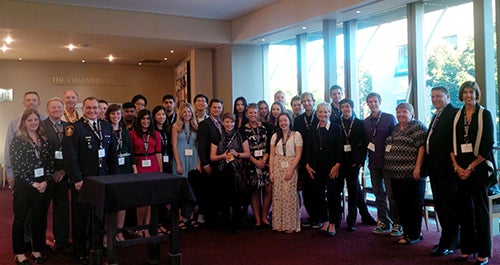
Ginny Dybenko and UWaterloo Stratford Campus Students at the Town and Gown reception.
We have already experienced substantial success here in Stratford. From a standing start just three years ago, we were pleased to welcome 350 students to classes in Stratford this past September.
Our Master's graduates from past years are enjoying outstanding success finding employment in digital industries here, and around the world. The University of Waterloo is more than a world-class institution for innovation and learning. It has a rich history of being connected and contributing to make its communities better places. Over the past five years, we have lead signature events and programs that we hope have strengthened relationships between the university, the City of Stratford and beyond.
As we develop future research and academic programs, it is important to us, in addition to responding to global employment opportunities, that we respond to the specific needs of the community - viewing Stratford and area residents as co-researchers and partners in the pursuit of knowledge.
To that end, we have recently introduced a leading edge 'Living Lab' research concept at our campus. In November, the University of Waterloo Faculties of Environment, Applied Health Sciences, and Arts conducted a planning session with many community leaders. The objective was to uncover pressing challenges in the community that we may be able to help address with academic research. We've named this initiative Community Health Environment Communications (CHEC). It's too early to draw any conclusions from the discussions as yet, however we’ll be sure to keep you up to date on future activities. (See article)
We hope that you feel that the University of Waterloo presence in the community has been a positive one to date and we look forward to a long and productive future together.
If you haven't yet been by our campus, please drop in. If you're receiving this newsletter, you're already on "our list" so keep an eye open for the many community events hosted here – we'd be pleased to welcome you.
All the best.
Ginny Dybenko
Executive Director, University of Waterloo Stratford Campus
Back to top
Campus news
From the classroom to the community
This year, as part of Principles of Marketing in a Globalized World students in the Master of Digital Experience Innovation (MDEI) program provided input on existing Social Media Marketing Plans (SMMP) for 5 local organizations; the City of Stratford, the Stratford Festival, the Stratford Tourism Alliance, Seed Co. (Stratford Economic Development), and the University of Waterloo Stratford Campus.
The project, conceived by instructor Kathleen Rodenburg, saw the classroom transformed into a virtual 'company' with students acting as employees who provided consultancy services for their appointed organization. Expectations were consistent with a typical work environment – students were responsible for conducting professional meetings, providing updates and reports, and presenting final recommendations.
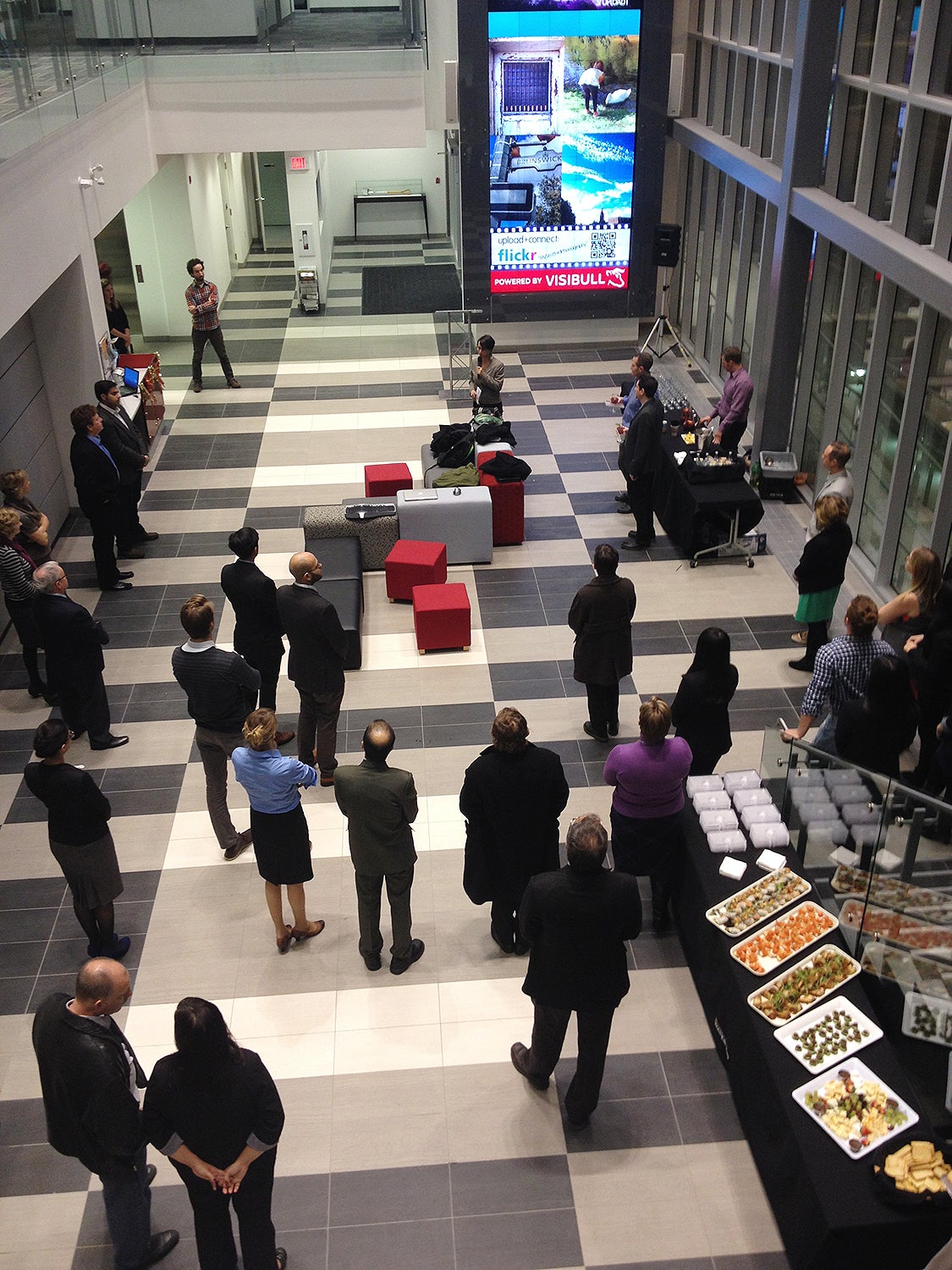
MDEI students viewing content on the MicroTiles wall after presenting their projects to clients.
The process gave students the chance to apply principles and best practices they learned throughout the course. "Marketing is a process and by applying that process, students were able to build recommendations based on strategic thought and planning," Robenburg explains. "They had to ensure they defined goals and objectives, identified target audiences, addressed key stakeholders, identified required resources, and provided recommendations for key messages and content."
For Michelle Fujita, a student partnered with the Stratford Tourism Alliance, it was an opportunity to learn about engaging with clients, and develop workable solutions. "Working with a partner gave us a better understanding of how consulting is done in a professional environment," she explains. "It was great working on a real project and coming up with ideas that we could actually see implemented in the future."
Her teammate, Faizan Agha, who hails from Pakistan and has most recently lived in Germany, enjoyed how the project gave new perspectives on local business practices: "I got the chance to better understand the Canadian tourism industry and about the local model of tourism," he explains.
For employers, it provided a fresh perspective, and dedicated support for a specific strategic priority – an opportunity that is often lost as routine tasks and more urgent issues inevitably fill each day. Students were able to focus their energies on an area of need and provide recommendations based on current best practices that they learned in class.
Back to top
Embarking on internships

A key area of strength for the University of Waterloo is experiential education – it's an integral part of how all students learn and a key focus of the university's Strategic Plan. For students in GBDA, that means completing major projects, and an internship between their third and fourth year.
"The one-time, paid internship required for all GBDA students helps to connect academic and professional work." explains Susan Cole, Internship and Experiential Learning Manager. "Students can fine-tune their career goals, and become more competitive in the job market as they engage with professionals and gain hands-on experience."
Sravanthi Dornadula will be headed to Seattle where she will be applying her skills as a User Experience (UX) Design intern for Amazon. "I'll be engaged in UX fundamentals like ideation, sketching, usability testing, and wireframing, and will also have the chance to conceive, design and develop creative advertising for cross-platform campaigns," she explains. Working for the retail giant is appealing on its own, however Sravanthi is also excited about the opportunity to see how design is approached in a dynamic, multidisciplinary environment.
Managing the placement of 60+ students is no small feat. To date 38 positions have been posted, 312 applications have been submitted, and 25 students have job offers from companies including Amazon, Havas Worldwide, Christie® Digital and The Source. Over the next few months, students will continue to be placed as organizations enter their spring recruitment cycle. It’s a massive effort, but one that will reap valuable rewards for students and employees alike.
If you think that your organization would benefit from the talents of our GBDA students please contact Susan Cole for more information.
Back to top
Sounds of the city
Jessica Thompson, Assistant Professor in Hybrid Practice at the University of Waterloo, describes her artistic practice investigating spatial and social conditions within urban environments through interactive artworks situated at the intersection of sound, performance and mobile technologies.
I teach in both the Department of Fine Art and at the Stratford Campus. Prior to joining the University of Waterloo, I taught Sound Design and Foundation Studies at Brock University and Sound Art at the University at Buffalo.
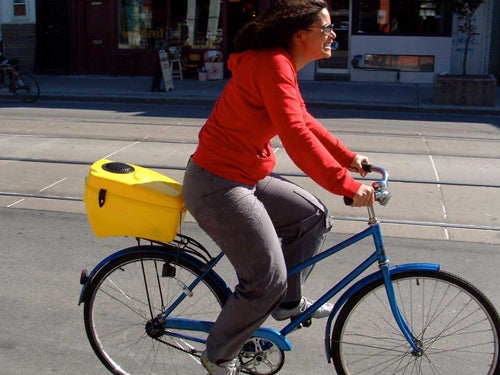
My approach to both sound and media is greatly informed by my experience of walking in urban environments. I consider walking to be a form of personal and spatial encoding. I began working with sound and technology simultaneously out of a desire to articulate the immediacy of walking while carving out a sense of place within the acoustic ecology of the city. My pieces often start with an impulse to express or modify this experience and will often draw from a simple gesture, such as taking a step, drawing a line, swinging a suitcase or pedaling a bike. My current research investigates the ways that sound reveals spatial and social conditions within cities and how these conditions may be articulated through networked performance.
Most of my early successes were due to the skills that I developed during my art degree – I've always liked writing (I've written in journals since I was 14), and writing about art meant that I learned to communicate abstract ideas clearly, and for a variety of audiences. Most of all, being forced to constantly create, present, analyze and critique meant that I became really good at figuring out solutions to a variety of design, logistical and production challenges. Because my interactive sound projects rely entirely on user participation, I am always dealing with how my ideas will work when they are in the hands of ordinary people.
This experience often finds its way into the classroom – students are required to write as well as make, produce status reports and post mortem reports for larger projects, and my course assignments enable students to develop creative problem solving skills through innovative approaches to the subject matter. In a highly competitive landscape where almost all job candidates list things like 'video and audio production' on their resumes, my hope these projects will help students to stand apart from their peers, and help them to apply their skills and experience to a variety of creative careers, and to bring creativity to a variety of industries.
For more details, see Jessica's complete Faculty profile.
Back to top
Gaining a global perspective
With "Global" in the name, it's no surprise that many Global Business and Digital Arts (GBDA) students have their sights set on an international exchange as a key part of their university experience.
For the first time, GBDA students have dispersed across the globe – for the next four to five months, countries like England, Spain, Singapore, Germany, Sweden and the Netherlands will be home. Approximately 30% of third year students are participating in an exchange, a rate that is virtually unprecedented for a single program.
For others like Kevin Snider, this is the first time embarking on an overseas adventure. Studying at the University of Leeds in England, he will take classes including typography, social media for entrepreneurs, and the economics of innovation. The thing he's most excited about? "I'll be one of the first in my family to travel to Europe," Kevin explains. "I'm excited about figuring things out on my own and meeting people from around the world."
GBDA students may participate in a one-term exchange at the end of third year, or beginning of fourth year. While exchanges are optional, it is something that Christine McWebb, Director of Academic Programs, actively encourages. "It supports the broader university mandate to make Waterloo one of the most internationalized universities in Canada," she states. "It is also ensures that our students have skills that are relevant in the global economy – digital media is affecting business practices around the world, and we want to ensure our graduates are prepared for that reality."
For now, students are simply getting settled, meeting new friends and becoming familiar with their surroundings. The most pressing issue on their mind? Kevin jokes, "Not getting lost."
Back to top
Campus initiatives
Inspiring future entrepreneurs

If you visit the Stratford Campus on a Tuesday night, you might see a group of high school students busily working to develop the next big business idea.
They are part of the Junior Achievement Company program, a division of the London and District Junior Achievement organization. Now in its fifth year, the program has 29 registered students and has expanded to two companies supervised by eight community business mentors.
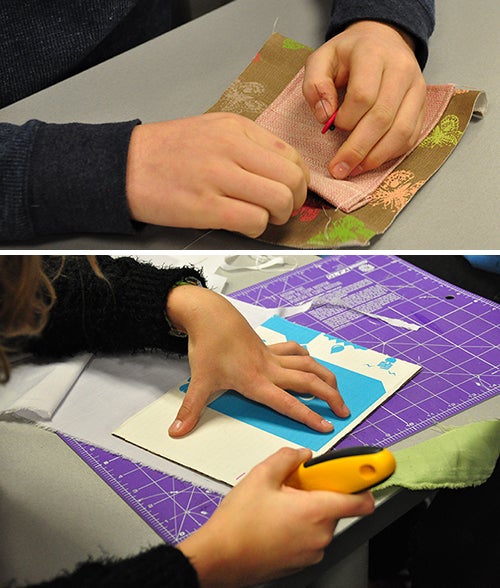
The Stratford Campus is their home base, and provides physical space, and a supportive culture that celebrates innovation and entrepreneurship. "The facilities are outstanding and provide the students with a first-class learning environment" states Jeff Carruthers, President of Cavalier Equestrian Inc., and Mentor for the Stratford program. "The university personnel have been enthusiastic supporters of Junior Achievement."
In 2012/2013, their company launched the "T-Bag" – a backpack made of recycled t-shirts. The idea proved to be a winner as they captured the title for company of the year against 14 other teams. This year, teams have launched Sew Cool, a line of multi-purpose pencil cases, and Body Bliss, a selection of high quality, all-natural skin care products.
It's a program that inspires young minds and expands their business outlook. As Carruthers explains "The program builds leaders and entrepreneurs for today and the future."
For more information on Junior Achievement and to get involved see the London and District Junior Achievement website.
Back to top
Building healthy communities
An exciting new development is underway that promises to complement the great work taking place at the Stratford Campus and surrounding community. The CHEC (Community-Health-Environment-Communications) Initiative involves the University of Waterloo’s Faculties of Environment, Applied Health Sciences, and Arts, in collaboration with the Stratford Campus and local community. CHEC's mandate is to work with communities to identify opportunities for developing and enhancing health, equity, and sustainability within a globally networked digital era. CHEC will achieve this by integrating diverse skills and perspectives and fostering coordination across domains of research and practice that may not typically work together to address common challenges.
This past November, the CHEC Initiative held a very successful Community Stakeholder Workshop at the Stratford Campus that brought together 50 community leaders from public, private and not-for-profit sectors active in a variety of fields (e.g. public health, economic development, communication technologies, environmental management, social services, etc.). Participants explored:
- Key concerns facing Stratford and surrounding region;
- Community strengths and assets;
- How CHEC might address information needs and contribute to local project initiatives;
- Opportunities for collaboration.
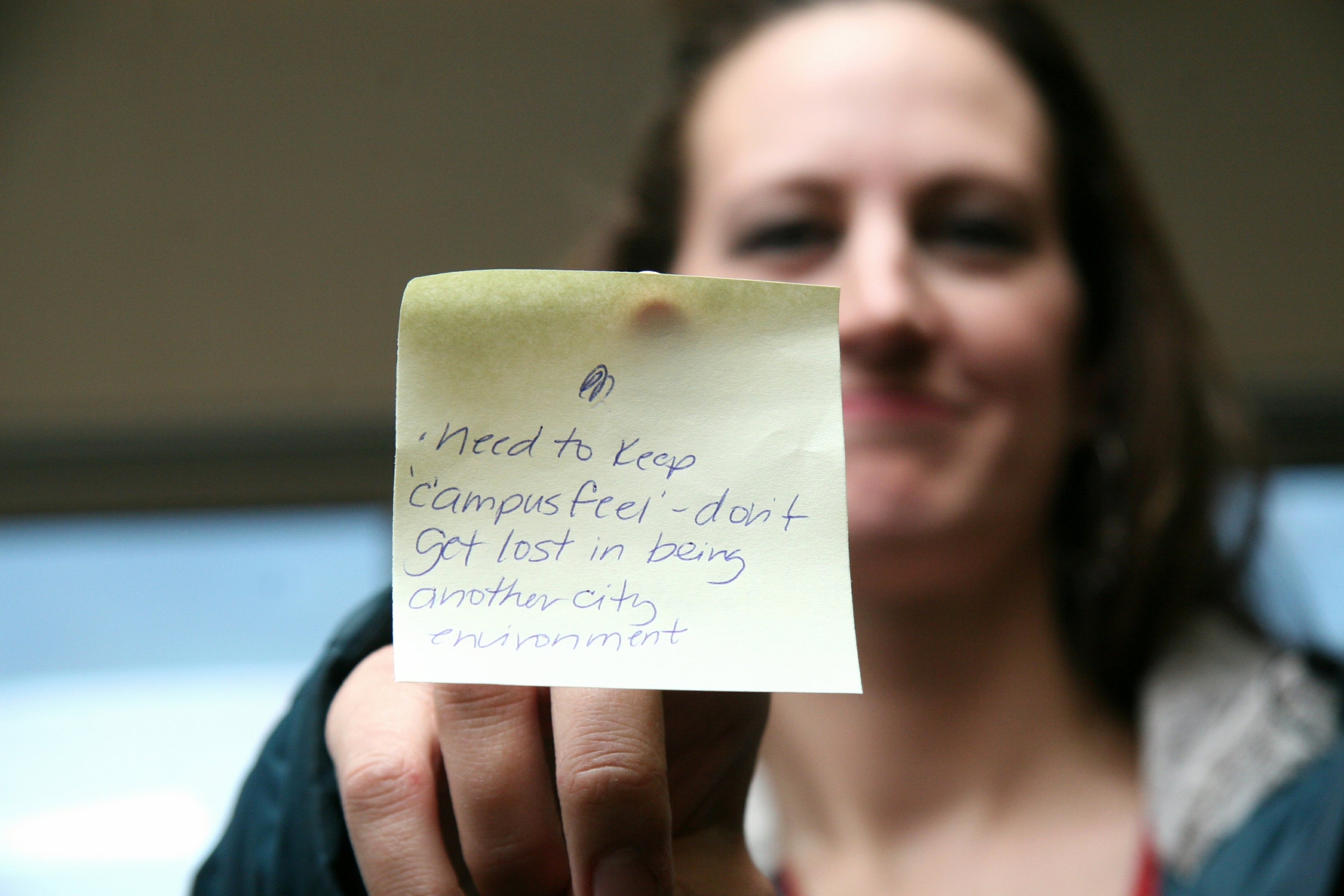
CHEC has also brought The School of Planning and The Center for Community Mapping together with Stratford students to improve the experience and uptake of a digital mobile app called Building Stories. Building Stories is a crowd-sourced platform that enables users to provide and access information about points of interest with cultural significance. Documents, photos, narratives and videos can be uploaded to facilitate and augment self-guided tours. The students will be involved in tourism marketing research and improving the digital storytelling experience to make it easier for visitors to Stratford to discover the meaningful treasures of the community.
The energy, ideas and connections inspired throughout the Community Stakeholder Workshop are strengthening many of CHEC's research initiatives, and will continue to guide CHEC as it expands its breadth of activity into the future. Many organizations have expressed their desire to be a part of CHEC's relationship-building process with researchers at the University of Waterloo to collaboratively address priority concerns. Projects are underway along various avenues. For instance, one initiative is focusing on improving community-wide management and use of data in "real-time" to better measure food insecurity and the effectiveness of innovative community-based interventions. Another is focusing on the collaborative governance of transportation reform. This includes overcoming the challenges of integrating active transportation (e.g. walking, cycling) into conventional networks built for private automobile use. This study is also examining how equitably risks and benefits associated with transportation reform are being distributed amongst citizens across communities.
The CHEC Initiative seeks to enhance connections between Stratford and the University of Waterloo more broadly, and to position Stratford as a leading hub in facilitating the globally shared need for healthier and more sustainable communities in a digital era. For more information please contact Dr. Sara Edge, CHEC's Director of Research and Programming at ssedge@uwaterloo.ca, (519) 888-4567 x. 23015.
Back to top
Stratford Campus hosts the Rotaract Club of Stratford
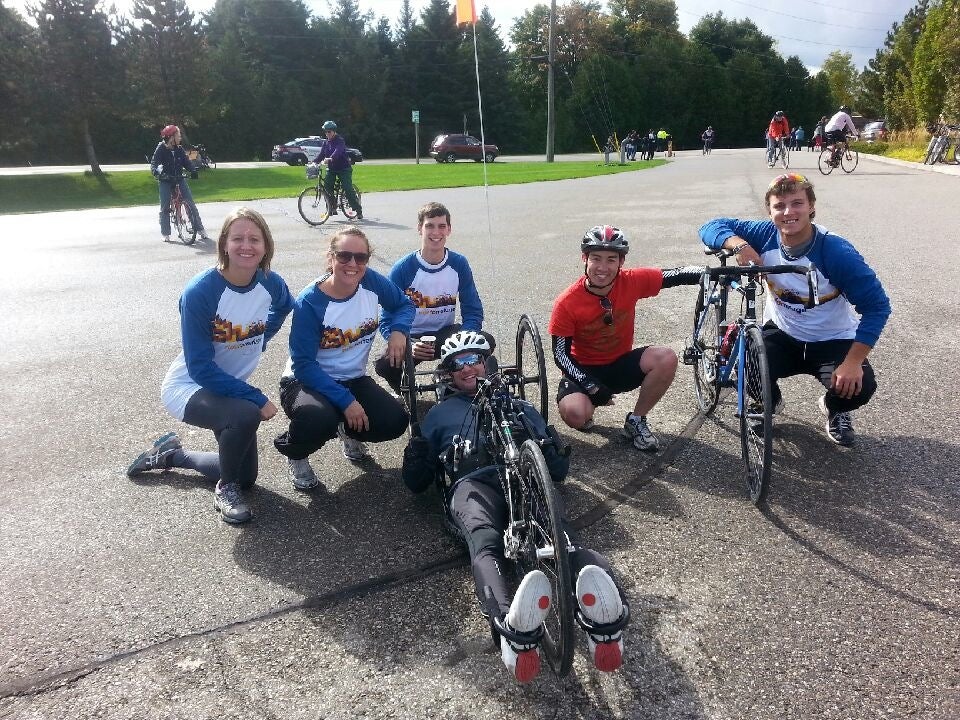
The Rotaract Club of Stratford launched in 2013 and consists of young leaders ages 18 to 30 who live and work in the surrounding community. The club is one of more than 8,400 Rotary-sponsored entities in 170 countries and regions world-wide, making it one of the fastest growing service programs.
Stratford Club President Amanda Hansford explains that the local chapter provides members with the opportunity to strengthen their ties and networks in the community by volunteering their time to causes and initiatives that are important to them.
Rotaract Club of Stratford.
The local group meets at the Stratford Campus twice a month. The group looks for different ways to make an impact in the community and organizes a variety of fundraising initiatives. Among other things, they have organized a monthly trivia night at Molly Bloom's with proceeds distributed to various charities – to date they have raised more than $1,000.
To learn more about the Rotaract Club of Stratford please visit their website.
Back to top
Community connections
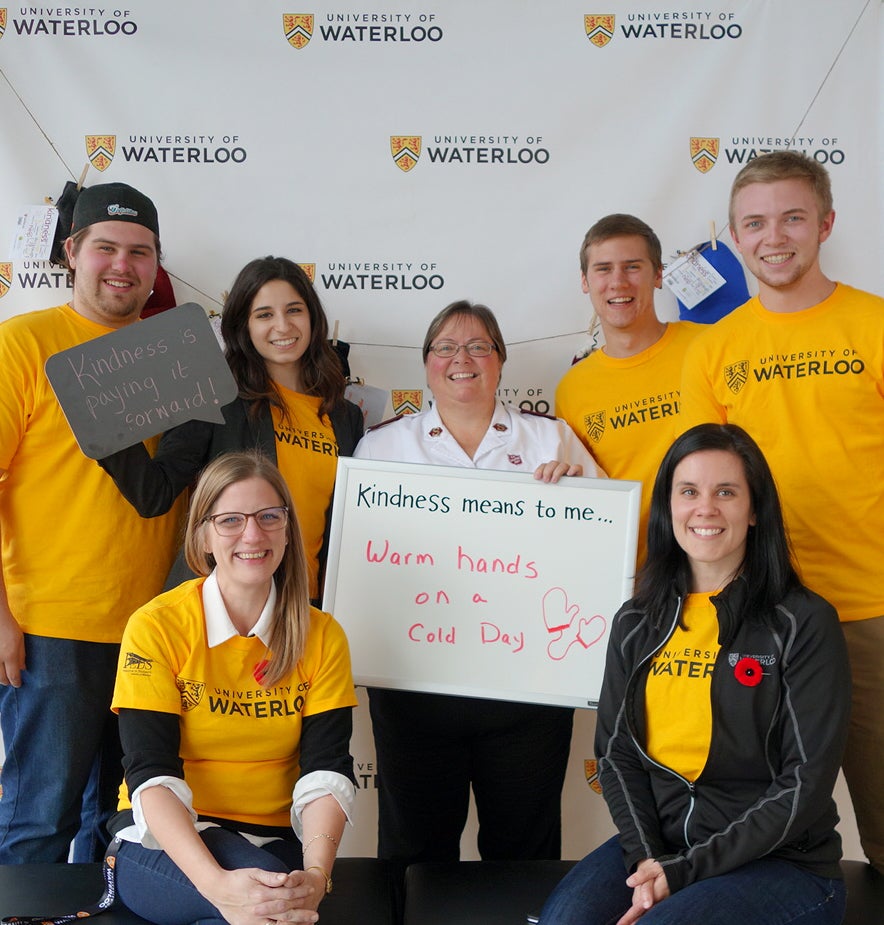 A little kindness goes a long way
On November 7, 2014 the Stratford Campus hosted a very successful Random Acts of Kindness Day event. Students, faculty and staff, dubbed the "Kindness Krew," collected warm winter accessories for distribution to local charities. Throughout the day individuals and local businesses dropped off hats, scarves, mittens, socks and other goods that will benefit local families in the area. A whopping 500 items were collected, far surpassing the original goal of 100.
Items collected were given to local charities such as the Salvation Army.
Partners including the Stratford Perth Community Foundation, the Stratford Accelerator Centre®, the GBDA Student Society and the Stratford Campus were on hand to welcome guests, serve goodies, and pose for photos in the "insta-thanks" photo booth. Check out Storify to see how the whole day unfolded.
Back to top
Hour of Code comes to Stratford
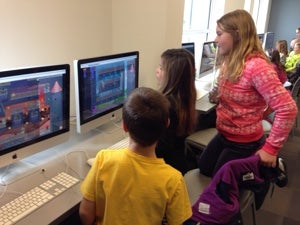
Students from Stratford Bedford Public School wrote their first lines of computer programming code at the Stratford Campus with support from the Stratford Accelerator Centre®.
Joining millions of people worldwide and their peers locally from 25 different schools within the Avon-Maitland District School Board, Bedford students used Tynker, one of the many online learning platforms available at www.code.org to make a dragon "dash" across the screen.
Stratford Bedford Public School students in the computer lab.
According to Bedford Vice-Principal Charles Longston, "through the Hour of Code program we can demystify computer science and show kids early on that anyone can master the ability to code. By exposing our kids to these essential skills at an early age, we will open more doors to future science, technology, engineering and mathematics academic and career paths."
During their stay at the campus the students were also introduced to computer science careers and entrepreneurship via a video tutorial, and toured the Engage Lab where they were able to use Oculus Rift headsets and other technologies.
"In an era where technology is often taken for granted, it was inspiring to watch the awe and excitement in the students," says Joani Gerber, Director, Operations at the Stratford Accelerator Centre. "I was so pleased to join my colleagues at the University of Waterloo to help lead our local participation in the Hour of Code movement, providing our Stratford area students with exposure to the benefits of computer science, higher learning, and entrepreneurship." It's a new crop of digital media experts in the making!
For more information see the Hour of Code blog.
Back to top