Why Chemical Engineering?
The department administers a Bachelor of Applied Science (BASc) degree program.
Chemical engineering is applying principles of math, physics, and chemistry to re-engineer products the world relies on. Chemical engineers create global solutions to a wide range of industrial, environmental, and societal problems in safe, sustainable, and energy-efficient ways. Whether you’re creating the next generation of life-saving pharmaceuticals, cybernetic systems, or alternative energy, as a chemical engineer you’ll be contributing to the betterment of society.
Waterloo's chemical engineering program lets you explore emerging areas like biotechnology, advanced materials, novel recycling techniques, biomedical applications, zero-emissions technologies, and more. With experience gained through co-op work placements, you'll see the practical side of theories discussed in classes. And, through undergraduate student exchange programs, you have the opportunity to learn about new cultures and gain valuable experience internationally.

Why study Chemical Engineering at the University of Waterloo?
- Our curriculum is highly relevant to industry, with flexibility so you can specialize in areas of interest.
- Smallest class sizes of all the engineering programs, you will experience individualized support from your instructors and a tight-knit community.
- A large faculty complement includes nine Research Chairs, with a wide variety of expertise. See our research areas for an overview.
- Access to Chemical Engineering experts for career suggestions, research experience or guidance during senior-level design projects.
- Paid co-op work experience in a wide variety of Chemical Engineering-related jobs.
- Our IP policy: Students own what they invent at the University of Waterloo, making it an entrepreneurial ecosystem. Here support is available to commercialize innovations and nurture new start-ups.
Enjoy working with computers?
Did you know that a branch of chemical engineering uses AI machine learning, simulations, and automation? Our department has a research theme called Process Systems Engineering—a field where researchers leverage computational tools to design, optimize and control advanced processes.
If this is an area of study you want to delve into, you can choose the Chemical Process Modeling, Optimization, and Control specialization to address complex problems and innovate for a better world.
Interested in other specializations available for chemical engineering students?
Specialization offerings are unique to your engineering program and are listed on your diploma. Specializations that are available to Chemical Engineering students include:
Sample first-year courses
This is a sample schedule. Courses are subject to change.
| 1A Term | 1B Term |
|---|---|
|
CHE100 - Chemical Engineering Concepts 1 CHE102 - Chemistry for Engineers CHE120 - Computer Literacy and Programming for Chemical Engineers CHE180 - Chemical Engineering Design Studio 1 MATH115 - Linear Algebra for Engineering MATH116 - Calculus 1 for Engineering |
CHE101 - Chemical Engineering Concepts 2 CHE161 - Engineering Biology CHE181 - Chemical Engineering Design Studio 2 MATH118 - Calculus 2 for Engineering PHYS115 - Mechanics COMMST100 - Interpersonal Communication |
Co-op for Chemical Engineering students
Through the University of Waterloo's world-renowned co-op program, you will gain paid work experience relevant to your field of study during your degree. In CHE 180, we guide you through every step of the employment process—from crafting résumés to preparing for interviews—while giving you the freedom to explore different roles and industries. It’s a practical way to discover what suits you best, strengthen your professional skills, and connect your coursework to real-world practice. Altogether, it sets you up with a meaningful edge when you graduate.
From your very first year, you’ll typically rotate between academic terms and four‑month work placements, blending classroom learning with on‑the‑job experience. You can choose to return to the same employer for multiple terms to deepen your expertise and take on more responsibility, or you can branch out and work with different organizations to broaden your perspective.
Your first work term will be halfway through first year
| Year | September to December (Fall) | January to April (Winter) | May to August (Spring) |
|---|---|---|---|
| First | Study | Co-op | Study |
| Second | Co-op | Study | Co-op |
| Third | Study | Co-op | Study |
| Fourth | Study | Co-op | Co-op |
| Fifth | Study | Study | - |
or at the end of first year
| Year | September to December (Fall) | January to April (Winter) | May to August (Spring) |
|---|---|---|---|
| First | Study | Study | Co-op |
| Second | Study | Co-op | Study |
| Third | Co-op | Study | Co-op |
| Fourth | Co-op | Study | Co-op |
| Fifth | Study | Study | - |
There are two options for co-op sequences. You can request your preference if you receive an offer of admission. Learn more about co-op.


"Chemical engineering has allowed me to explore various industries, as we learn about process optimization, advanced calculus, and thermodynamics. Through the program, I discovered my interest in consulting, as consultants solve real-world problems that businesses face. Chemical engineering has taught me how to go through an end-to-end process and identify risks and possible mitigations. The program also has allowed me to make a close group of friends as we have all our classes together, through the cohort system you get to know your peers well and form connections that last past university."
Ayyappan Arunachalam
BASc student Chemical Engineering, Class of 2027
Chemical Engineering is the discipline that manipulates matter at the molecular level. Therefore, Chemical Engineers have expertise in creating new and advanced materials. Chemical Engineering is involved in almost every product society relies upon. As a Chemical Engineer, you could build the batteries of the future, design smart materials for robotics, tackle climate change and enable a circular economy.
Whether you're creating the next generation of lifesaving pharmaceuticals, novel biomedical devices, cybernetic systems, or alternative energy, you'll be part of the solution as a Chemical Engineer.
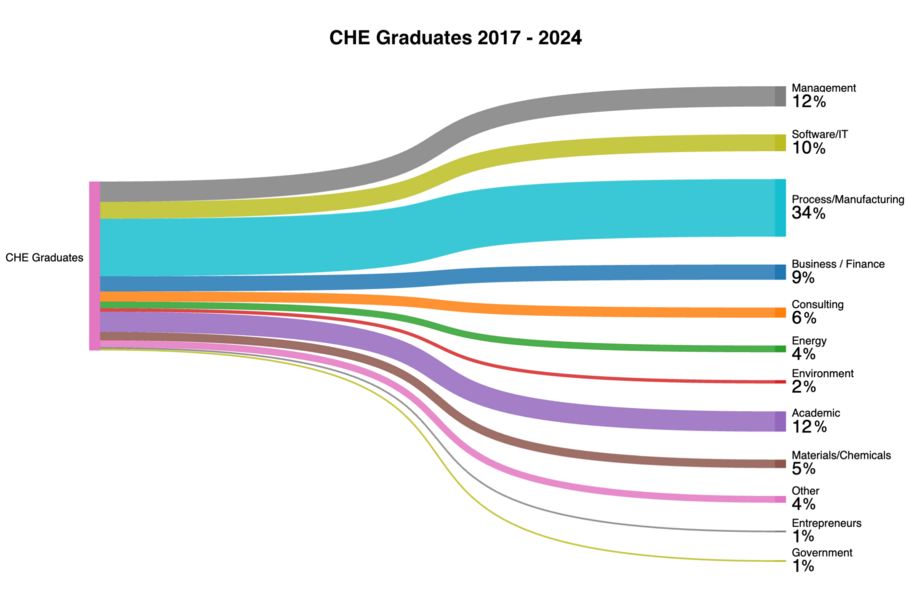
What sectors do our students work in after graduation?