
Researchers in the Department of Chemical Engineering have developed a new 3D-printed electrode design for redox flow batteries, a promising technology for storing energy generated by wind and solar power. Their work shows how carefully designed internal structures can help battery liquids move more effectively through the system while reducing the energy needed to pump the liquid.
Led by Professor Maxime van der Heijden, the research team created porous electrodes using 3D printing. The goal was to improve what engineers call mass transport, the movement of molecules in the battery liquid to the places where energy-storing reactions occur.
Redox flow batteries work differently from lithium-ion batteries. Instead of storing energy in solid materials, they store energy in liquid electrolytes held in external tanks. Because the amount of stored energy can be increased by using larger tanks, these batteries are attractive for large-scale renewable energy storage and grid applications.
Electrodes are a critical part of the battery because they provide the surface where chemical reactions take place. Making electrodes porous increases the available surface area and creates more locations where these reactions can occur.
“Most electrodes used in redox flow batteries are fibrous carbon materials that were not specifically designed for liquid-phase electrochemistry,” says van der Heijden. “As a result, there are opportunities to engineer electrode structures that improve the transport of reactive species to the electrode surface while reducing pumping losses.”
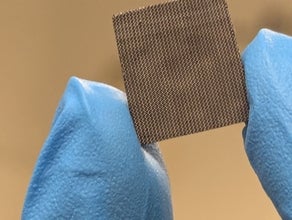
Heat-treated electrode showing its porous structure and the fine details retained after heat treatment
Traditional commercial electrodes contain networks of carbon fibers that provide a large surface area for reactions. However, those same structures can make it more difficult for the liquid electrolyte to move through the battery.
To address this challenge, the researchers investigated whether 3D printing could create electrode structures with tailored architectures that improve fluid flow and mass transport. Using a digital light processing (DLP) 3D printer, they fabricated porous electrode structures and converted them into conductive carbon electrodes through a heat-treatment process. The electrodes were then evaluated in laboratory flow-cell experiments and in a proof-of-concept vanadium redox flow battery.
A critical aspect of this research was the use of triply periodic minimal surface (TPMS) geometries, repeating three-dimensional structures found in nature, including in biological membranes, leaves and insect wings. The team investigated several TPMS designs and found that one known as the diamond geometry delivered the strongest transport performance among the structures studied.
This proof of concept lays the foundation for future generations of 3D-printed electrodes for redox flow batteries. Future research will focus on increasing surface area, improving manufacturing methods and exploring advanced design tools to create even more effective electrode structures.
The study, “Enhancing Mass Transport in Redox Flow Batteries with 3D-Printed Triply Periodic Minimal Surface Electrode Structures,” has been published in the Journal of Energy Storage.