Alumni

Monday, October 15, 2018 12:00 am - Thursday, October 18, 2018 12:00 am EDT (GMT -04:00)

Quantum Innovators in science and engineering

The Quantum Innovators in science and engineering workshop brings together the most promising young researchers in quantum physics and engineering. Guests are invited for a four-day conference aimed at exploring the frontier of our field.

Alexander Grimm, Yale University

In recent years, circuit quantum electrodynamics (QED) has seen considerable efforts towards protecting quantum information from unwanted sources of decoherence through quantum error correction. Independent of the implementation, this is based on encoding a logical qubit into a stable manifold within a larger Hilbert space, whose symmetries restrict the number of independent errors and make them detectable and correctable.

Friday, June 1, 2018 11:45 am - 11:45 am EDT (GMT -04:00)

RAC1 Journal Club/Seminar Series

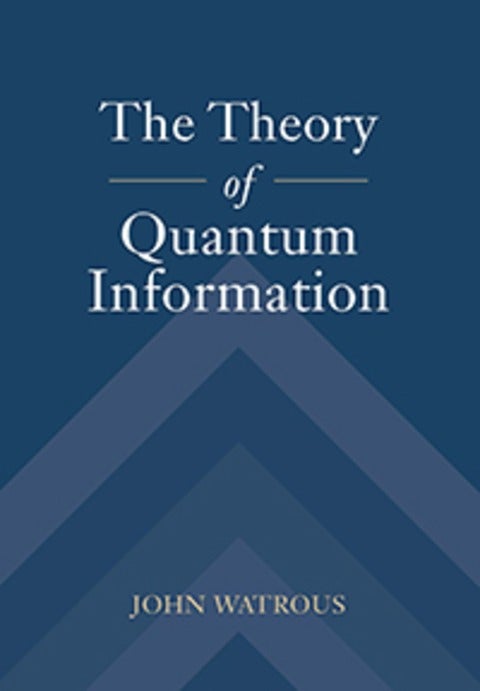
The number theory of quantum information

Jon YardJon Yard, IQC

Abstract: Quantum-mechanical amplitudes and unitaries are typically expressed over the complex numbers. Because there is a continuum of complex numbers, classical computations of quantum systems generally utilize finite-precision approximations by rational numbers.

Wednesday, May 23, 2018 1:15 pm - 1:15 pm EDT (GMT -04:00)

Maximal Coherence and the Resource Theory of Purity

Dagmar Bruss, University of Duesseldorf

The resource theory of quantum coherence studies the off-diagonal elements of a density matrix in a distinguished basis, whereas the resource theory of purity studies all deviations from the maximally mixed state. We establish a direct connection between the two resource theories, by identifying purity as the maximal coherence, which is achievable by unitary operations. The states that saturate this maximum identify a universal family of maximally coherent mixed states.

Thursday, May 17, 2018 4:00 pm - 4:00 pm EDT (GMT -04:00)

Asymptotic limits in quantum frequency estimation

Jan Haase, Universität Ulm

Whenever one is tempted to employ a quantum system for any kind of applications, the focus usually lies on two properties setting it apart from a system described by a classical theory, namely the coherent superposition of different quantum states and entanglement between two ore more constituents forming the system.