Alumni

Tuesday, April 24, 2018 1:00 pm - 1:00 pm EDT (GMT -04:00)

Quantum Computing - Dissipative Quantum Search

PhD Seminar

Chunhao Wang, PhD candidate

David R. Cheriton School of Computer Science

We give a dissipative quantum search algorithm that is based on a novel dissipative query model. If there are $N$ items and $M$ of them are marked, this algorithm performs a fixed-point quantum search using $O(\sqrt{N/M}\log(1/\epsilon))$ queries with error bounded by $\epsilon$. In addition, we present a continuous-time version of this algorithm in terms of Lindblad evolution.
Tuesday, April 24, 2018 2:00 pm - 2:00 pm EDT (GMT -04:00)

Quantum Computing - A Quantum Algorithm for Simulating Non-sparse Hamiltonians

PhD Seminar

Chunhao Wang, PhD candidate

David R. Cheriton School of Computer Science

We present a quantum algorithm for simulating the dynamics of Hamiltonians that are not necessarily sparse. Our algorithm is based on the assumption that the entries of the Hamiltonian are stored in a data structure that allows for the efficient preparation of states that encode the rows of the Hamiltonian. We use a linear combination of quantum walks to achieve a poly-logarithmic dependence on the precision. 

Joshua Choi - University of Virginia

Metal halide perovskites (MHPs) are revolutionizing the solar cell research field - the record power conversion efficiency of MHPs based solar cells has reached 22.7%, which rivals that of silicon solar cells. What is particularly exciting about MHPs is that they can be manufactured into solar cell devices at low-costing using low temperature solution processing. Based on these attributes, MHPs have been called the “next big thing in photovoltaics” and worldwide research efforts have grown explosively.

Eric Bittner, University of Houston

Entangled photons offer an exquisite probe to correlated dynamics within a material system. In my talk I shall discuss some recent experiments and our theoretical investigations into developing an input/output scattering theory approach that connects an incoming photon Fock state to an outgoing Fock state, treating both the internal (material) and photon dynamics on a consistent footing. As proof of concept, we show how entangled photons can probe the inner workings of a model system undergoing spontaneous symmetry breaking.

News Release

Government of Canada announces contract award to the University of Waterloo for research and development in support of Arctic surveillance

April 12, 2018 – Ottawa, Ont. – National Defence/Canadian Armed Forces

En français

New $2.7 million project funded by Department of National Defence will develop technology for quantum radar.

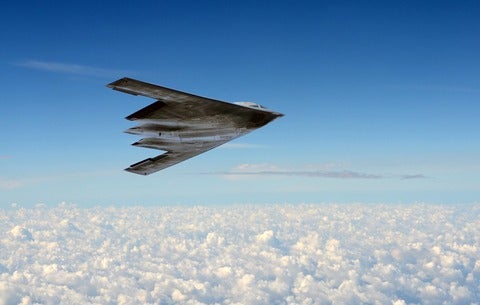
Stealth aircraft in the Canadian arctic will be no match for a new quantum radar system.

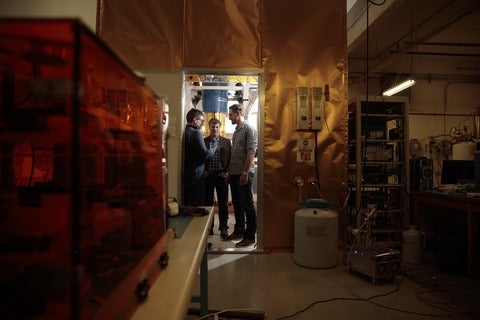
Researchers at the University of Waterloo are developing a new technology that promises to help radar operators cut through heavy background noise and isolate objects —including stealth aircraft and missiles— with unparalleled accuracy.

Monday, April 30, 2018 2:30 pm - 2:30 pm EDT (GMT -04:00)

Asymptotic performance of port-based teleportation

Felix Leditzky, University of Colorado, Boulder

Port-based teleportation (PBT) is a variant of the well-known task of quantum teleportation in which Alice and Bob share multiple entangled states called "ports". While in the standard teleportation protocol using a single entangled state the receiver Bob has to apply a non-trivial correction unitary, in PBT he merely has to pick up the right quantum system at a port specified by the classical message he received from Alice.

Thursday, April 26, 2018 7:00 pm - 7:00 pm EDT (GMT -04:00)

Entangled: The series – QUANTUM + Literature

Chad Orzel, Union College
The invention of quantum physics in the early 20th century forced scientists to reconsider many cherished ideas from classical physics, leading to revolutionary changes in our scientific and philosophical understanding of the universe. Quantum phenomena have also proven to be a rich source of metaphors and inspiration for fiction. 
 

Tuesday, April 10, 2018 10:30 am - 10:30 am EDT (GMT -04:00)

Cryogenic Dissipation in Nanoscale Optomechanical Cavities

Bradley Hauer, University of Alberta

Cavity optomechanics, a field which studies the interplay between the photonic and phononic modes of an optical cavity, has seen rapid progress over the past decade. Micro/nano-scale optomechanical cavities have demonstrated potential for use in technologies such as quantum-limited metrology and transduction, as well as probes for exploring the fundamental nature of quantum mechanics.

Friday, April 20, 2018 11:45 am - 11:45 am EDT (GMT -04:00)

RAC1 Journal Club/Seminar Series

Keysight's Quantum Engineering Toolkit: A commercial, customizable integrated control and test system

Presented by guest speaker Nizar Messaoudi, Keysight Technologies Application Engineer

With traditional classical complementary metal oxide semiconductor (CMOS) computing struggling to keep up with Moore’s law, interest in quantum computing has exploded and the University of Waterloo is at the centre of this technological revolution.