Alumni

Marzio Pozzuoli, RuggedCom

Abstract:
In 2001 RuggedCom was a fledging startup. A decade later it was bought by Siemens for nearly half a billion dollars. Mr. Pozzuoli, its founder, will discuss its path to success and the role played in that success by the Canadian experience and the strategies outlined in Geoffrey Moore’s iconic book “Crossing the Chasm”.
 
Biography:
Thursday, May 28, 2015 4:00 pm - 5:00 pm EDT (GMT -04:00)

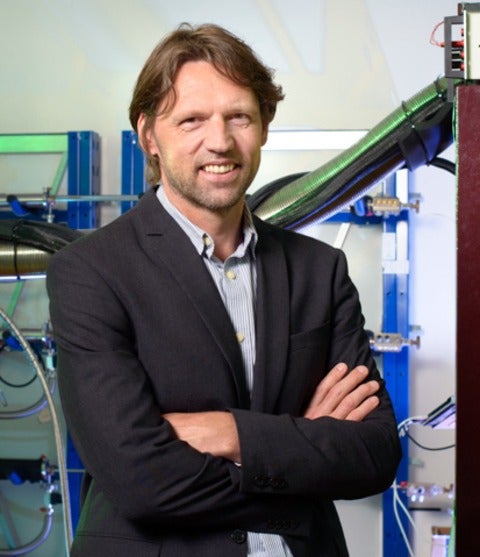
Quantum Frontiers Distinguished Lecture: Leo Kouwenhoven

Leo Kouwenhoven, Delft University of Technology

Majorana Fermions: Particle Physics on a Chip

Join us for the next Quantum Frontiers Distinguished Lecture Series when Dr. Leo Kouwenhoven will talk about particles that are equal to their anti-particles.

Wednesday, June 10, 2015 4:00 pm - 5:00 pm EDT (GMT -04:00)

Aleksander Kubica: Unfolding the color code

Aleksander Kubica, California Institute of Technology

The topological color code and the toric code are two leading candidates for realizing fault-tolerant quantum computation. In the talk, I will introduce these two models and show their equivalence in d dimensions. I will describe codes with or without boundaries, and explain what insights one gets in the former case by looking at the condensation of anyonic excitations on the boundaries. I will conclude with a recipe of how one can implement fault-tolerantly a logical non-Pauli gate in the toric code in d dimensions.

Tuesday, May 26, 2015 10:30 am - 11:30 am EDT (GMT -04:00)

Scott Aaronson: Exploring the Limits of the Efficiently Computable

Scott Aaronson, Massachusetts Institute of Technology (MIT)

I'll give a broad overview of my research over the last decade aimed at understanding the relationship between computational complexity and physics; and in particular, the capabilities and limitations of quantum computers.

Paul Kwiat, University of Illinois at Urbana-Champaign

Nearly 80 years after Schroedinger described entanglement as the quintessential nonclassical phenomenon, and 50 years after Bell showed the inconsistency of quantum correlations with local realism, the quantum information revolution seeks to use its almost magical properties to enable new feats in information processing. As we shall see, entanglement can now be produced at high rates with exquisite precision, enabling unprecedented tests of nonlocality and such feats as quantum cryptography and teleportation.

Urbasi Sinha, Raman Research Institute

In a double slit interference experiment, the wave function at the screen with both slits open is not exactly equal to the sum of the wave functions with the slits individually open one at a time. The three scenarios represent three different boundary conditions and as such, the superposition principle should not be applicable. However, most well-known text books in quantum mechanics implicitly and/or explicitly use this assumption that is only approximately true.

Monday, May 4, 2015 2:30 pm - 3:30 pm EDT (GMT -04:00)

Daniel Terno: Wave, particles and quantum control

Daniel Terno, Macquarie University

The debate on wave vs particle nature of light goes back to the days of Huygens and Newton. When used to model properties of quantum system these concepts lose their objective meaning and simply become the two aspects of wave-particle duality. Duality played a central role in Bohr—Einstein debates and prompted Bohr to formulate the complementarity principle. Complementarity leaves open the possibility that by adapting to the specific experimental sit-up a quantum system always behaves definitely either as a particle or as a wave.

Friday, May 1, 2015 12:00 pm - 1:00 pm EDT (GMT -04:00)

Tim J. Bartley: Mesoscopic quantum optics

Tim J. Bartley, National Institute of Standards and Technology, Boulder

Fundamental to quantum optics is the study of the distribution of photons in modes of an electromagnetic field. Until now, direct photon number measurements on nonclassical states occupying a single mode have been limited to the few-photon regime (typically no more than 5). I will present results from direct measurements of nonclassical states containing up to 50 (fifty) photons, at telecom wavelengths and with total raw efficiencies well above 60%.

Ben Baragiola, University of New Mexico

Traveling wave packets of light prepared with a definite number of photons, known as multimode Fock states, are well-suited for the role of "flying qubits" to relay information in a quantum computing device. In both the optical and microwave domain, propagating single-photon fields are routinely produced and manipulated, with ongoing progress toward higher photon numbers.