Alumni

Michele Piscitelli, Royal Holloway University

The focus of this talk will be a general introduction to Nuclear Magnetic Resonance (NMR) detection schemes that are based on the use of Superconducting Quantum Interference Devices (SQUIDs) as highly sensitive magnetometers. I will begin by providing an overview of the relevant concepts and principles behind SQUID-detected NMR. In the main part of my talk I will be presenting our experimental results and achievements in the field of ultralow field SQUID NMR spectroscopy and Magnetic Resonance Imaging (MRI).

Monday, April 20, 2015 2:30 pm - 3:30 pm EDT (GMT -04:00)

Jerry Chow: Taking Superconducting Qubits to the Next Generation

Jerry Chow, IBM T.J. Watson Research Center, USA

Fault tolerant quantum computing is possible by employing quantum error correction techniques. In this talk I will describe an implementation of a true quantum code using 4 lithographically defined superconducting qubits in a square lattice capable of measuring both types of possible quantum errors occurring on a single qubit. The experiment requires highly coherent qubits, high quality quantum operations implementing the detecting circuit, and a high quality independent qubit measurement set-up.

Tuesday, June 9, 2015 7:00 pm - 7:00 pm EDT (GMT -04:00)

Quantum Computing: Transforming the Digital Age

Public lecture by Dr. Krysta Svore, Microsoft Research

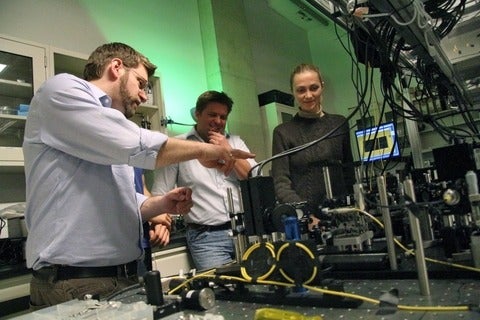
Krysta SvoreIn 1981, Richard Feynman proposed a device called a “quantum computer” to take advantage of the laws of quantum physics to achieve computational speed-ups over classical methods. Quantum computing promises to revolutionize how we compute.
Thursday, April 30, 2015 4:00 pm - 5:00 pm EDT (GMT -04:00)

Quantum Frontiers Distinguished Lecture: Sajeev John

Sajeev John, University of Toronto

Photonic band gap materials: semiconductors of light

Join us for the next Quantum Frontiers Distinguished Lecture Series when Dr. Sajeev John will talk about light-trapping crystals.

Monday, March 16, 2015 11:00 am - 12:00 pm EDT (GMT -04:00)

Na Young Kim: Carbon Nanotube Transport and Exciton-Polariton Condensation

Na Young Kim, Stanford University

We in modern society are beneficiaries of advanced electronics, photonics and the combination of two. As an effort to develop new platforms of electronics, photonics and optoelectronics harnessing quantum nature, I have studied transport properties of carbon nanotubes, where long-range interaction plays a significant role. In photonics domain, I have been studying exciton-polaritons in a quantum-well-microcavity structure, where dynamical macroscopic condensation emerge via stimulated scattering process arising from exchange interactions.

Konstantinos Lagoudakis,  Stanford University

Light matter interactions lie in the heart of several phenomena of fundamental and applied interest. Both condensation of exciton polaritons in semiconductor microcavities as well as quantum information processing with charged quantum dots in micro-resonators rely on strong light matter interactions.

Thursday, April 30, 2015 11:00 am - 12:00 pm EDT (GMT -04:00)

Matthieu Nannini: Nanolithography using Thermal Probe AFM: principle and applications

Matthieu Nannini, McGill University

While IBM Zurich's millipede project of data storage did not
have the success anticipated it would, a new technology for nano
lithography was born. Since 2009, IBM Zurich has been refining their

Thursday, March 5, 2015 11:45 am - 12:45 pm EST (GMT -05:00)

Laura Mančhinska: Limits to catalysis in quantum thermodynamics

Laura Mančhinska, CQT, Singapore

Quantum thermodynamics is a research field that aims at fleshing out the ultimate limits of thermodynamic processes in the quantum regime. A complete picture of quantum thermodynamics allows for catalysts, i.e., systems facilitating state transformations while remaining essentially intact in their state, very much reminding of catalysts in chemical reactions. In this work, we present a comprehensive analysis of the power and limitation of such thermal catalysis.