Current graduate students

Friday, September 28, 2018 10:30 am - 10:30 am EDT (GMT -04:00)

Dynamics of quantum coherence in non-equilibrium many-body systems

Salil Bedkihal, Exeter

Understanding the interplay of non-equilibrium effects, dissipation and many body interactions is a fundamental challenge in condensed matter physics. In this work, as a case study, we focus on the transient dynamics and the steady state characteristics of the double-dot Aharonov-Bohm (AB) interferometer subjected to a voltage and/or temperature bias. We first consider an exactly solvable case, the noninteracting double-dot AB interferometer.
Tuesday, September 25, 2018 1:00 pm - 3:00 pm EDT (GMT -04:00)

Transformative Quantum Technologies Information Session

Transformative Quantum TechnologiesInterested in learning more about the Transformative Quantum Technologies (TQT) initiative? Attend the TQT information session from 1:00 – 3:00 PM in the RAC 2 Quiet Labs foyer. Please join us to learn about TQT’s program opportunities, latest research developments and future directions.
Friday, September 28, 2018 1:00 pm - 1:00 pm EDT (GMT -04:00)

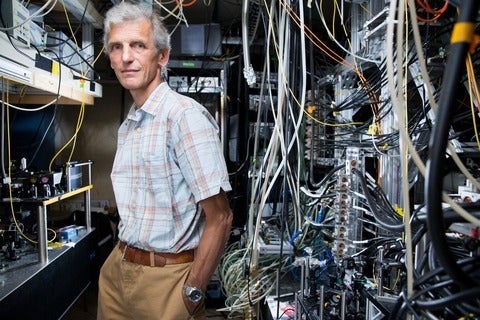
New forms of matter with ultracold atoms: synthetic magnetic fields and supersolidity

Wolfgang Ketterle - MIT

The properties of ultracold atoms can be profoundly modified with the help of laser beams. They can modify the wavefunction of neutral atoms in such a way that they show behavior of charged particles, e.g. electrons in high magnetic fields. In this way, synthetic magnetic fields and spin-orbit coupling have been realized, and a supersolid phase has been observed. A supersolid is superfluid and breaks translational symmetry, i.e. it has shape.

Thursday, September 27, 2018 1:00 pm - 1:00 pm EDT (GMT -04:00)

Space-time density matrix for continuous variables

Tian Zhang, University of Oxford

In ordinary, non-relativistic quantum theory, especially in quantum information, space and time are treated differently. For example, time is a parameter rather than an operator; states are defined across the whole space but only at one time, and then evolve under the prescribed dynamics. These go against our intuition from relativity. Thus, space-time density matrices have been introduced and here we discuss one of these formulations called pseudo-density matrix (PDM) which treats space and time indiscriminately.

Monday, September 17, 2018 2:30 pm - 2:30 pm EDT (GMT -04:00)

Quantum Annealing with Non-stoquastic Hamiltonians

IQC Colloquium - Layla Hormozi, IQC

We study the role of Hamiltonian complexity in the performance of quantum annealers. It is well-known that non-stoquastic Hamiltonians are more complex than stoquastic Hamiltonians and universal adiabatic quantum computing is possible when they are employed. Here we ask whether utilizing non-stoquastic Hamiltonians in quantum annealers can lead to a better performance in solving optimization problems.