Current students

Friday, June 1, 2018 11:45 am - 11:45 am EDT (GMT -04:00)

RAC1 Journal Club/Seminar Series

The number theory of quantum information

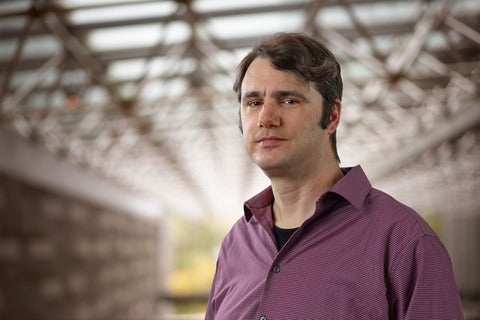
Jon YardJon Yard, IQC

Abstract: Quantum-mechanical amplitudes and unitaries are typically expressed over the complex numbers. Because there is a continuum of complex numbers, classical computations of quantum systems generally utilize finite-precision approximations by rational numbers.

Wednesday, May 23, 2018 1:15 pm - 1:15 pm EDT (GMT -04:00)

Maximal Coherence and the Resource Theory of Purity

Dagmar Bruss, University of Duesseldorf

The resource theory of quantum coherence studies the off-diagonal elements of a density matrix in a distinguished basis, whereas the resource theory of purity studies all deviations from the maximally mixed state. We establish a direct connection between the two resource theories, by identifying purity as the maximal coherence, which is achievable by unitary operations. The states that saturate this maximum identify a universal family of maximally coherent mixed states.

A new conference for graduate students and postdoctoral fellows in quantum science aims to foster collaboration and provide a glimpse into the exciting research taking place in Canada.

Hosted jointly by the three Canada First Excellence Research Fund (CFREF) programs— the Stewart Blusson Quantum Matter Institute (SBQMI), Institut Quantique (IQ), and Transformative Quantum Technologies (TQT)— the Canadian Graduate Quantum Conference runs June 20-22 at the University of British Columbia (UBC) in Vancouver. 

Thursday, May 17, 2018 4:00 pm - 4:00 pm EDT (GMT -04:00)

Asymptotic limits in quantum frequency estimation

Jan Haase, Universität Ulm

Whenever one is tempted to employ a quantum system for any kind of applications, the focus usually lies on two properties setting it apart from a system described by a classical theory, namely the coherent superposition of different quantum states and entanglement between two ore more constituents forming the system.

Tuesday, April 24, 2018 1:00 pm - 1:00 pm EDT (GMT -04:00)

Quantum Computing - Dissipative Quantum Search

PhD Seminar

Chunhao Wang, PhD candidate

David R. Cheriton School of Computer Science

We give a dissipative quantum search algorithm that is based on a novel dissipative query model. If there are $N$ items and $M$ of them are marked, this algorithm performs a fixed-point quantum search using $O(\sqrt{N/M}\log(1/\epsilon))$ queries with error bounded by $\epsilon$. In addition, we present a continuous-time version of this algorithm in terms of Lindblad evolution.

Tuesday, April 24, 2018 2:00 pm - 2:00 pm EDT (GMT -04:00)

Quantum Computing - A Quantum Algorithm for Simulating Non-sparse Hamiltonians

PhD Seminar

Chunhao Wang, PhD candidate

David R. Cheriton School of Computer Science

We present a quantum algorithm for simulating the dynamics of Hamiltonians that are not necessarily sparse. Our algorithm is based on the assumption that the entries of the Hamiltonian are stored in a data structure that allows for the efficient preparation of states that encode the rows of the Hamiltonian. We use a linear combination of quantum walks to achieve a poly-logarithmic dependence on the precision.