Current students

Thursday, April 20, 2017 3:00 pm - 3:00 pm EDT (GMT -04:00)

Special seminar: Andrew Daley

Out-of-equilibrium dynamics in AMO quantum simulators

Andrew Daley, University of Strathclyde

Over the past few years, the possibility to control and measure atomic and molecular systems time-dependently has generated a lot of progress in exploring out-of-equilibrium dynamics for strongly interacting many-particle systems. This connects directly to fundamental questions relating to the relaxation of such systems to equilibrium, as well as the spreading of correlations and build-up of entanglement.

Thursday, April 20, 2017 11:30 am - 11:30 am EDT (GMT -04:00)

Special seminar: Marco Piani

Operational characterization of quantum properties

Marco Piani, University of Strathclyde

 Quantum features like quantum superposition and quantum correlations — the latter comprising, but not limited to entanglement — are both of foundational and applicative interest. We develop tools to characterize such features operationally, looking for ways to detect, quantify, and utilize them. Some recent results I will report on regard the use of such features in the discrimination of physical processes, a task within the area of quantum metrology.

Friday, April 21, 2017 11:45 am - 11:45 am EDT (GMT -04:00)

RAC1 Journal Club/Seminar Series

Quantum Information Enabled Neutron Interferometry

Joachim Nsofini, IQC

In the quest to explore big quantum systems, there have been opportunities to explore smaller quantum system like the neutron interferometer. A neutron interferometer (NI) has proven to be a useful tool in the study of quantum effects ranging from  experiments with single particle interference to measuring quantities of significant importance in condensed-matter and Standard Model physics.

Monday, April 17, 2017 2:30 pm - 2:30 pm EDT (GMT -04:00)

Colloquium: Peter Maunz

Scalable surface ion traps for high-fidelity quantum operations

Peter Maunz, Sandia National Laboratories

Trapped ion systems can be used to implement quantum computation as well as quantum simulation. To scale these systems to the number of qubits required to solve interesting problems in quantum chemistry or solid state physics, the use of large multi-zone ion traps has been proposed [1]. Microfabrication enables the realization of surface electrode ion traps with complex electrode structures.

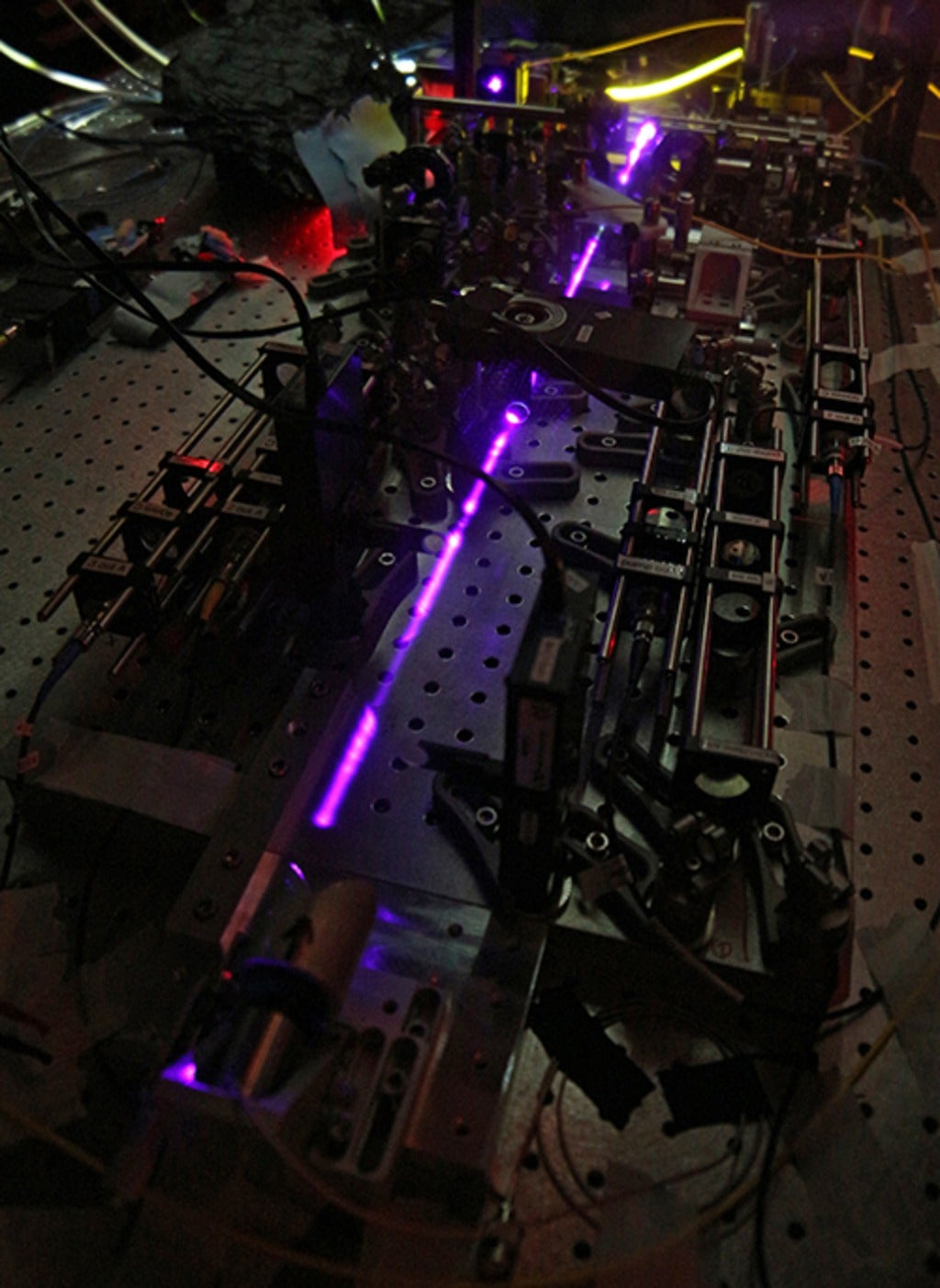
In a paper published in Physical Review Letters, PhD student Sascha Agne and colleagues experimentally realized a three-photon Greenberger-Horne-Zeilinger (GHZ) interferometer and observed genuine three-photon interference for the first time, bringing scientists one step closer to exciting applications in quantum communication.

Monday, April 10, 2017 2:30 pm - 2:30 pm EDT (GMT -04:00)

Colloquium: Muxin Han

Quantum Gravity, Tensor Network, and Holographic Entanglement Entropy

Muxin Han, Florida Atlantic University

The relation between nonperturbative Quantum Gravity and tensor network is explored from the perspectives of bulk-boundary duality and holographic entanglement entropy. We find that the quantum gravity states in a space Σ with boundary ∂Σ is an exact holographic mapping. The tensor network, understood as the boundary quantum state, is the output of the exact holographic mapping emerging from a coarse graining procedure of quantum gravity state.

Monday, April 3, 2017 2:30 pm - 2:30 pm EDT (GMT -04:00)

Colloquium: Kin Fai Mak

Superconductivity in single-layer NbSe2

Kin Fai Mak, Pennsylvania State University

The discovery of graphene has stimulated not only the field of carbon nanoelectronics, but also studies of novel electronic phenomena in a wide range of atomically thin van der Waals’ materials. In this talk, I will discuss our recent effort in the isolation of a single layer of niobium diselenide (NbSe2), a new non-centrosymmetric superconductor.

Friday, April 7, 2017 11:45 am - 11:45 am EDT (GMT -04:00)

RAC1 Journal Club/Seminar Series

The puzzle of genuine multiparticle interference

Sascha Agne, IQC

Two recent experiments demonstrate access to a new realm of quantum phenomena called genuine multiparticle interference. For three photons this means that interference between all three photons is observed while, simultaneously, neither pairs nor single photons display interference.

Monday, March 27, 2017 2:30 pm - 2:30 pm EDT (GMT -04:00)

Colloquium: Thomas Vidick

Rigorous RG algorithms and area laws for low energy eigenstates in 1D

Thomas Vidick, California Institute of Technology

One of the central challenges in the study of quantum many-body systems is the complexity of simulating them on a classical computer. We give a new algorithm for finding low energy states for 1D systems, based on a rigorously justified RG type transformation.