Current undergraduate students

Thursday, February 22, 2018 7:00 pm - 7:00 pm EST (GMT -05:00)

Entangled: The series – QUANTUM + logic

Quantum mechanics reveals that at its core, the world is not as it seems – it is far more interesting.
 
In the quantum world, outcomes are counter-intuitive, differing from what we expect based on our everyday experiences. The particle physicist Richard Feynman remarked that this means we seem to have to walk “a logical tightrope” when we talk about a quantum system.  

 

Tuesday, January 9, 2018 7:00 pm - 7:00 pm EST (GMT -05:00)

CryptoWorks21 Distinguished Lecture: Tools of Commercialization

“He who is good with a hammer thinks everything is a nail.”

- Modified quote from the original by Abraham Maslow


How does one sell security? How does one commercialize such nebulous concepts such as “Trust”, “Security” and “Cryptography”?  Cryptography, which is just one building block of security, is based on other more abstract building blocks such as algorithms which have a foundation on hard mathematical problems.

Friday, December 8, 2017 2:00 pm - 5:00 pm EST (GMT -05:00)

Research Advancement Centre 2 Open House

Join us at the Research Advancement Centre 2 Open House

RAC 2 Open House
Friday, December 8
2:00-5:00pm

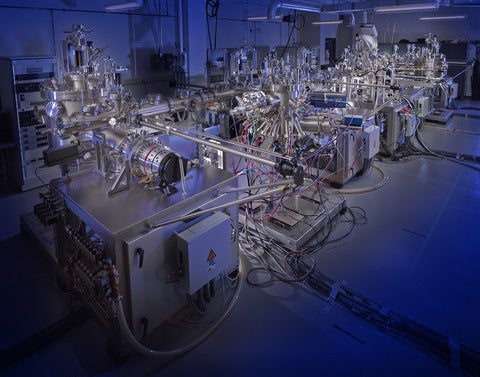
Transformative Quantum Technologies (TQT) invites the University of Waterloo community to explore the Research Advancement Centre 2 (RAC 2) building and see first-hand where groundbreaking research in quantum information and science technology happens.

The Institute for Quantum Computing is pleased to announce a call for entries to the Quantum Shorts flash fiction competition. The competition is open to stories up to 1000 words long that take inspiration from quantum physics and include the phrase “There are only two possibilities: yes or no”. The competition is free to enter, offering prizes of up to US $1500.

Tuesday, September 12, 2017 1:00 pm - 1:00 pm EDT (GMT -04:00)

Seminar: Successes and limits in engineering photon pair sources

Evan Meyer-Scott, Universität Paderborn 

I will present a realization of a great photon pair source based on parametric down-conversion, and discuss a not-so-great limit to the performance of photon pair sources in general. The former is a fully fiber-coupled waveguide pair source with 46% raw heralding efficiency, and no optical alignment required. The latter restricts the achievable heralding efficiency, when spectrally filtering the photons to increase the purity.

Behrooz Semnani, PhD candidate, Department of  Electrical and Computer Engineering, University of Waterloo  

Recent rapid advancements in nanofabrication technologies have widened the realm of possibilities in nanophotonics, nonlinear and sub-wavelength optics. Realizing nonlinear optics in subwavelength scale paves the way for low cost integrated photonics. Ultra-high-Q photonic crystal nanocavities and nanostructured materials are examples of such structures. Those structures offer very small mode volume guaranteeing highly enhanced field intensity.

Tuesday, September 12, 2017 11:00 am - 11:00 am EDT (GMT -04:00)

Self-testing QRNG: A lot of randomness for little trust!

Hugo Zbinden, Université de Genève

An approach to quantum random number generation based on unambiguous quantum state discrimination (USD) is developed. We consider a prepare-and-measure protocol, where two non-orthogonal quantum states can be prepared, and a measurement device aims at unambiguously discriminating between them.

Thursday, September 28, 2017 1:00 pm - 1:00 pm EDT (GMT -04:00)

Application of a resource theory for magic states to fault-tolerant quantum computing

Mark Howard & Earl T. Campbell

Motivated by their necessity for most fault-tolerant quantum computation schemes, we formulate a resource theory for magic states. We first show that robustness of magic is a well-behaved magic monotone that operationally quantifies the classical simulation overhead for a Gottesman-Knill type scheme using ancillary magic states. Our framework subsequently finds immediate application in the task of synthesizing non-Clifford gates using magic states.

Tuesday, August 29, 2017 11:00 am - 11:00 am EDT (GMT -04:00)

Robust and high-fidelity control for quantum computation

Hsi-Sheng Goan - Department of Physics and Center for Quantum Science and Engineering, National Taiwan University, Taipei

An essential prerequisite for quantum information processing is precise coherent control of the dynamics of quantum systems or quantum bits (qubits). Most of the control sequences implemented in quantum experiments are developed and designed based on the assumption of having ideal (closed) quantum coherent systems.