Friday, December 1, 2017 11:45 am
-
11:45 am
EST (GMT -05:00)
Future students
Monday, November 27, 2017 2:30 pm
-
2:30 pm
EST (GMT -05:00)
The emergence of topological superconductivity in 2D strongly correlated doped Dirac systems
Colloquium: Zhengcheng Gu, The Chinese University of Hong Kong
Searching for p+ip topological superconducting (SC) state has become a fascinating subject in condensed matter physics, as a dream application awaits in topological quantum computation. In this talk, I will report the theoretical discovery of a p+ip SC ground state (coexisting with ferromagnetic order) in honeycomb lattice Hubbard model with infinite repulsive interaction at low doping(< 0.2), by using both the state-of-art Grassmann tensor product state(GTPS) approach and a quantum field theory approach.
Wednesday, November 8, 2017
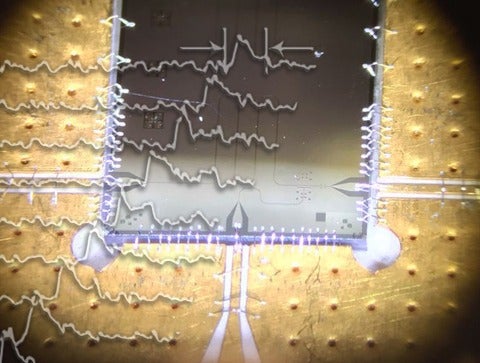
Shaping photons on-demand
Experiment finds way to increase photon efficiency for quantum communications
A team of researchers at the Institute for Quantum Computing (IQC) demonstrated a new type of on-demand single photon generator that can shape photons to increase their efficiency when used in a quantum network.
Next-generation communication networks will rely on the transmission of quantum information. Single photons, as carriers of quantum information, will play an integral role in building these future networks.
Monday, December 4, 2017 9:00 am
-
9:00 am
EST (GMT -05:00)
Indium Thin Films Applied to Superconducting Quantum Circuits
 PhD Thesis Presentation
Corey Rae McRae
Friday, October 27, 2017 2:00 pm
-
2:00 pm
EDT (GMT -04:00)
Indium Thin Films Applied to Superconducting Quantum Circuits
Physics and Astronomy - Milestone Series
Corey Rae McCrae
PhD student
Department of Physics & Astronomy and Institute for Quantum Computing

Tuesday, October 17, 2017
IQC faculty member named Fellow of the American Physical Society
Faculty member Norbert Lütkenhaus has been named a Fellow of the American Physical Society. He is recognized for his “pioneering theoretical contributions to the fields of quantum secure communications and optical quantum information processing.”
Wednesday, October 11, 2017
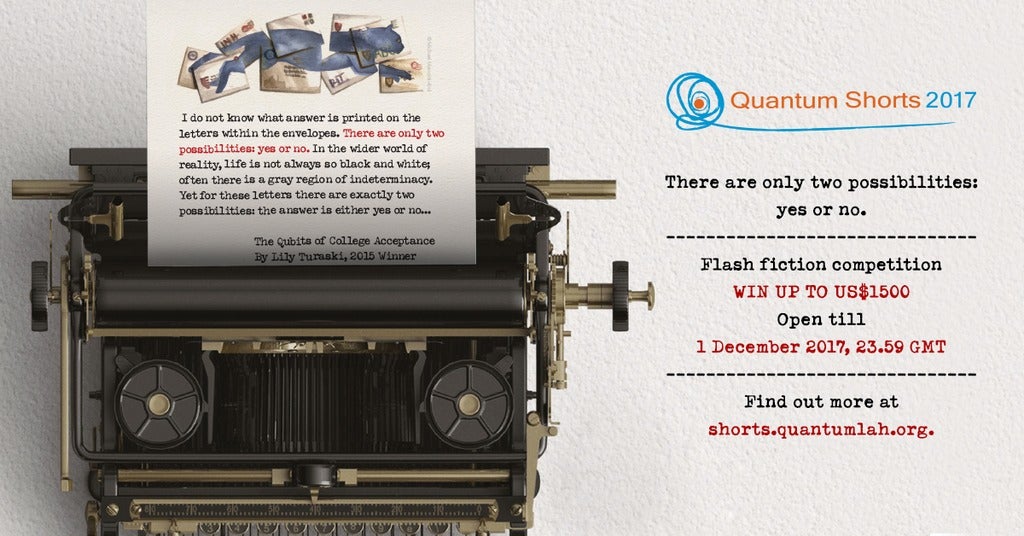
Flash fiction competition Quantum Shorts opens for entries
The Institute for Quantum Computing is pleased to announce a call for entries to the Quantum Shorts flash fiction competition. The competition is open to stories up to 1000 words long that take inspiration from quantum physics and include the phrase “There are only two possibilities: yes or no”. The competition is free to enter, offering prizes of up to US $1500.
Thursday, September 14, 2017
Quantum Machine Learning
Article by ICFO - The Institute of Photonic Sciences
An international team of scientists presents a thorough review in Nature on quantum machine learning, its current status and future prospects.
Sunday, October 1, 2017
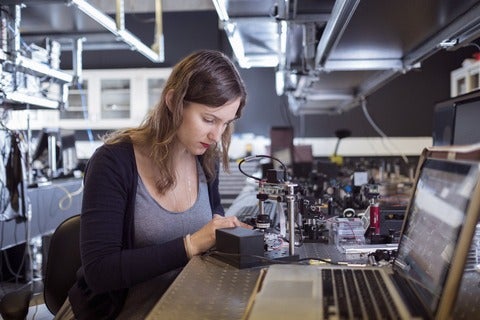
New device offers simple and affordable way to identify optical coatings in the lab
A light emitting diode (LED)-based spectrophotometer designed and implemented by Institute for Quantum Computing (IQC) researchers is the first demonstration of characterizing optical coatings using a simple, automated device.
Monday, September 25, 2017 11:00 am
-
11:00 am
EDT (GMT -04:00)
Seminar: Aging and Domain Growth in the Spin Glass Copper Manganese
Daniel Tennant - University of Texas, Austin
I will report on dynamical magnetic susceptibility measurements of
both bulk and thin film samples of the spin glass Copper Manganese.
By studying the Thermoremanent Magnetization (TRM) of multi-layer thin
films of various thicknesses, we are able to show the maximum energy
barrier encountered during correlated spin flip transitions is cut off
by the thickness of the film and is independent of temperature. The
distribution of energy barriers is shown to follow from a hierarchical