Future students

Wednesday, December 16, 2015 1:00 pm - 1:00 pm EST (GMT -05:00)

Seminar: Edward Chen

Nitrogen-vacancy (NV) centers in diamond nanophotonic structures for quantum networking

Edward Chen, Massachusetts Institute of Technology

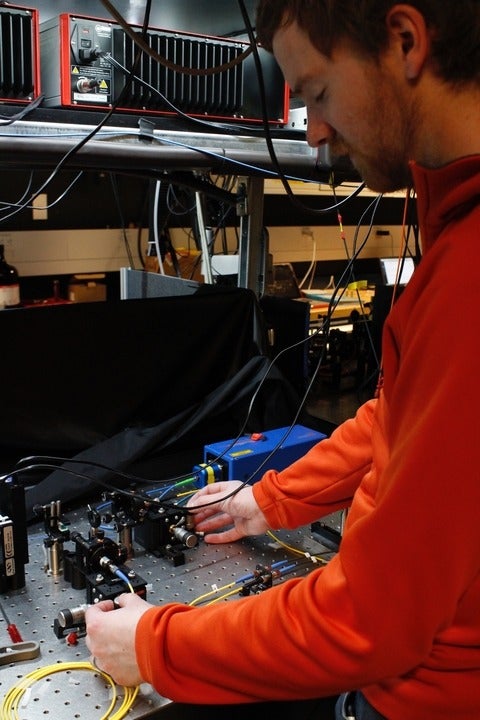
The exceptional optical and spin properties of the negatively charged nitrogen-vacancy (NV) center in diamond have led to a wide range of hallmark demonstrations ranging from super-resolution imaging to quantum entanglement, teleportation, and sensing. The solid-state environment of the NV allows us to engineer nano-structures that can enhance the properties of the NV and improve the readout and initialization fidelities of the spin.
Monday, December 14, 2015 12:00 pm - 12:00 pm EST (GMT -05:00)

Seminar: Xingshan Cui

Quantum Max-flow/Min-cut

Xingshan Cui, University of California, Santa Barbara

The classical max-flow min-cut theorem describes transport through certain idealized classical networks. We consider the quantum analog for tensor networks. By associating a tensor to each node in an integral flow network, we can also interpret it as a tensor network, and more specifically, as a linear map.

Monday, December 7, 2015 2:30 pm - 2:30 pm EST (GMT -05:00)

Colloquium: Nengkun Yu

Sample-optimal tomography of quantum states

Nengkun Yu, IQC

It is a fundamental problem to decide how many copies of an unknown mixed quantum state are necessary and sufficient to determine the state. Previously, it was known only that estimating states to error ϵ in trace distance required O(dr2/ϵ2) copies for a d-dimensional density matrix of rank r. Here, we give a theoretical measurement scheme (POVM) that requires O((dr/δ)ln(d/δ)) copies of ρ to error δ in infidelity, and a matching lower bound up to logarithmic factors.

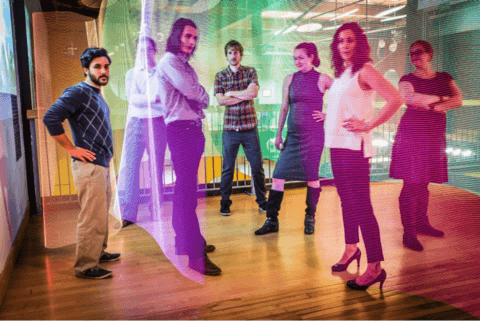
Researchers in Canada, the United States and Europe led by the National Institute of Standards and Technology in Boulder, Colorado and Institute for Quantum Computing alumnus Krister Shalm have ruled out classical theories of correlation with remarkably high precision. A group including Institute for Quantum Computing members Evan Meyer-Scott, Yanbao Zhang, Thomas Jennewein, and alumnus Deny Hamel built and performed an experiment that shows the world is not governed by local realism.

Monday, November 30, 2015 2:30 pm - 2:30 pm EST (GMT -05:00)

Colloquium: Karsten Flensberg

Towards demonstration of Majorana-based topological qubits

Karsten Flensberg, Niels Bohr Institute

The first part of the talk presents recent progress in the search for condensed matter systems hosting Majorana bound state in semiconductor-superconductor nanowire-based heterostructures. In the second part a proposal for the next steps towards manipulation of quantum information stored in topological qubits is presented.

Friday, November 6, 2015 2:30 pm - 2:30 pm EST (GMT -05:00)

Analysis seminar: Fred Shultz

Applications of order isomorphisms of C*-algebras

Fred Shultz, Wellesley College

We will review known results about order isomorphisms of C*-algebras,
and will describe some applications to complete positivity of maps and
a generalization of the Choi matrix. (This is joint work with Vern Paulsen.)
Then we will describe some applications to quantum information theory.

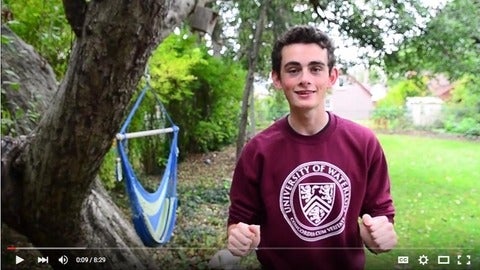
John Fish could end up travelling to the Silicon Valley later this week as the winner of the Breakthrough Junior Challenge. He is one of the 15 finalists out of more than 2,000 students from 86 countries, and only one of two Canadians to get this far in the annual challenge that invites students, ages 13-18, to share their passion for math and science with the world through video.

Tuesday, November 10, 2015 1:00 pm - 1:00 pm EST (GMT -05:00)

Seminar: Nai-Hui Chia

How hard is deciding trivial versus non-trivial in the dihedral coset problem

Nai-Hui Chia, Pennsylvania State University

The dihedral coset problem (DCP) is an important open problem in quantum algorithms and has been studied since the early days of quantum computing. This problem attracts attention even from experts in cryptography due to its application to the lattice-based cryptosystems. It has been shown by Oded Regev in 2005 that the DCP has deep connections to the unique shortest vector problem and the random subset sum problem.