Future students

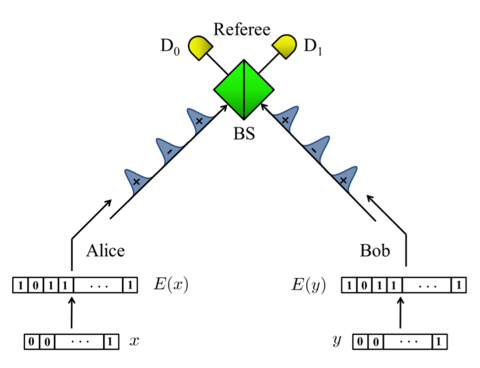
Computer scientists, including Institute for Quantum Computing (IQC) members John Watrous and Richard Cleve have long been looking at protocols where quantum communication offers an advantage compared to the classical case. However technology hasn’t progressed as quickly, so researchers had previously been unable to implement the protocols.
Thursday, November 5, 2015 12:00 pm - 12:00 pm EST (GMT -05:00)

Seminar: Ankit Garg

A deterministic polynomial time algorithm for word problem for the free skew field

Ankit Garg, Princeton University

We study the word problem for the free skew field of non-commutative rational functions. We prove that an existing algorithm due to Gurvits is actually a deterministic polynomial time algorithm for this problem (over the rationals). Our analysis is simple, providing explicit bounds on the "capacity'' measure of totally positive operators introduced by Gurvits.

Monday, November 2, 2015 2:30 pm - 2:30 pm EST (GMT -05:00)

Colloquium: Mukund Vengalattore

Measurement-induced localization of an ultracold lattice gas

Mukund Vengalattore, Cornell University

The act of observation has profound consequences on a quantum system. I will describe our experimental demonstration of a Heisenberg microscope based on nondestructive imaging of a lattice gas. We show that the act of imaging these atoms induces their localization - a manifestation of the quantum Zeno effect.

Thursday, October 15, 2015 10:00 am - Friday, March 11, 2016 4:00 pm EDT (GMT -04:00)

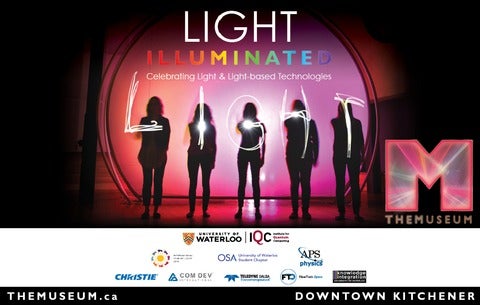
LIGHT Illuminated at THEMUSEUM

Celebrating light and light-based technologies

LIGHT Illuminated celebrates the United Nation's International Year of Light. In this interactive exhibition at THEMUSEUM you can learn about the value and importance of light-based technologies by exploring a black-light room, playing with colour mixing stations, and trying to get through a laser maze.
Monday, November 9, 2015 2:30 pm - 2:30 pm EST (GMT -05:00)

Colloquium: Bertrand Reulet

What are the properties of the electromagnetic field radiated by a quantum conductor, or how to generate entangled radiation with a normal metal ?

Bertrand Reulet, University of Sherbrooke

​A classical current in a conductor radiates a classical electromagnetic field. We explore some properties of the field radiated by a conductor when electron transport must be described by quantum mechanics, i.e. when the electron current becomes quantum itself.

Joseph Salfi, University of New South Wales

The behavior of conventional transistors derives from large numbers of acceptor and donor impurities that promote carriers into the valence and conduction bands. More recently, nano-electronic devices based on the bound states of individual dopant impurities in silicon have received considerable attention for quantum computation, due to the long spin coherence times of dopants in silicon. This invariably requires control over dopant wavefunctions and the interactions between individual dopants [1].

Hao Qin, Telecom ParisTech

We report a quantum hacking strategy on a Continuous-Variable (CV) Quantum Key Distribution (QKD) system by inserting an external light. In the implementations of CV QKD systems, transmitting openly local oscillator pulses is a potential vulnerability for an eavesdropper to launch side channel attacks. In this work, other than targeting on local oscillator, we concern two imperfections in a balanced homodyne detector used in CV QKD system: the imbalance in the beam splitter and the finite linear detection limit.

Monday, December 14, 2015 2:30 pm - 2:30 pm EST (GMT -05:00)

Jamie Sikora: Quantum Correlations: Dimension Bounds and Conic Formulations

Jamie Sikora, Centre for Quantum Technologies, National University of Singapore

In this talk, I will discuss correlations that can be generated by performing local measurements on bipartite quantum systems. I'll present an algebraic characterization of the set of quantum correlations which allows us to identify an easy-to-compute lower bound on the smallest Hilbert space dimension needed to generate a quantum correlation. I will then discuss some examples showing the tightness of our lower bound.

Monday, September 14, 2015 1:00 pm - 1:00 pm EDT (GMT -04:00)

Chris Granade: Practical Bayesian Tomography

Chris Granade, University of Sydney

In recent years, Bayesian methods have been proposed as a solution to a wide range of issues in quantum state and process tomography. In this talk, we make these methods practical by solving three distinct problems: numerical intractability, a lack of informative prior distributions, and an inability to track time-dependent processes. Our approach allows for practical computation of point and region estimators for quantum states and channels, and allows tracking of time-dependent states.