CryptoWorks21 - Intellectual Property (IP) in Academia
Speaker: Doug Beynon
Abstract:
Speaker: Doug Beynon
Abstract:
Speaker: Tom Hunter
Speaker: Viona Duncan
Speaker: Heather Hoff
Abstract: Software is a key asset of any new business. How do you protect the results of weeks or months of hard labour? Who owns the software and how do I mange its development to ensure its inherent value is maintained? Should I use Open Source, or even contribute to Open Source? What are the benefits and how does this measure up against the risks?
Speaker: Neil Henderson
Speaker: Jeffrey Wong
Abstract: Is your work new, and is it useful? Who else knows about it, and how? These are fundamental questions to whether or not a patent can be obtained. Is your idea abstract or tangible? Can software be patented, and if so how? This lecture will cover the criteria for patentability, the process for obtaining a patent and the timeline, and the costs and strategies involved in developing a patent portfolio.
Back by popular demand, CryptoWorks21 will once again launch the Intellectual Property (IP) Management Lunch and Learn Lecture Series! Our knowledgeable speakers will provide more in-depth presentation built from the previous sessions.
The lectures are designed for researchers working in areas related to information technology, including cryptography and quantum technology.
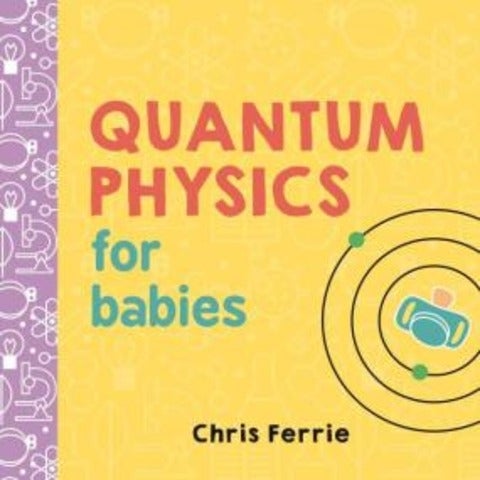
In a recent survey, nearly 1 in 3 Americans said they would rather clean a toilet than do a single math problem. Tell someone on the street that you are a physicist, or worse, a mathematician, and you’ll be acknowledged with a “I hated math in school” or “I was never any good at math.” Tell them you are a quantum physicist and you’ll be lucky if you get a response. Chris Ferrie plans to vanquish those doubts and fears by introducing children to quantum physics. But, how young is too young? Enter Quantum Physics for Babies.
Hear from author and quantum theorist Chris Ferrie, IQC and University of Waterloo, Faculty of Mathematics alumnus, about his experience in communicating quantum information science to a larger audience. This general talk is suitable for all audiences.
Come play in The Quantum Mechanics Golf Tournament and join the fight against cancer
The Quantum Mechanics are asking for your support in the fight against cancer.
The team, made of University of Waterloo, Institute for Quantum Computing (IQC) and Perimeter Institute members, is participating in the Grand Ride in honour of Pearl Sullivan, Dean of Engineering and Raymond Laflamme, Executive Director of IQC at the University of Waterloo and all those in our communities who have been touched by cancer.
The modern information era is built on silicon nanoelectronic devices. The future quantum information era might be built on silicon too, if we succeed in controlling the interactions between individual spins hosted in silicon nanostructures.
Spins in silicon constitute excellent solid-state qubits, because of the weak spin-orbit coupling and the possibility to remove nuclear spins from the environment through 28Si isotopic enrichment.