
Our course-based master's program offers a robust foundation in quantum technology through three fundamental lab courses, delivered by a team of world-class instructors, teaching assistants, and support staff.
These courses are held in the Quantum Explorations Laboratory, a state-of-the-art space dedicated exclusively to teaching and training.
Outfitted with advanced equipment, the lab prepares students to engage in-depth with quantum systems and a range of quantum computing implementations, setting a strong foundation for future research and careers.
Specialized quantum laboratories for applied learning
Laboratory of coherent control
This course provides a testbed on which students can build an intuition around quantum information processing with the help of Nuclear Magnetic Resonance (NMR) spectrometers and nitrogen vacancy centres.
- Simulations and experiments are combined such that students can see both experimental outcomes and their correspondence to theoretical predictions.
- A fully customizable software interface and pulse programmer offers endless potential for experimenting with quantum information processing.
- 17 distinct experiments at the forefront of quantum information research are delivered ranging from the controlled-not gate to quantum simulation.
- Room temperature operation allows for easy access to experimental apparatus, enabling exploration outside of class time.

Students characterizing a single spin qubit using a nuclear magnetic resonance spectrometer.

Students running a dynamical decoupling sequence to extend the lifetime of a spin qubit using a nuclear magnetic resonance spectrometer.

A nuclear magnetic resonance spectrometer along with a set of liquid samples used for quantum control of 1 and 2 qubits.


Laboratory on low temperature quantum technology and nanofabrication
This course introduces low temperature measurement techniques and the properties of superconducting devices that are relevant to quantum technologies.
- Work directly with liquid helium cryogenic systems, which reach temperatures in the single Kelvin range when vacuum pumped.
- Become comfortable with electronics commonly used with superconducting systems.
- Explore the characteristics and fabrication of superconducting devices relevant to quantum computing such as Josephson Junctions, microwave resonators, and thin films.
- Characterize a superconducting qubit using a dilution refrigerator comparable to those used at IBM and Google

A liquid helium flow cryostat used to characterize superconducting quantum devices down to 1.5 Kelvin.

Students looking at a dilution cryostat that is used to cool superconducting qubits to ultra-low temperatures (~15 milliKelvin)

A student characterizing a cryogenic microwave circuit component using a Vector Network Analyzer (VNA)

Students working with liquid helium flow cryostats. One cryostat (front) contains a superconducting microwave resonator (readout on a vector network analyzer) and the other (rear) contains Josephson junctions. These two devices are integral to the construction of superconducting qubit architectures.

Student working on a dilution cryostat that is used to cool superconducting qubits to their operating temperature (~15 milliKelvin).


Laboratory on photonic quantum technology
In this course, students create, manipulate, and measure optical quantum states, and use single photons to explore fundamental topics in quantum information processing.
- Use an entangled single photon source to characterize 2-qubit quantum states, explore Bell non-locality, and perform remote-state preparation through a quantum eraser experiment.
- Use a heralded single photon source to explore the indistinguishability of single photons and characterize a true quantum light source.
- Distinguish between coherent, thermal, and single photon light sources by examining the statistics of each and comparing with theoretical expectations.

A quantum light source producing maximally entangled quantum states in photon polarization. This source is used for exploring entanglement and Bell nonlocality with two-qubits.

A student working on a quantum state/process tomography experiment. Tomography is a technique used to characterize an unknown quantum state, or the action of an unknown quantum process.

A shot of a single photon counting module. Single photons are detected, and their time of arrival is precisely recorded. The software counts the number of photon arrivals and checks for correlations in the time of those arrivals.

Student working on equations in the photonics lab


Advice from program alumni
Class of 2021
Class of 2022
Class of 2023
Class of 2022
Class of 2022
Class of 2021
Admission requirements
Apply through the graduate online application system. When applying, search for "Physics - MSc (Coursework)" and choose "Quantum Technology" in the "Graduate research field or Graduate specialization" dropdown menu. This program is a course-based MSc and distinct from the thesis-based MSc program.
- An Honours Bachelor's degree (or equivalent) in Science with at least a 75% standing.
- Program-specific questions (PSQ) / Supplementary information form
- These are questions specific to the program you’re applying to. They can be viewed once you’ve started an application and are completed through a form in the online application.
- Transcript(s)
- References
- Three references are required, two of which are normally from academic sources.
- Proof of English language proficiency, if applicable
- TOEFL 90 (writing 25, speaking 25), IELTS 7.0 (writing 6.5, speaking 6.5)
Tuition and fees
- Visit the graduate program tuition page on the Finance website to determine the tuition and incidental fees per term for your program.
- Review living costs and housing.
- Review the funding graduate school resources for graduate students.
Program requirements
At this time, the only MSc in Physics coursework option includes a graduate specialization in Quantum Technology. A graduate specialization is a university credential that is recognized on the student’s transcript but not on the diploma and is intended to reflect that a student has successfully completed a set of courses that together provide in-depth study in the area of the graduate specialization.
- Students must complete the following 8 one-term courses (0.50 unit weight) acceptable for graduate credit in order to obtain the graduate specialization in Quantum Technology on their transcript:
- PHYS 701 Quantum Mechanics 1
- PHYS 760/QIC 860 Laboratory on Control of Quantum Technology
- PHYS 761/QIC 861 Laboratory on Photonic Quantum Technology
- PHYS 762/QIC 862 Laboratory on Low Temperature Quantum Technology and Nano-fabrication
- PHYS 763/QIC 863 Independent Project in Quantum Technology or 1 QIC 800 level elective
- PHYS 767/QIC 710 Quantum Information Processing
- QIC 750 Quantum Information Processing Devices
- 1 PHYS 700 level or QIC 800 level elective
- An average of at least 70% in the required courses. A minimum grade of 65% is required for a pass in each course. No more than two of the first four completed courses can have averages of less than 70%. If a student does not meet these minimum grade requirements, or receives a failing grade in any course, the student may be required to withdraw from the program.
- Substitutions of courses are possible, subject to approval from the Graduate Officer.
- It is recommended that students who wish to go on to PhD programs choose the PHYS 763/QIC 863 Independent Project in Quantum Technology course to develop their research capabilities.
- Students must complete the course and milestone requirements associated with their chosen study option in addition to the Graduate Academic Integrity Module (Graduate AIM).
Grant Brassem, class of 2023
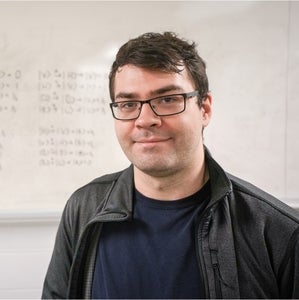
I’d get hands-on experience with the actual software platforms used to run modern laboratory equipment, while simultaneously gaining a strong theoretical background to do the work. The best part of this program is that it gives you a solid foundation to further your career—whether in academia, specialized lab work, or industry.
Got questions? We’re here to help
-
For program (courses and labs) specific questions: Michael Grabowecky
-
For Science admission questions: Holly Haig-Brown
-
For IQC admission questions: Paula Roser
-
For technical support or help with your application: Email gradapply@uwaterloo.ca.