New IQC graduate wins American Physical Society award for exceptional contributions to physics community
Dr. José Polo-Gómez has won the American Physical Society’s (APS) 2026 Irwin Oppenheim Award for his research at the Institute for Quantum Computing (IQC) where he earned his PhD in Applied Mathematics, Quantum Information from the University of Waterloo.
The award, which honours early-career scientists, recognizes Polo-Gómez “for showing that the second law of thermodynamics limits the ability to distinguish between quantum states” in his 2024 paper Thermodynamic bound on quantum state discrimination.
Dr. Polo-Gómez found that the second law of thermodynamics, a physical law that relates heat exchanges to disorder (and in its simplest form constrains how much heat can be converted into energy transfer), limits how well quantum states can be distinguished, a problem intimately related to how well information from quantum systems can be retrieved.
He credits a lot of his work to quantum physicist Asher Peres, who developed an early version of this argument in the 1990s.

“I feel deeply honoured by this unexpected recognition from the American Physical Society. I'm very fond of this paper, I think the main argument on which the result is based is both beautiful and simple.”
- Dr. José Polo-Gómez.
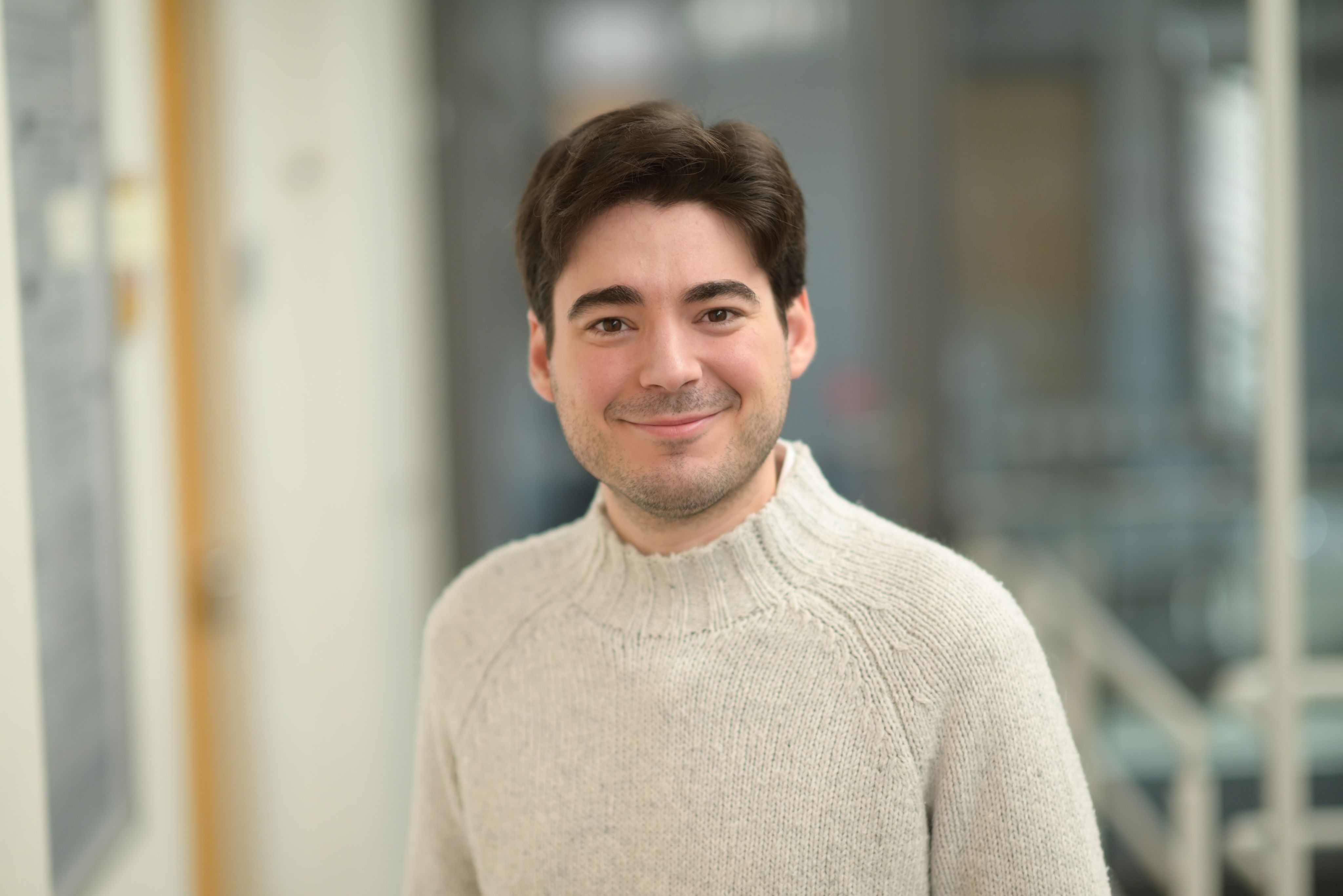
He extends his thanks to IQC faculty Dr. Richard Cleve, professor in the Department of Computer Science, and Dr. John Watrous. Polo-Gómez used Cleve’s quantum information course project as an “excuse” to start working on the paper and Watrous first taught him quantum information at IQC.
He wrote the paper while doing his PhD supervised by Dr. Eduardo Martín-Martínez, IQC affiliate and professor, Department of Applied Mathematics. His thesis focused on studying how to describe measurements of quantum fields with techniques from relativistic quantum information, a mathematical field which combines quantum information, general relativity, and quantum field theory.
Polo-Gómez says his fascination with quantum mechanics began in elementary school. Today he is a postdoctoral researcher at the Max Planck Institute of Quantum Optics, and he continues to be driven by a deep curiosity about nature at its most fundamental level.
He came to Waterloo for the opportunity to work with Martín-Martínez and the interdisciplinary environment at IQC and nearby Perimeter Institute for Theoretical Physics.
“Waterloo is an environment where you’re bound to do interesting things with people from all kinds of backgrounds,” Polo-Gómez says.
After finishing his formal studies, his thirst for learning is far from quenched: “I’m still interested in all sorts of fundamental questions and want to understand how everything around me works. There are still so many unanswered questions and not enough time to think about all of them.”
Un nouveau diplômé de l’IQC remporte un prix de l’American Physical Society pour sa contribution exceptionnelle à la communauté de physique
By Naomi Grosman
José Polo-Gómez a remporté le prix Irwin-Oppenheim 2026 de l’American Physical Society pour la recherche réalisée à l’Institut d’informatique quantique (IQC) dans le cadre de son doctorat en mathématiques appliquées et information quantique à l’Université de Waterloo.
Le prix, destiné aux scientifiques en début de carrière, lui est décerné pour son article « Thermodynamic bound on quantum state discrimination », publié en 2024, dans lequel il prouve que le deuxième principe de la thermodynamique limite la capacité de différencier les états quantiques.
Le chercheur a découvert que le deuxième principe de la thermodynamique, qui décrit les liens entre les échanges thermiques et le désordre (et qui, simplement dit, restreint la quantité de chaleur pouvant être convertie en énergie), compliquait la distinction des états quantiques, un problème intrinsèquement lié à la capacité à extraire de l’information des systèmes quantiques.
Il attribue une grande part de ses découvertes au physicien quantique Asher Peres, lequel a émis une version préliminaire de cette théorie dans les années 1990.
« Je suis profondément honoré de cette reconnaissance inattendue de l’American Physical Society. Je suis assez content de cet article; je trouve la thèse sur laquelle il repose à la fois belle et simple. »
- José Polo-Gómez.
L’homme remercie également deux membres de l’IQC : John Watrous, qui a été le premier à lui enseigner l’information quantique à l’IQC, et Richard Cleve, professeur au Département d’informatique, dont le cours d’informatique quantique lui a donné un prétexte pour commencer à travailler sur son article.
José Polo-Gómez a rédigé l’article dans le cadre de son doctorat, sous la tutelle d’Eduardo Martín-Martínez, membre affilié de l’IQC et professeur au Département de mathématiques appliquées. Sa thèse portait sur les façons de décrire les mesures des champs quantiques à l’aide de techniques d’information quantique relativiste, une discipline qui combine les théories de l’information quantique, de la relativité générale et des champs quantiques.
Le scientifique explique que sa fascination pour la mécanique quantique remonte à l’école primaire. Aujourd’hui chercheur postdoctoral à l’Institut Max-Planck d’optique quantique, il demeure mû par une profonde curiosité de la nature sous sa forme la plus fondamentale.
Ce qui l’a attiré à Waterloo, c’était la possibilité de travailler avec Eduardo Martín-Martínez et de profiter de l’environnement interdisciplinaire proposé par l’IQC et l’Institut Périmètre de physique théorique à proximité.
« Travailler à Waterloo, c’est collaborer à une foule de projets passionnants avec des gens de tous les milieux », se rappelle José Polo-Gómez.
Malgré tous ses diplômes, le chercheur est loin d’avoir étanché sa soif d’apprendre : « Je m’intéresse encore à toutes sortes de questions fondamentales, et je veux comprendre comment les choses qui m’entourent fonctionnent. Il y a tant de questions sans réponse, et si peu de temps pour les explorer. »