News

Filter by:

Limit to news where the title matches:
Limit to items where the date of the news item:
Date range
Limit to news items tagged with one or more of:
Limit to news items where the audience is one or more of:

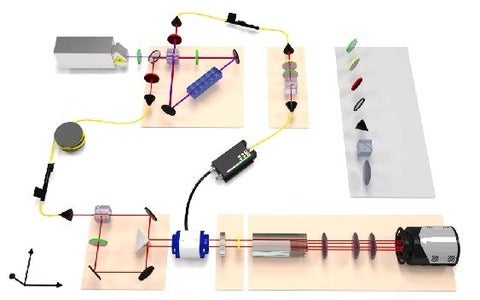
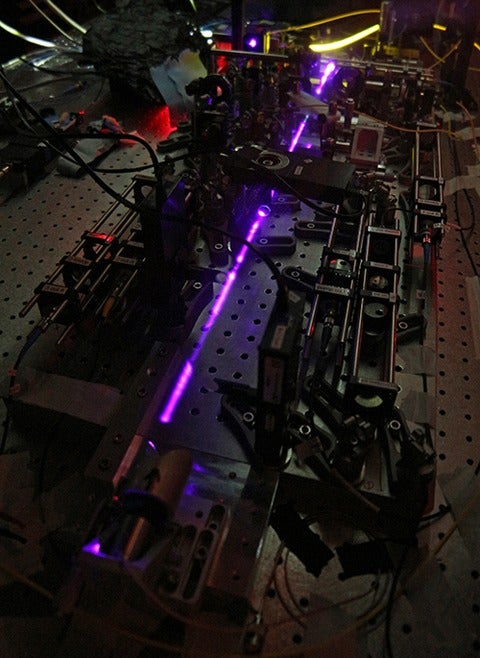
In a paper published in Physical Review Letters, PhD student Sascha Agne and colleagues experimentally realized a three-photon Greenberger-Horne-Zeilinger (GHZ) interferometer and observed genuine three-photon interference for the first time, bringing scientists one step closer to exciting applications in quantum communication.

New Haven, Conn. – Buoyed by a $3 million federal grant, a Yale University-led experiment will explore key questions about the tiny particles called neutrinos — and potentially improve the way we monitor and safeguard nuclear reactors in the process.

The U.S. Department of Energy grant from the Office of High Energy Physics will be used to build a first-of-its-kind, short-distance detection device for the Precision Oscillation and Spectrum Experiment (PROSPECT), a project involving 68 scientists and engineers from 10 universities and four national laboratories.

Imagine a movie showing particles in a gas moving and colliding with each other. Then when you play the movie backwards the velocity of the particles will be opposite, but their motion is still governed by the same laws of physics – we could just as well call the backwards film “forward” – there is no fundamental way to distinguish the arrow of time. This is called time-reversal symmetry.