News

Filter by:

Limit to news where the title matches:
Limit to items where the date of the news item:
Date range
Limit to news items tagged with one or more of:
Limit to news items where the audience is one or more of:
Thursday, February 18, 2016

Measurement by eraser

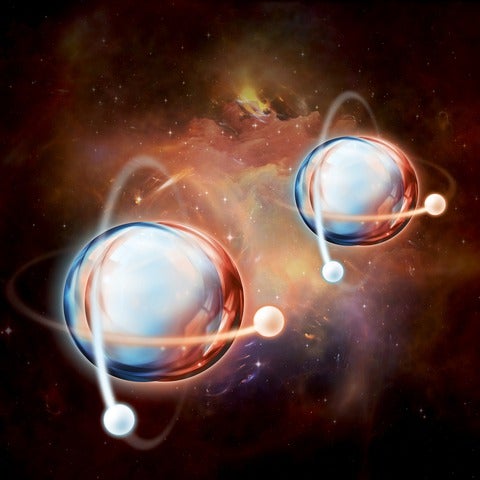
Postdoctoral fellow at the Institute for Quantum Computing (IQC) Aharon Brodutch and Eliahu Cohen (Tel Aviv University, University of Bristol) have developed a new method for designing complex quantum measurements.

A team lead by researchers from the Institute for Quantum Computing and the Department of Physics and Astronomy at the University of Waterloo has successfully detected the presence of single photons while preserving their quantum states.

IQC PhD student John Donohue, along with Elie Wolfe from the Perimeter Institute of Theoretical Physics, has determined the required complexity of a quantum system and how many bits of shared classical information are needed between two parties to generate a general probability distribution with a known set of quantum correlations.

One of the tasks that quantum computing promises is algorithmic speedups over classical computing for certain types of problems – one of which is quantum searching. To achieve this, it’s important to build a robust quantum memory, more specifically, a memory that can store information which can be addressed quantum mechanically.

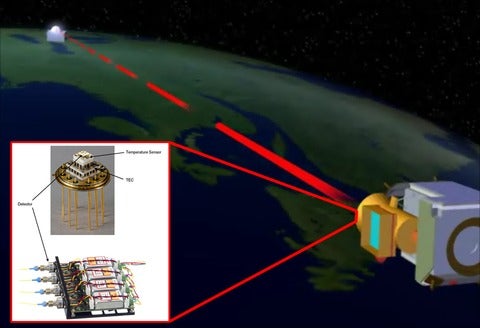
University of Waterloo researchers performed a lab demonstration proving the feasibility of Quantum Key Distribution over a satellite uplink.

In an emulated environment for performing QKD, a team of researchers analyzed the impact of the optical loss that occurs between the photon source and the satellite receiver. They successfully generated a secure key using algorithms tailored for a satellite receiver, an important step towards extending the distance of ultra-secure communications.

Researchers in Canada, the United States and Europe led by the National Institute of Standards and Technology in Boulder, Colorado and Institute for Quantum Computing alumnus Krister Shalm have ruled out classical theories of correlation with remarkably high precision. A group including Institute for Quantum Computing members Evan Meyer-Scott, Yanbao Zhang, Thomas Jennewein, and alumnus Deny Hamel built and performed an experiment that shows the world is not governed by local realism.