Sometimes, complex physics hides within mundane fixtures of daily life – like a bathroom. Researchers in the Department of Mechanical and Mechatronics Engineering are applying groundbreaking physics to tackle an annoying problem: urinal splashback. They recently published their work developing new urinal designs in the journal Proceedings of the National Academy of Sciences (PNAS) Nexus (with a few fun puns in the process). The research also collaborated with a team at Weber State University in Utah. Their new technology will allow users to void without voiding their pants.
Dr. Zhao Pan, an associate professor in the department, leads the Waterloo research team. The group discovered that droplet splashback is significantly reduced when it impacts a surface at a 30-degree angle or less. This phenomenon can be observed when a dog uses a tree or vertical wall to urinate, ensuring the impinging angle of the stream is low, decreasing splash back on the dog’s fur. The group then worked to apply this knowledge to urinals to prevent unpleasant splashes on shoes and floors and help limit the transmission of disease by ensuring that the urine streams do not spray. There is something to be said about humans learning from a man’s best friend.
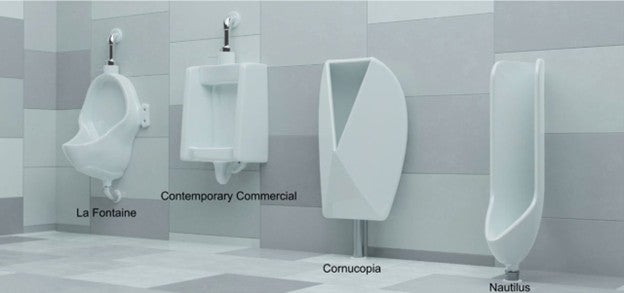
To test their hypothesis, the team used an anatomically accurate urethra nozzle to “urinate” coloured water at different heights and speeds onto different urinal models, dubbed Duchamp’s “La Fountaine”, Contemporary Commercial, Cornucopeea, and Nautilus (also named by the group, Cornucope(e)a, Urine-No, and Nauti-Loo).
The Nauti-Loo brought pride to its namesake school and came out as the winner, with its low impinging angle guaranteeing low splashback independent of aim or user height. The geometry of the Nauti-Loo is generated from a logarithmic spiral, which also governs the shape of the nautilus shell. Measured splashback from this design was 98 per cent lower than the contemporary commercial design in common use. Its design makes it easy to clean due to its larger “open area” and can be installed on the floor, making it accessible for kids and adults who are on the shorter side.
Despite the mathematical beauty of the Cornucopeea design, it proved suboptimal. This model produced an impinging angle at exactly 30 degrees. However, only for users of a particular height. This fact, combined with its difficulty to clean, prevents it from commercial implementation. Duchamp’s “La Fontaine” is a groundbreaking piece of art, consisting simply of a commonly available urinal back in 1917. The century between this urinal and the contemporary design originating from the company, American Standard shows how consistent certain design features have remained over time. While both share a flat bottom, which would generate splash at lower flow rates, the side walls catch most of the droplets, resulting in the century-old design producing less splash in this case. While both designs also generate splash at higher flow rates, the higher side walls of the modern design catch more splash, allowing the modern design at least some minimal improvement.
This project not only reduces the uncomfortable offence on the senses within bathrooms but also reduces the financial and environmental costs of keeping a public washroom clean. For example, the Toronto subway was projected to spend an average of $122,418 per bathroom cleaning costs between 2020 and 2024. Switching from existing urinals could save $10,000 annually in janitorial costs per bathroom. Money aside, cleaner bathrooms create a healthier and more pleasant environment for all, as hygiene is a critical aspect of maintaining welcoming and positive public spaces. These new designs contribute significantly to accessibility, as these new urinal designs exceed all accessibility standards for children and wheelchair users. For more information on the study, read it in PNAS Nexus. Plus, learn more about the project when the research was in progress in Waterloo News.
A special acknowledgement goes out to our late student, Apostoli Marinakos, who showed a genuine passion for this project, and considered this project romantic, before his passing.