
Objectives
- Provide outstanding patient experience through excellent customer service, clear communication and ongoing enhancements in service delivery.
- Nurture a culture of learning and continuous improvement through effective staff and faculty training, resourcing and recognition.
- Provide quality, safe, contemporary and evidence-informed care that achieves excellent patient outcomes in comprehensive care and clinics for specific needs.
- Modernize the Waterloo Eye Institute's infrastructure using advanced technology, streamlining administrative tasks, and ensuring efficient, cost-effective clinic management.
- Advance health equity by increasing access to eye and vision care for underserved communities and individuals, including through initiatives focused on leadership in outreach, advocacy, culturally competent care and teleoptometry, as well as patient and community education about eye and vision health.
Printable version
Goal 2: Accomplishments
Patient experience
Initiatives to improve patient experience in 2024-25 included:
- The launch of an upgraded patient website that improves navigation and provides more patient education and information about specialized services.
- Significant work on improving patient communication, including a new patient newsletter and updates to automated emails/texts.
- Standardizing processes, such as the implementation of a single check-in desk at the interim clinic location, with all staff trained to assist patients requiring a range of services.
Patient experience survey results have remained roughly steady over the last few years, with 2024 (full calendar year) numbers as follows:

Patient satisfaction slightly rose in the winter 2025 term, after the move to the interim clinic location, with 81.56% reporting an excellent experience and 90.38% reporting they would definitely recommend our services to family and friends.
Patient satisfaction, Jan–Apr 2025
rate their experience as excellent or very good
would probably or definitely recommend our services to friends and family
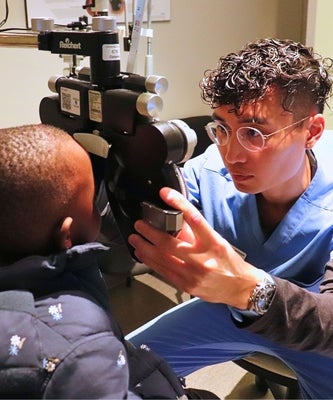
WEI at Surrey Place
Waterloo Eye Institute @ Surrey Place is a partnership between the University of Waterloo School of Optometry & Vision Science and Surrey Place, a Toronto-based organization that serves people with intellectual and developmental disabilities.
Funded by an anonymous charitable foundation, the partnership exists to provide high-quality eye and vision care to Surrey Place clients, as well as to research the prevalence of vision disorders within this population and the best methods of providing individuals with appropriate eye care.
We started seeing patients at Surrey Place’s Etobicoke location in July 2024 and have provided eye exams to dozens of historically underserved patients. We have also provided clinical education to upper-year students with the aim of providing enriched training and experience with patients with special needs.
Community impact
Outreach activities continued with the goal of providing more access to eye care for underserved populations. In partnership with Reception House Waterloo Region, clinics for newcomers to Canada increased in frequency to monthly dedicated days at our downtown Kitchener location.
A November 2024 outreach trip focusing on youth in the Jane and Finch area of Toronto was held in partnership with Youth Association for Academics, Athletics & Character Education (YAAACE) and the Humber River-Black Creek constituency office of MP Judy Sgro.
In collaboration with Region of Waterloo Public Health, our third-year students participated in a vision screening program for senior kindergarten children across Waterloo Region. The program provided screenings to 5,161 students in 140 schools over the academic year, helping identify those in need of additional care and ensuring appropriate referral and follow up in partnership with local optometrists.
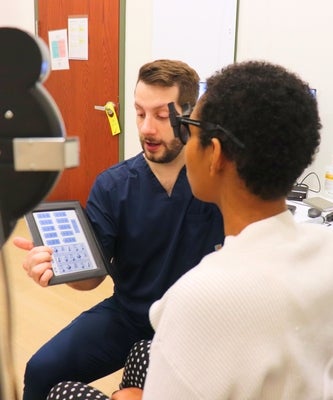

A patient is examined using teleoptometry-enabled equipment during an in-person to Churchill organized by the Manitoba Association of Optometrists in partnership with the School and Churchill Health Centre.
Goal 2: In progress
Teleoptometry
Many people in rural, remote and Indigenous communities lack the access to ongoing eye care needed to monitor chronic conditions such as age-related macular degeneration, glaucoma and diabetic retinopathy.
One possible solution, currently being piloted in Churchill in partnership with the Churchill Health Centre and the Manitoba Association of Optometrists, is to establish regional hubs with teleoptometry-enabled equipment. Optometrists could use the equipment when they visit in person, and between trips, a trained local optometric assistant could operate the equipment while optometrists provide patient care remotely.
The vision is for the Waterloo Eye Institute Teleoptometry Centre to facilitate access to remote eye care as a complement to in-person care. We are also developing models to increase access to specialty care such as low vision rehabilitation and vision therapy with optometric partners.
In 2024-2025, progress was made in work with partners to research best practices for teleoptometry as well as patient and health-care provider experiences with this technology. Faculty member Dr. Tammy Labreche is spearheading an effort to explore new models for low vision rehabilitation using teleoptometry.
Pan-Canadian Strategy for Indigenous Access to Eye Care
With partners across the country, we aim to develop a national framework and guidance on improving access to eyecare services to remote Indigenous communities. The Pan-Canadian Strategy for Indigenous Access to Eyecare is being developed in partnership with the many optometrists and organizations doing incredible work in community and on reserve. We have already made great strides in learning from BCDO and its efforts with the rural access program.
In 2024-25, $150,000 was raised for Indigenous outreach program support to continue research and exploration of best practices from associations and optometric partners. To support these efforts, the University approved the recruitment of a faculty member to oversee community outreach. In April 2025, Dr. Yongjiang (John) Chen was appointed to the position, which will support the continued development and enactment of this strategy. We continue to listen and learn from optometrists who have established trusted relationships with Indigenous communities. We continue to explore opportunities to engage more optometry students in this important work with a view towards expanding the number of providers excited to learn from and share with interested communities.
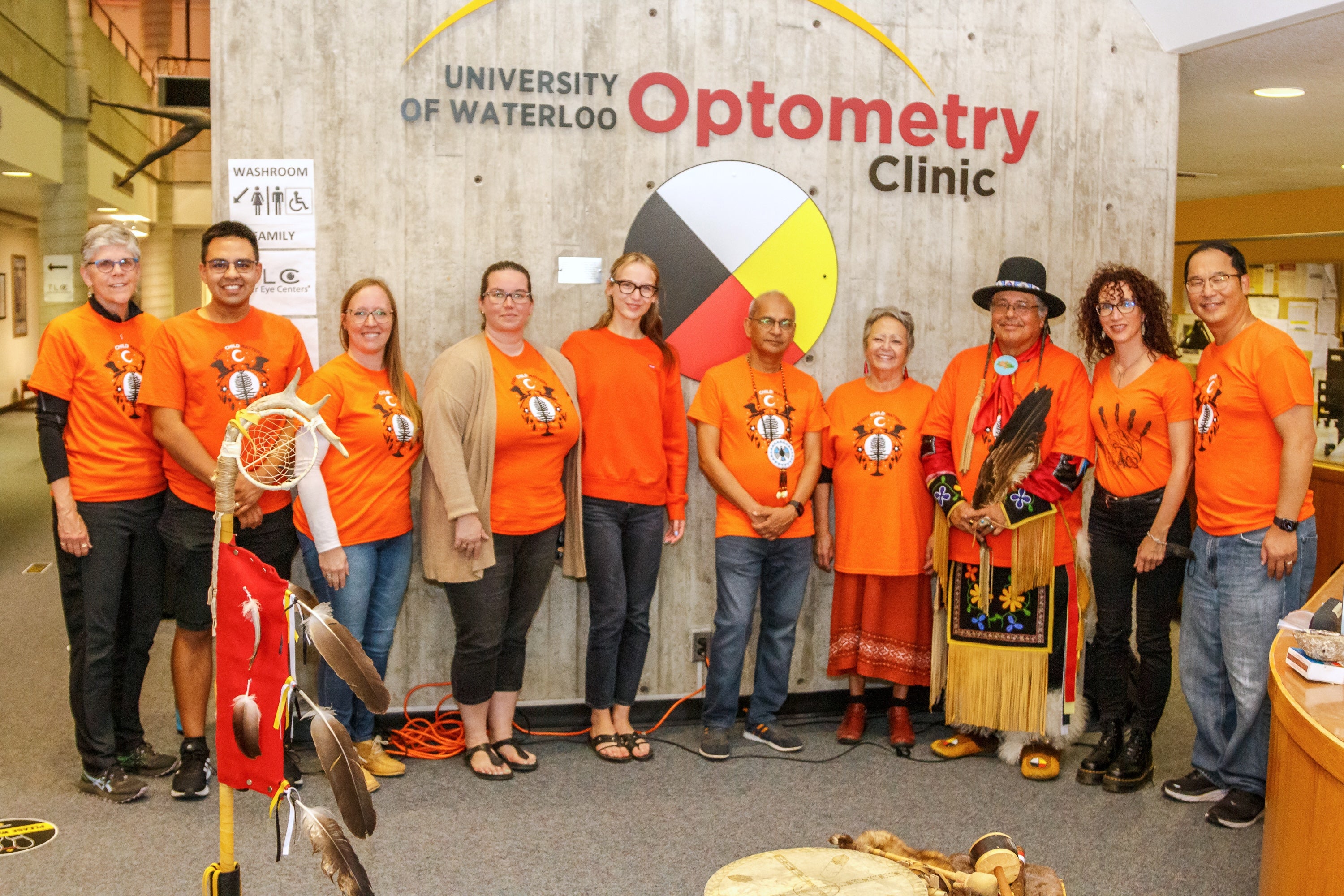
[Photo: Medicine wheel unveiling, 2023]
Co-developing eye data governance policies

The University of Waterloo is co-leading the development of data governance policies for eye data with the Southern Chiefs' Organization, which represents 33 Anishinaabe and Dakota Nations and more than 88,000 citizens in what is now southern Manitoba.
The interdisciplinary project, including the School of Optometry and Vision Science and School of Public Health Sciences, is funded by the Digital Research Alliance of Canada’s DRI EDIA Champions pilot program. With co-developed data governance policies, planned eye data research will be built on equitable, ethical and culturally safe foundations following OCAP principles of ownership, control, access and possession.
The Manitoba Association of Optometrists have been key partners as they seek to provide eye and vision care services in community through the development of dedicated eye lanes. The hope is to incorporate teleoptometry capabilities to continue to expand timely access to care.
[Photo: Dr. Helen Chen, Memoona Maah, Gina Najiman and Dr. Stanley Woo, Waterloo members of the team working on eye data governance.]