SERS at the 2022 Eco-Summit
SERS participated in the Sustainability Office's 2022 Eco-Summit. SERS achieved a gold ranking in the Green Office program and two SERS undergraduate students participated in panel sessions.
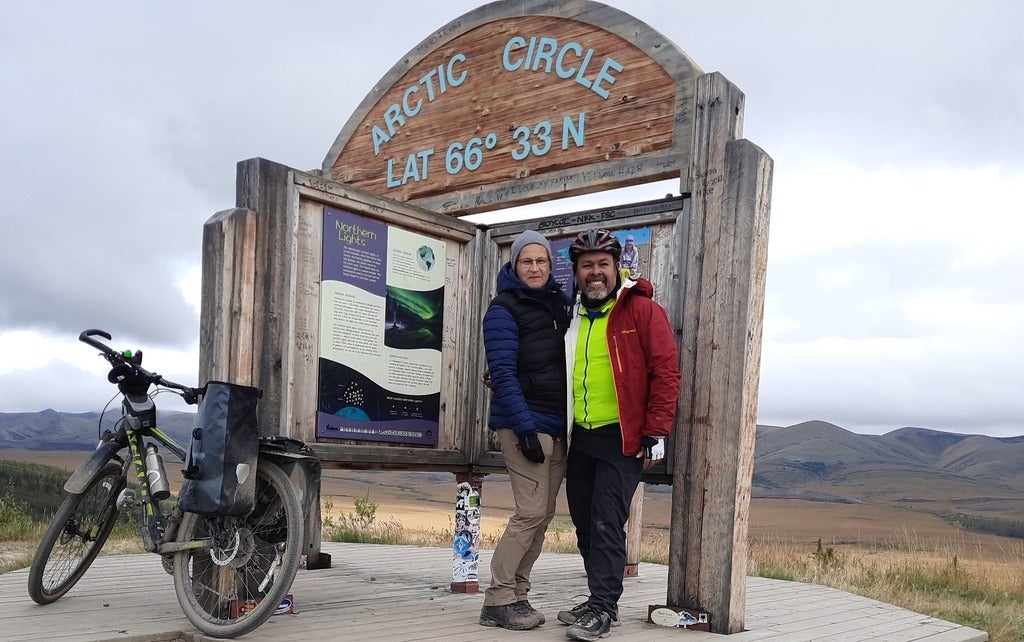
Maren Oelbermann and Pedro Gonzalez Hernandez cycled 770 km along the Dempster Highway to raise money to support the Grand River Cancer Centre.
A new study led by University of Waterloo researchers discovered greenhouse gas production during spring freeze-thaw events in cold temperate regions is significantly less when biobased residues like compost replace nitrogen fertilizer.
The School of Environment, Resources and Sustainability is saddened by the recent death of one of our founding members and former School Directors, Sally Lerner. During her tenure from 1971 (when the School was named Man-Environment Studies) through retirement in 1996 (when it was named Environment and Resource Studies), Sally established a strong focus on social and environmental justice in the School – a focus that is stronger than ever today.
In a new commentary in Nature, SERS graduate Dr Marie Claire Brisbois highlights the importance of focusing on climate action solutions that are already working.
Building on her success in teaching in SERS, Christine brings a passion for student-centric, field-based, experiential learning to the role. It is exciting to think about how her initiatives will enrich curriculum development and pedagogy on campus.
SERS has officially received our Silver Certification! SERS faculty and staff will continue to work towards maintaining a more sustainable office in the future, and hopefully achieve Gold or Platinum Certifications.
Congratulations to Lowine Hill and Madu Galappaththi for their recognition as SERS student achievement leaders. Lowine and Madu (in collaboration with planning student Sarah Ghorpade) established a unique program for the Faculty of Environment that focuses on critical reflections on the colonial aspects of sustainability research.
In light of the meeting of the Convention of Biological Diversity (CBD) and negotiations around post-2020 global conservation targets, there is renewed attention on the need to assess and apply novel conservation policy tools. One of these tools is referred to as ‘Other Effective area-based Conservation Measures (OECMs)’. 25 experts representing 26 institutions and 14 countries recently published a paper in Nature that assesses for the first time the core opportunities and challenges of OECMS to address the biodiversity crisis. This work is one output of Science for People Partnership (SNAPP) ‘Coastal Outcomes’ working group.
This article originally appeared on the Faculty of Environment's website.