Current graduate students

Monday, January 29, 2018 2:30 pm - 2:30 pm EST (GMT -05:00)

Engineering magnetism and chiral edge state of quantum anomalous Hall system

Ke He, Tsinghua University

The quantum anomalous Hall (QAH) effect is a quantum Hall effect induced by spontaneous magnetization instead of an external magnetic field. The effect occurs in two-dimensional (2D) insulators with topologically nontrivial electronic band structure which is characterized by a non-zero Chern number. The experimental observation of the QAH effect in thin films of magnetically doped (Bi,Sb)2Te3 topological insulators (TIs) paves the way for practical applications of dissipationless quantum Hall edge states.
Tuesday, January 30, 2018 4:00 pm - 4:00 pm EST (GMT -05:00)

The Fermi-Hubbard Model for Universal Quantum Computation

Jiawei Ji - The University of Calgary

Quantum circuits based only on matchgates are able to perform non-trivial (but not universal) quantum algorithms. Because matchgates can be mapped to non-interacting fermions, these circuits can be efficiently simulated on a classical computer. One can perform universal quantum computation by adding any non-matchgate parity-preserving gate, implying that interacting fermions are natural candidates for universal quantum computation within the circuit model.

Friday, January 12, 2018 11:45 am - 11:45 am EST (GMT -05:00)

RAC1 Journal Club/Seminar Series

Brandon Buonacorsi - Modeling the Exchange Interaction in Silicon Quantum Dots

Silicon metal-oxide-semiconductor field effect transistor (MOSFET) quantum dots are promising candidates for scalable quantum computing using electron spin qubits due to their long coherence times, compact size, and ease of integration into existing fabrication technologies.  I will introduce how we fabricate these devices and describe the experimental characterizations we do to check the stability and tunability of our quantum dots.  In a double quantum dot device, two qubit gates are realized

Tuesday, January 9, 2018 7:00 pm - 7:00 pm EST (GMT -05:00)

CryptoWorks21 Distinguished Lecture: Tools of Commercialization

“He who is good with a hammer thinks everything is a nail.”

- Modified quote from the original by Abraham Maslow


How does one sell security? How does one commercialize such nebulous concepts such as “Trust”, “Security” and “Cryptography”?  Cryptography, which is just one building block of security, is based on other more abstract building blocks such as algorithms which have a foundation on hard mathematical problems.

Friday, December 15, 2017 12:30 pm - 12:30 pm EST (GMT -05:00)

Quantum computing with the D-Wave processor

IQC/Physics Special Seminar - Loren Swenson, D-Wave Systems

I will introduce quantum annealing as a technique for harnessing quantum mechanics to solve hard problems. The design of a quantum annealing processor based on superconducting flux qubits, some of the challenges we have encountered in constructing it, and measurements confirming the role of quantum mechanics in such processors will be presented. Finally, I will briefly discuss recent benchmarking and simulation results using the D-Wave 2000Q processor.

Colloquium: Xiaoting Wang, University of Electronic Science and Technology of China 

Quantum information processing (QIP) has been identified as one of the key future technologies that are crucial for communication, cryptography, computing, complex-system simulation, metrology, artificial intelligence and national security. Quantum control, on the other hand, provides a powerful tool to analyze and improve the physical performances of different QIP devices.

Friday, December 8, 2017 2:00 pm - 5:00 pm EST (GMT -05:00)

Research Advancement Centre 2 Open House

Join us at the Research Advancement Centre 2 Open House

RAC 2 Open House
Friday, December 8
2:00-5:00pm

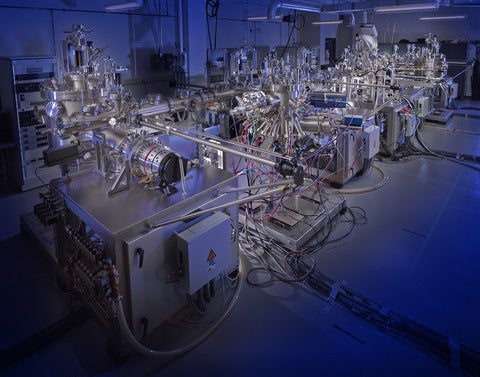
Transformative Quantum Technologies (TQT) invites the University of Waterloo community to explore the Research Advancement Centre 2 (RAC 2) building and see first-hand where groundbreaking research in quantum information and science technology happens.